Best Time to Post on Instagram on Friday: A 2026 Guide
Sep 23, 2026 · 13 min read
The popular advice on the best time to post on Instagram on Friday is too tidy to be useful. Friday does not behave like a single clock time, it behaves like a spread of audience states, and the strongest benchmark data from 2026 points to a distribution problem, not a universal answer.
That matters because the same Friday post can hit a commuter, a lunch-break scroller, or an evening Reels viewer at completely different moments in their day. If you treat Friday like one fixed hour, you collapse market, format, and goal into a number that no credible benchmark can defend.
Why Friday Is Not a Single Hour
Friday is the day many professionals want simplified, and that's exactly why the advice gets unreliable. The search for one best hour assumes every audience follows the same routine, every content format earns attention in the same way, and every account is trying to achieve the same outcome. None of those assumptions hold up when you look at the current benchmark data.
Hootsuite's 2026 analysis shows a late-afternoon peak around 4 PM on Friday, with the strongest window sitting in the broader 4 to 5 PM range, while HubSpot's 2026 report points to a Friday engagement pattern that runs from lunch into early evening rather than a single timestamp (Hootsuite's Friday timing analysis, HubSpot's 2026 Instagram Engagement Report). Those findings are not contradictory. They're different slices of the same behavior curve.
The real question is what the post needs to do
A Friday post aimed at awareness does not need the same timing as a post meant to trigger saves or conversions. Reels tend to benefit from later, lean-back browsing, while carousels can win earlier in the day when people are still in a task-oriented mindset. That's why Friday should be treated as a scheduling decision about where the post lands in the day, not just when it goes live.
Practical rule: If you can't say what audience state the post is meant to catch, you're not choosing a posting time yet, you're guessing.
That framing is also why ad pressure, feed competition, and format matter. On Fridays, the app is full of unfinished work, travel planning, dinner reservations, and weekend logistics, so attention gets fragmented quickly. The best Friday slot is the one that matches the next decision your audience is likely to make.
What the 2026 Benchmarks Actually Say
The strongest 2026 sources don't give you one universal Friday answer. They give you a cluster of plausible windows that line up around different audience routines, and the disagreement tells you more than the headline does. Friday is not a fixed peak, it's a band.
Hootsuite's 2026 dataset places Friday at 4 PM, and broadens that into a 4 to 5 PM peak window, while HubSpot's survey puts Friday's main window at 12 PM to 3 PM for 37% of marketers, with 35% also selecting both 3 PM to 6 PM and 6 PM to 9 PM as secondary windows (Hootsuite, HubSpot). SocialPilot's 2026 benchmark summary adds another layer of disagreement by showing that independent studies cluster around different local-time bands rather than one platform-wide hour (SocialPilot's benchmark roundup). Buffer's 2026 commentary goes further and notes that Friday timing varies so much that some guides even describe Friday as a weaker overall engagement day, depending on the dataset and methodology (Buffer's Friday timing guide).
Friday window comparison
| Study | Friday Window | Sample | Best Fit |
|---|---|---|---|
| Hootsuite 2026 | Around 4 PM, strongest in 4 to 5 PM | Platform-wide timing analysis | Late-afternoon general feed posts |
| HubSpot 2026 | 12 PM to 3 PM, with 3 PM to 6 PM and 6 PM to 9 PM as secondary windows | Global marketer survey | Mixed B2B and broad brand content |
| SocialPilot 2026 | Different guides cluster into separate 2 to 3 hour bands | Benchmark synthesis | Testing by local market and niche |
What the overlap actually means
The useful overlap is not a single minute. It's the idea that midday to late afternoon keeps showing up across different datasets, even when the exact hour shifts. That's why the best interpretation is not “post at 4 PM and you're done.” It's “start with a hypothesis, then test the band that fits your audience.”
How Instagram Engagement Behaves on Fridays
Friday engagement follows the rhythm of interruptions. People open Instagram between tasks, during short breaks, and again once the workday loosens. That creates a day of uneven attention, where timing matters because the audience is not sitting down for one long browsing session.
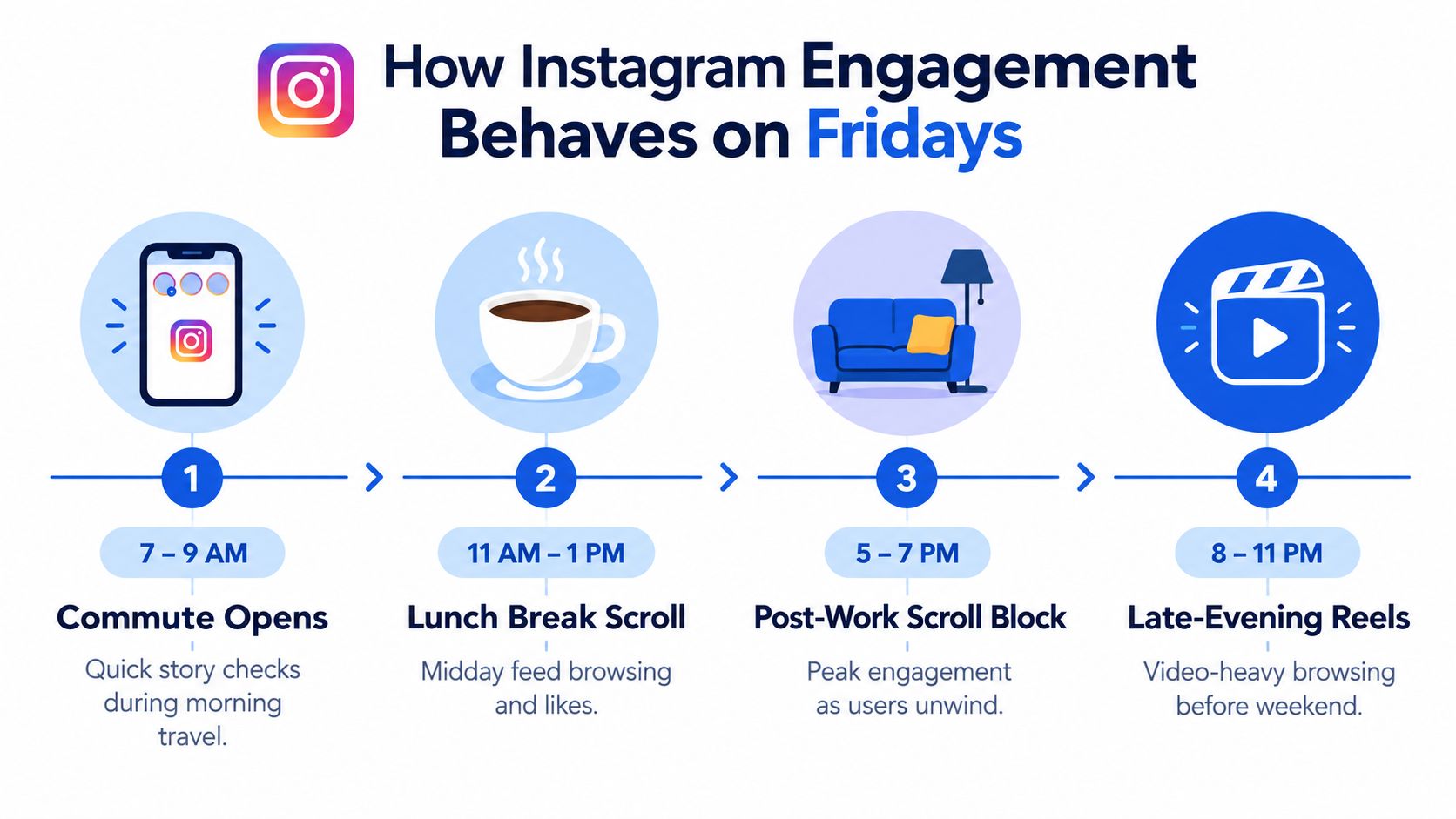
Four Friday attention blocks
Early checks usually come first. People skim Stories, scan updates, and move on fast. Lunch breaks create a slightly better opening, because attention is still limited but less rushed than a commute.
Later in the day, the pattern changes. HubSpot and Hootsuite both point to stronger late-day performance, which fits the way people shift from work mode into planning, browsing, and casual catch-up (HubSpot, Hootsuite). That same block tends to favor Reels, since video works better when users are willing to spend a little more time in the app.
What the overlap means
Content format changes how those blocks perform. Carousels can work well when attention is split, because a swipe asks for less commitment than a full watch. Reels need more concentration, so they usually fit the later window better. Stories sit between the two, light enough to work across the day.
Friday also competes with messages, maps, reservation apps, and group chats. That competition narrows attention, so a polished post can still miss if it lands in the wrong block. For a practical approach to testing hooks that match each format, see how to write scroll-stopping hooks.
Friday timing is less about chasing a perfect hour and more about matching the format to the type of attention your audience has.
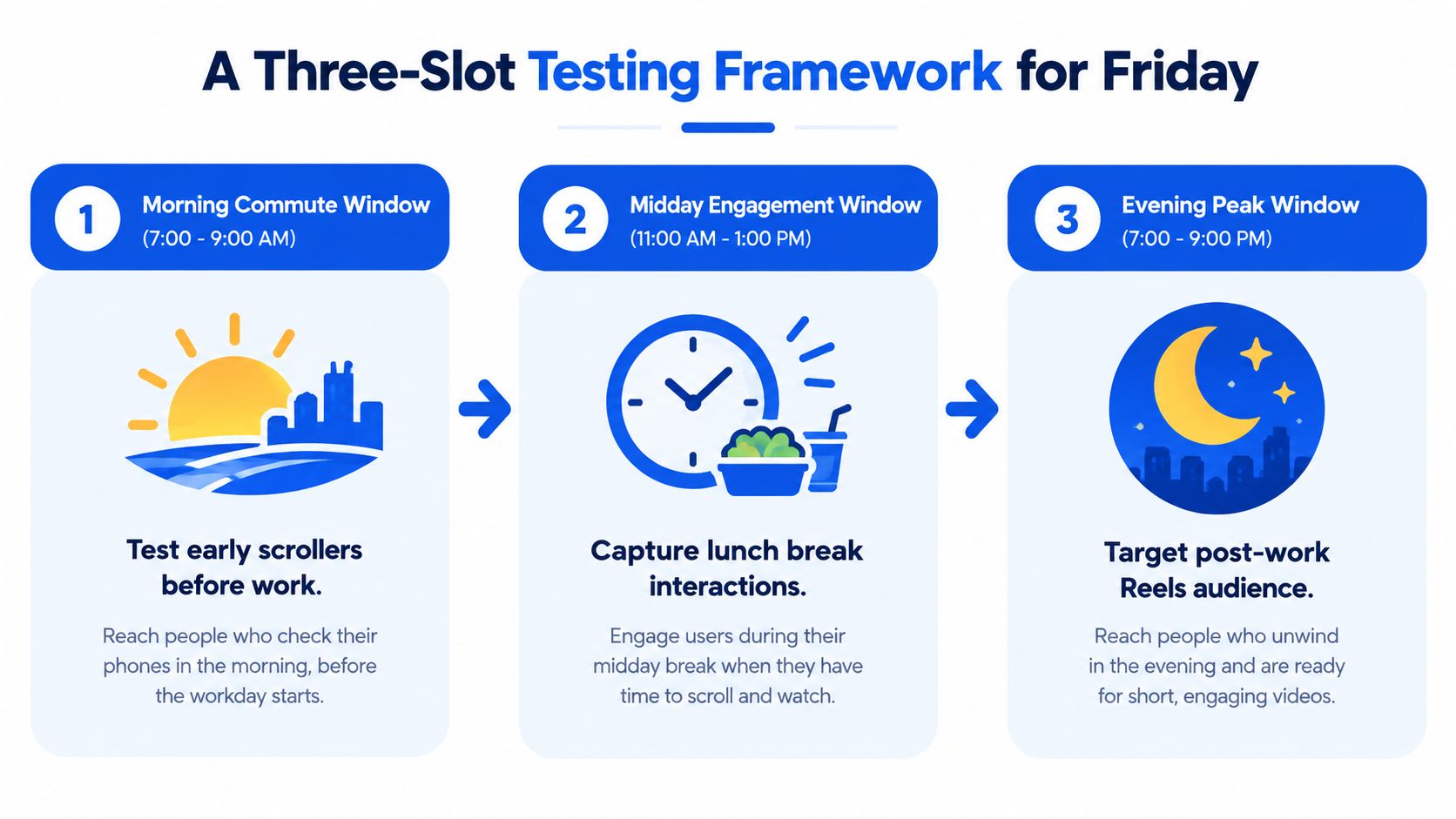
A Three-Slot Testing Framework for Friday
The cleanest way to use the conflicting 2026 benchmarks is to turn them into a three-slot test. You don't need to debate the exact hour before you publish. You need a controlled way to see which Friday window your audience rewards.
Keep the variables flat
Use the same creative, caption style, hashtag set, and format across the test. If you change the post type every time, timing stops being the variable that matters. The point is to isolate the schedule, not to compare a strong Reel against a weak carousel and call that a timing insight.
Test three local-time slots. A morning commute slot catches early scrollers. A midday slot catches people who check Instagram between tasks. An evening slot tests the unwind window that benchmark reports keep circling back to.
Read the result across two Fridays
One Friday gives you a directional read, but two Fridays make the signal cleaner. That matters because a single Friday can be distorted by weather, holidays, school events, paydays, or a sudden news cycle. A clean test needs repetition, not just a lucky post.
Track performance at 1 hour, 6 hours, and 24 hours after publishing. That gives you an early read on initial traction, a mid-window sense of distribution, and a full-day view of how the post settled.
Testing rule: Don't crown a winning slot until the same pattern shows up twice under the same conditions.
For teams that want a scheduler to handle the calendar while the test runs, Social Media Scheduler can be used as part of a broader publishing workflow, but the logic stays the same, hold everything constant except time.
Matching Friday Windows to Audience Segments
Friday timing gets sharper once you segment by behavior instead of treating “Instagram users” as one audience. A lunchtime professional, an evening scroller, and a weekend planner are responding to different cues, even if they follow the same account.
Window fit by segment
| Time Window | Audience Segment | Recommended Format | Best Goal Fit |
|---|---|---|---|
| Morning | Weekend planners | Stories or quick carousels | Awareness |
| Late morning to early afternoon | Lunchtime professionals | Carousels or concise feed posts | Consideration |
| Late afternoon | Decision-makers comparing options | Carousels, product posts | Consideration |
| Evening | Leisure-first scrollers | Reels | Conversion or impulse action |
Lunchtime professionals are easy to misread. They usually want information they can process quickly, not a long explanation, so midday content works best when the ask is small and the value is immediate. That makes this window stronger for consideration than for heavy selling.
Late-afternoon decision-makers behave differently. They are often in weekend-planning mode, so product comparisons, offers, and decision-support posts can perform well if the post feels useful instead of urgent. Evening scrollers are the loosest segment, which is why lifestyle, entertainment, and impulse-friendly content often feels more natural there.
Match the format to the window
Stories can work across the day because they require little commitment. Carousels fit better when people still have enough focus to swipe through information. Reels belong in the evening, when audiences are more willing to watch without rushing.
The quickest way to choose, if the goal is awareness, lean earlier. If the goal is consideration, test midday or late afternoon. If the goal is conversion or stronger engagement on a visual post, evening is usually the more natural fit.
Adjusting Friday Timing Across Time Zones
Friday timing breaks down quickly if you ignore geography. A benchmark published in Eastern Time can be useless for a West Coast audience, and a local-time recommendation can be misleading if your audience is spread across regions. The clock on your scheduler isn't the same as the clock in your audience's day.
Convert the benchmark before you trust it
A Friday recommendation of 7 AM ET becomes 4 AM PT, 6 AM CT, 5 AM MT, and 12 PM GMT. That single shift can move a post from a workable lunch-adjacent slot to a dead zone or a pre-work slot, depending on where people live. The same logic applies in the other direction for global accounts.
If your audience is in Sydney, Dubai, or Berlin, the same published benchmark can land in a completely different part of the local day. That's why a scheduler should respect the audience's verified local time, not the company's headquarters time.
Use the audience clock, not the default dashboard clock
Instagram's professional dashboard time-zone setting can distort interpretation if it's left on the wrong region. The benchmark may look right on paper and still miss the audience in practice. For that reason, the most reliable setup is to convert the benchmark, then test it in the timezone where the audience lives.
Instagram scheduling setup for multi-time-zone planning matters here because one Friday post can land in three different local positions at once if your audience is international. The logic is simple, but the consequences are not.
| Original Benchmark Time (ET) | Pacific (PT) | Central (CT) | London (GMT) | Sydney (AEDT) |
|---|---|---|---|---|
| 7 AM ET | 4 AM PT | 6 AM CT | 12 PM GMT | 11 PM AEDT |
| 12 PM ET | 9 AM PT | 11 AM CT | 5 PM GMT | 4 AM AEDT |
| 4 PM ET | 1 PM PT | 3 PM CT | 9 PM GMT | 8 AM AEDT |
Reading Your Own Analytics to Confirm the Window

Benchmarks set the starting point. Your own analytics show whether Friday timing works for your account, because two accounts can publish at the same hour and still get very different outcomes from the same slot.
The three signals worth tracking
Start with reach by hour, engagement rate per post, and saves and shares relative to impressions. Those three metrics show whether the post was seen, actively interacted with, or useful enough to keep. Raw likes do not tell you which Friday slot deserves another run.
Filter your data to Fridays only, then group posts by time bucket over four to six weeks. Separate Reels from feed posts and Stories, because each format follows its own engagement curve. A Friday Reel that performs at night does not mean a Friday carousel should move to the same slot.
Clean up the noise before you draw a conclusion
Paid support can distort organic timing reads. Holidays, account spikes, and overlapping posts can do the same by pulling attention in two directions at once.
The cleanest analysis labels each post by its intended slot, such as lunch, late afternoon, or evening, so the data can be sliced without guesswork. That makes it easier to compare like with like instead of mixing together posts that reached different audiences under different conditions.
If a post won for reasons you cannot separate from timing, do not count it as a timing win.
A useful Friday check is the share-to-reach ratio. Shares show whether the post traveled beyond the first layer of viewers, which is often a better sign of slot quality than likes alone. If that ratio holds up across the same kind of post, at the same kind of time, with similar reach conditions, the window is probably real. If it disappears the next week, the result was a coincidence, not a pattern.
Putting Friday Into a Weekly Posting Rhythm
Friday works better when it sits inside a weekly rhythm instead of being treated like a random slot you remember to use. A structured cadence gives you a way to compare performance across the week and stop overloading Friday with every important post.
Use Friday as the test day
A practical weekly rhythm is simple. Monday and Wednesday carry dependable evergreen posts, Thursday primes attention, Friday runs the timing experiments, and the weekend is for reviewing what worked and recycling winners into Stories or carousels. That keeps Friday useful without making it the only day that matters.
Rotating Friday slots across several weeks builds a personal heatmap. Over time, that becomes more useful than any generic benchmark because it reflects your audience, your format mix, and your market. It also gives a scheduler enough data to surface pattern-based suggestions instead of blind defaults.
Keep the cadence realistic
Don't stack too many Friday tests if your account still relies on unpaid reach. One or two well-run experiments are enough to create a useful signal. If a Friday post performs well, a Monday follow-up can extend the lifespan of the idea without making the calendar feel repetitive.
Plan a month of content around that structure, not around inspiration alone. The point is to make Friday one intentional slot inside a repeatable system, so the data gets cleaner every week.
- Monday: Publish a stable evergreen post.
- Wednesday: Publish a second dependable post.
- Thursday: Warm the audience with lighter pre-Friday content.
- Friday: Test the selected slot.
- Weekend: Review results and recycle the strongest asset.
If you want a cleaner way to test Friday timing across markets and formats, use Social Media Scheduler to queue posts in the local window you want to test, compare performance by slot, and keep the calendar consistent while you learn what your audience responds to. The platform's analytics for reach, engagement, and engagement rate make it easier to validate a Friday hypothesis instead of relying on generic charts.