Campaign Planning: A Multi-Channel Workflow
Oct 30, 2026 · 15 min read
Post consistently, follow trends, and find the best time to publish. That advice starts with distribution before anyone has decided what the campaign must achieve. A full calendar isn't evidence of a useful plan.
Campaign planning should start with a business outcome, then specify the work, dependencies, and evidence needed to make decisions. When platforms report incompatible metrics and recommendation systems change, the team needs a stable objective and explicit uncertainty, not a different strategy after every disappointing post.
Lock One Primary Outcome Before You Post
Choose one primary outcome KPI before drafting anything: lead conversion, cost per lead, return on ad spend, long-term ROI, or brand equity. Complete the campaign brief in one sitting, using the objective-specific measures below as diagnostics rather than treating every metric as an equal definition of success.
Campaign brief by objective
| Objective | Primary KPI | Funnel stage | Reallocate when |
|---|---|---|---|
| Awareness | Deduplicated reach and frequency | Top | Frequency rises while new reach stalls |
| Consideration | Engagement rate, saves, or qualified clicks vs baseline | Mid | In a hypothetical weekly review, the chosen metric remains below the pre-launch baseline after a full week |
| Action | Owned conversions or cost per lead | Bottom | Cost per outcome exceeds the threshold written in the brief |
| Brand equity | Repeat engagement across the campaign window | Across stages | Short-term spikes arrive with no returning audience |
The table describes how to score each objective operationally. It doesn't make likes a business outcome or repeat engagement a direct measure of brand equity. If the primary objective is brand equity, use returning engagement as a directional indicator and specify what additional brand measurement would substantiate the conclusion.
Nielsen's Annual Marketing Report recommends measuring immediate consumer outcomes alongside longer-term brand effects and optimizing investment against the KPI that matters to the organization. That distinction prevents a team from declaring success because a highly visible post performed well while the intended business result stayed unchanged.
Define the score before choosing the assets
Write the KPI as an operational definition. For cost per lead, identify the costs included, what qualifies someone as a lead, where the lead is recorded, and the reporting window. Otherwise, the media buyer and sales lead can report different answers without either calculation being arithmetically wrong.
Take the baseline before launch. Use a comparable audience, format, and measurement window wherever possible, and flag any differences rather than treating unlike periods as equivalent.
For a small business translating a commercial goal into deliverables and approval responsibilities, Scéaled's marketing project guidance for Irish SMEs is a useful companion to this exercise. Keep the objective, audience, offer, budget ceiling, approver, and deadline together so channel decisions remain connected to the commercial task.
Make tracking part of production
Assign every channel and asset a funnel stage. A discovery clip might introduce the problem; a LinkedIn explanation might address an objection; a landing-page offer might convert existing interest. Don't ask each asset to perform every job.
Before queuing, attach a campaign ID and standardized UTM parameters to destination links. Keep platform engagement and downstream conversions in separate columns, and carry the calendar metadata with every scheduled item.
Finish with a sentence the team can apply in practice:
Reallocation rule: When a variant misses its agreed threshold after the observation window and tracking checks pass, pause it and move available effort or budget toward an eligible alternative.
Write the threshold, window, and eligible alternative beside that sentence. The review should test a decision rule, not invent one under pressure.
Assign Each Channel a Job and a Slot
Keep a network only when you can name its contribution and produce an appropriate native format. Treat the following slots as starting hypotheses, not evidence of universal best times.
Channel job, format, and slot logic
| Channel | Job in the mix | Format that fits | Slot logic |
|---|---|---|---|
| Consideration for a professional audience | Short argument or document-style post | Test weekday working hours in the audience timezone | |
| X | Timely commentary | Short text or clip with a clear point | Near the moment being discussed, not a standing blast |
| Threads | Lighter timely conversation | Short text | Same broad window as the related X post, only if the audience is there |
| Discovery and proof | Reel, carousel, or still with a native caption | Test evenings and weekends for browsing; don't copy another network's clock | |
| TikTok | Discovery | Short video with a strong open | Test evenings and weekends; assess the opening rather than chasing a perfect minute |
| Community and local proof | Native post or short video | When that community is already active; don't mirror TikTok timing by default | |
| YouTube | Longer explanation with a longer life | Long-form or Short | Prioritize title and opening frame over minute-level timing |
| Bluesky | Interest-led conversation | Short text | Use only when the intended audience is already there |
LinkedIn earns a place when professional context helps the argument. X and Threads need a reason to join a conversation at that moment. Instagram and TikTok need an opening that makes the subject intelligible before the viewer moves on.
Facebook can carry customer proof or a local offer when an existing community makes that relevant. YouTube can hold the detailed explanation that shorter assets point toward. Bluesky belongs in the mix because a relevant conversation exists there, not because another publishing destination is available.
Select for execution capacity
For a hypothetical solo operation, cap the initial live plan at three channels. That's a staffing constraint to test, not an industry benchmark: count the time needed for adaptation, approvals, replies, and measurement before adding another destination.
An agency should keep each client's calendar separate. Shared production resources can be coordinated internally without exposing another client's drafts or making approval ownership ambiguous.
Community participation also requires a different approach from scheduled broadcasting. Bazzly's Reddit marketing guide is a useful reference when evaluating a discussion-led channel: decide whether the team can participate meaningfully before assigning it a publishing quota.
Set slots in the audience's timezone. Don't release everything simultaneously if you want to investigate timing, but don't claim that staggered posts alone isolate a timing effect either. Creative, audience, and context can still differ.
Give a launch week a sequence
Say a product launch uses a long explanation, three discovery cuts, and two proof posts. These are hypothetical production quantities, not a recommended performance formula.
Publish the explanation when the audience can give it attention. Place discovery cuts in separate test windows, each addressing a distinct problem or objection. Release proof when interested people have somewhere useful to go next, such as a demonstration or product page.
When evaluating a multi-channel scheduling workflow, use that sequence as the test: can the team preserve each asset's job and audience-specific slot without turning the campaign into identical captions everywhere?
Split Posts into Three Portfolios
Patreon's creator research, reported by TechCrunch, found that 53% of creators said it was harder to reach followers than five years earlier, 78% said the algorithm affected what they created, and 56% said it had discouraged them from exploring their interests. Those findings concern creators' reported experiences, not a measured decline in every account's reach.
The planning implication isn't to imitate more trends. It's to limit how much of the campaign a distribution change is allowed to rewrite.
Use a portfolio view to separate creative exploration from dependable production and audience relationships.

Cap experimentation without freezing creativity
Experimentation content tests distribution hypotheses: a different opening, an unfamiliar format, or a new way to frame an existing problem. Give experiments a capacity limit and a stopping rule so unsuccessful tests don't consume the resources needed for the campaign's core argument.
Change something interpretable. If the audience, message, format, and offer all change together, the result may be useful operationally, but it won't identify which change mattered.
Repeatable formats give the team a production structure it can reuse. A demonstration followed by an objection and response, for example, can carry different examples without requiring a new creative system each time.
Repeatability doesn't guarantee distribution. Its value is operational: the team can preserve a recognizable argument and produce another version without rebuilding everything after a ranking change.
Build a reason to return
Relationship content asks people to take a durable next step: subscribe to a newsletter, visit a useful resource, reply with a specific problem, or return to a continuing series. Distinguish owned destinations, such as a website or email list, from platform-hosted communities that still depend on another company's rules.
Judge these assets through returning viewers, saves, direct responses, qualified traffic, and subscriber conversion where those measures are available. Also examine platform concentration: if nearly every meaningful audience interaction depends on the same network, another discovery spike doesn't remove that dependency.
Use the accompanying video as a prompt for discussing which creative choices should remain under the team's control.
For a hypothetical four-post week, assign one experiment, two repeatable posts, and one relationship post. Reduce the experimental allocation first if production or approvals can't support the workload.
When reach falls, investigate the experiment row first. Preserve the audience problem, central point of view, and useful destination unless outcome evidence challenges those choices.
Maximum adaptation isn't the strategy. Run controlled tests while protecting assets and relationships that remain useful when distribution weakens.
Build the Calendar from the Critical Path
The Project Management Institute's history of project network models explains how CPM identifies the activity sequence determining minimum completion time, while PERT uses optimistic, most likely, and pessimistic duration estimates to account for uncertainty. For campaign planning, the practical lesson is to schedule dependent work before scheduling publication.
Build the work sequence first
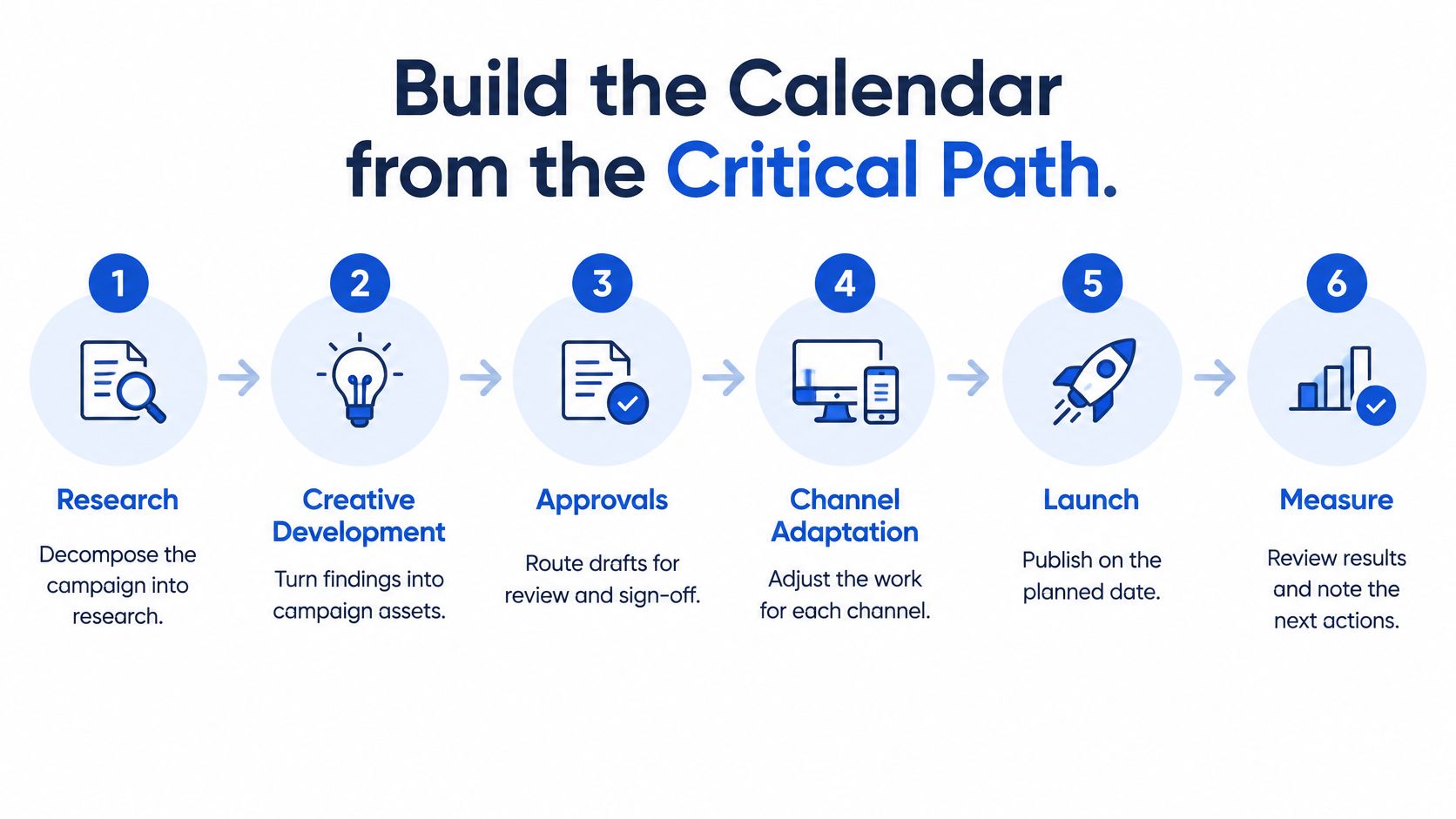
Decompose the campaign. List research, creative development, approvals, channel adaptation, launch, and measurement. Give each activity an output someone can inspect, such as an approved message, locked film, or tested conversion event.
Mark dependencies. Copy waits on the frozen message; finished media waits on approval. Identify which tasks can run in parallel and which require an earlier decision.
Estimate uncertainty and identify the critical path. Record optimistic, most likely, and pessimistic durations, then identify the longest dependent sequence under the scheduling assumptions you're using. Don't nominate legal review as critical: production, tracking, or landing-page work may determine the launch date.
Check the launch milestone. Build the week-view publishing calendar only when the dependency sequence fits. If it doesn't, move the date, reduce scope, or change resources explicitly rather than compressing approval time without agreement.
Populate complete slots. Attach the metadata below before treating an item as publishable. A delayed prerequisite should move the dependent item, not leave someone improvising an unapproved replacement.
Track status and ownership. Use draft, queued, or published states, with the approval condition visible. In a hypothetical launch workflow, check the critical path twice weekly and increase attention when a prerequisite slips.
The process graphic makes the production sequence visible, but the dependency record determines which delay changes the launch.
Calendar slot template
| Field | Example entry |
|---|---|
| Campaign ID and UTM set | PRD-W1 with utm_campaign=prd_w1 |
| Channel and format | LinkedIn, document-style post |
| Creative version | Hero film cut 2, locked |
| Call to action | Book a demo |
| Audience timezone and publish time | Audience zone, weekday working hours |
| Status and dependency | Queued, owner named, waits on hero approval |
Treat the example's queued status as provisional until hero approval clears. If the publishing system can't enforce that condition, leave the item in draft instead. Add objective, audience, market, immutable asset ID, and the exact scheduled timestamp to the operational record.
Test the hero-film dependency
Say a hypothetical product week contains ten posts: a hero film, LinkedIn explanations derived from it, and short discovery versions. If the approved film supplies their claims and footage, hero approval is a shared prerequisite.
The team can prepare captions and edit structures in parallel, but dependent cutdowns stay in draft until the film is locked. An altered product claim may require changes across every derivative, so approval isn't merely a checkbox on the hero's own slot.
Use a monthly content-planning workflow to organize the larger horizon without mistaking reserved space for completed work.
A calendar is executable when every queued post has an owner, a cleared dependency, and a publish date the production sequence can support.
Read Three Layers of Evidence
What should a small team do when it can't reliably connect impressions to business outcomes? Keep making decisions, but label what the evidence supports and how uncertain the decision remains.
Three evidence layers and the decision each allows
| Layer | Can support | Cannot prove | Decision it allows |
|---|---|---|---|
| Platform signals | Directional reach, frequency, and engagement | Cross-platform equivalence or causal sales | Pause a weak variant while the campaign is live |
| Owned outcomes | Sign-ups, leads, or sales on properties you control | Which impression caused the result | Shift effort toward channels sending qualified traffic |
| Incrementality | A holdout, geo split, or carefully designed time comparison | Fine rankings on tiny samples | Keep or kill the campaign bet with confidence proportionate to test quality |
Keep the operational rule beside the table: pause a variant only after its observation window, threshold, and tracking checks have been satisfied. If evidence is insufficient, record an inconclusive result rather than converting uncertainty into failure without saying so.
The IAB State of Data report identifies privacy and compliance, data quality and integration, bias, and implementation resources as barriers to AI-enabled campaign measurement. A small team should therefore design for missing information rather than assume another dashboard will resolve it.
Separate delivery from business effect
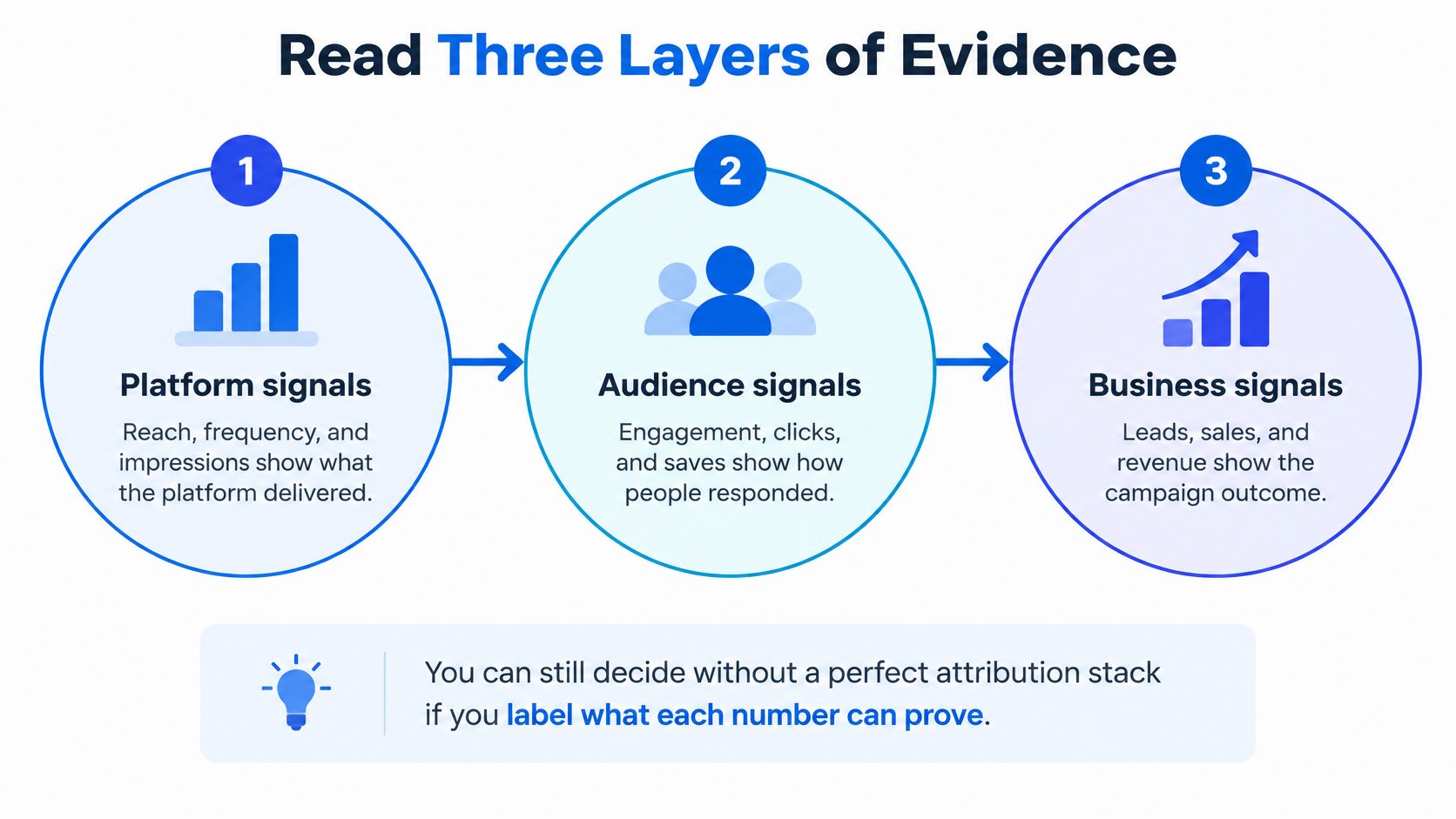
Platform signals describe what a network reports delivering and how users responded. Impressions count deliveries; they aren't deduplicated people. Don't add platform reach figures together and label the result unique campaign reach without a defensible deduplication method.
Engagement rates also need their definitions attached. An interactions-per-impression measure isn't interchangeable with interactions-per-follower, even if both dashboards display the same label.
Owned outcomes provide a firmer business record, but a tracked signup link identifies a recorded route, not proof that a particular exposure caused the signup. Menza's guide to marketing ROI is a useful companion when connecting that outcome record to campaign costs.
This diagram separates delivery, response, and business metrics. Those are measurement categories, not substitutes for the incrementality layer in the decision table.
Reserve causal language for a credible comparison
A well-designed holdout or geo experiment can support causal inference when assignment, contamination, and sample size are handled appropriately. A simple before-and-after comparison is usually directional because seasonality, pricing, or other activity could explain the change.
Without adequate volume, a creator can still combine native signals with a tracked signup destination. That supports a practical allocation decision, but the creator shouldn't describe the result as incremental sales.
Keep the pipeline light:
- Identify assets consistently. Preserve an immutable asset ID across the calendar, destination tracking, and reporting record.
- Retain native definitions. Store reported metrics with their platform, reporting window, and denominator.
- Normalize selectively. Calculate comparable reach, frequency, engagement rate, and conversion rate only where definitions and identity coverage permit.
- Record uncertainty. Mark missing attribution, incomplete reporting, and small samples beside the decision.
Review while the campaign is active. A low-cost, reversible creative pause can use weaker evidence than an expensive decision to abandon the entire campaign. More dashboard tiles don't improve that judgment; consistent definitions and an explicit decision standard do.
Schedule the Next Cycle Only If the Brief Holds
Continue only when the campaign still has a primary outcome KPI, a feasible critical path with named owners, and a written reallocation rule. If any is missing, stop expanding the workload and repair the missing decision first.
Keep the outcome definition stable through the next evaluation window unless the business objective itself changes. Otherwise, a team can escape an unsuccessful result by switching to whichever metric looks strongest.
Turn the decision into a working calendar
For a hypothetical fortnight, place the next two weeks on a shared calendar using draft, queued, and published states. Remove channels that never earned a distinct job, and revise the experiment allocation before replacing repeatable formats or relationship assets.
Use a weekly content system to turn the approved scope into a recurring production routine. Keep the campaign-level decision separate from the operational question of which post is ready next.
Record the reasoning in a short decision log:
- Objective changes. Note any change to the business outcome and who authorized it.
- Evidence available. Distinguish owned-outcome movement from a credible incrementality result or an inconclusive test.
- Resource movement. Identify which portfolio gained capacity and what work was removed.
- Next decision. State the threshold, observation window, and person responsible for acting.
Don't evaluate the cycle against its most successful post. Compare the intended outcome with the threshold agreed before launch, including the production effort and spend required to obtain it.
Keep observation separate from explanation
Our analytics show impressions, engagement, clicks, and top posts for every channel compared with the last period. Use those comparisons to identify changes worth investigating, not to claim that the campaign caused every difference.
A campaign can justify continuation without perfect attribution when the decision is affordable, reversible, and honestly qualified. It shouldn't justify unlimited expansion merely because the team can fill more slots.
Schedule the next cycle only when the brief still holds.
After you connect an agent and ask it to plan the week, it drafts the posts, and we tailor them for each channel and schedule them. Visit Social Media Scheduler to put your approved campaign into a coordinated publishing workflow. Every plan starts with a 7-day trial for $0; you aren't charged until the trial ends, and you can cancel before then.