Best Day to Post on Facebook in 2026
Nov 1, 2026 · 14 min read
Start your 2026 Facebook posting tests on Wednesday through Friday afternoon, not with a supposedly universal winning hour. Saturday wins some creator datasets, but your account's own Insights should override both recommendations.
The popular advice to pick a famous slot and stick to it skips the most important question: whose audience produced that result? A university page, an international creator, and a neighborhood retailer don't offer interchangeable evidence. The useful answer isn't an average of their winning hours. It's a controlled way to decide which recommendation deserves a place on your calendar.
Published Days Worth Testing First
Use Wednesday, Thursday, and Friday afternoon as the working hypothesis, then choose a rival window that fits your account. That's a testing recommendation for 2026, not a claim that a new universal winner has been established.
Published benchmarks disagree too sharply to combine into a meaningful average. Keep each sample, clock time, and performance measure together.
Published Facebook windows to test first
| Sample | Strongest day | Clock time | What was measured |
|---|---|---|---|
| University pages, 2024, 155 pages and 5,825 posts | Wednesday to Friday | Afternoon | Reactions, comments, and shares versus Monday–Tuesday; academic comparison detailed below |
| Adobe Express, more than 40,000 posts from the top 100 Social Blade creators | Saturday | About 4 a.m. and 12 p.m. were hourly view leaders | Saturday averaged 51,600 combined likes, shares, and comments per post; posts at those hours averaged approximately 3 million views |
| Cross-profile analysis cited by Adobe Express, nearly 2 billion engagements across 307,000 profiles | Tuesday and Wednesday | 12 p.m. to 8 p.m. local time | Engagement; weekends were among the weakest days |
| Hootsuite, 2025, analysis spanning 118 countries | Tuesday | 5:00 a.m. | Cross-country best-time analysis |
| Sprout Social's 2025 findings reported by Social Media Today | Weekdays | 9:00 a.m. to noon | When users were predominantly active |
| Marketing-Interactive, 2023 | Monday to Thursday | From 8:00 a.m. into early afternoon | Monday until 1 p.m., Tuesday until 2 p.m., Wednesday until 1 p.m., Thursday until noon |
The Adobe rows reveal the central conflict: Saturday can lead in a creator sample while weekends trail in a broader profile sample. Neither finding establishes what a local business should expect. Account size, audience geography, publishing habits, and the chosen outcome can all change the comparison.
There's another distinction inside the creator result. Saturday's engagement ranking and the hourly view ranking are separate findings. They don't prove that combining Saturday with the strongest viewing hour produces the strongest engagement slot.
Choose a control, not a compromise
A campus or community page has a reasonable starting affinity with the university-page comparison. A large creator has more reason to include a weekend challenger. A local business should give its own audience activity greater weight than either sample.
Keep the chosen benchmark as your control window while testing an alternative. Don't move every post whenever another industry chart appears.
Organize those comparisons inside a weekly content system, so content preparation doesn't change alongside timing. If likes are an explicit objective, Silver Spoon Agency's guide to turn Facebook attention into likes is a useful companion, but keep creative improvements separate from the timing experiment. Otherwise, you won't know whether the hour or the post improved performance.
Why the Best Day Moves With Audience and Time Zone
A recommended weekday is like a weather forecast for someone else's city. It may be accurate there and unhelpful where your audience lives.
Say a business publishes during its home city's morning routine. Followers elsewhere may be eating lunch, finishing work, or sleeping. Publishing once doesn't give each market its own morning release, so the account's headquarters shouldn't automatically determine the schedule.
The practical relationship is easier to see when audience location, activity, and objectives are considered together.
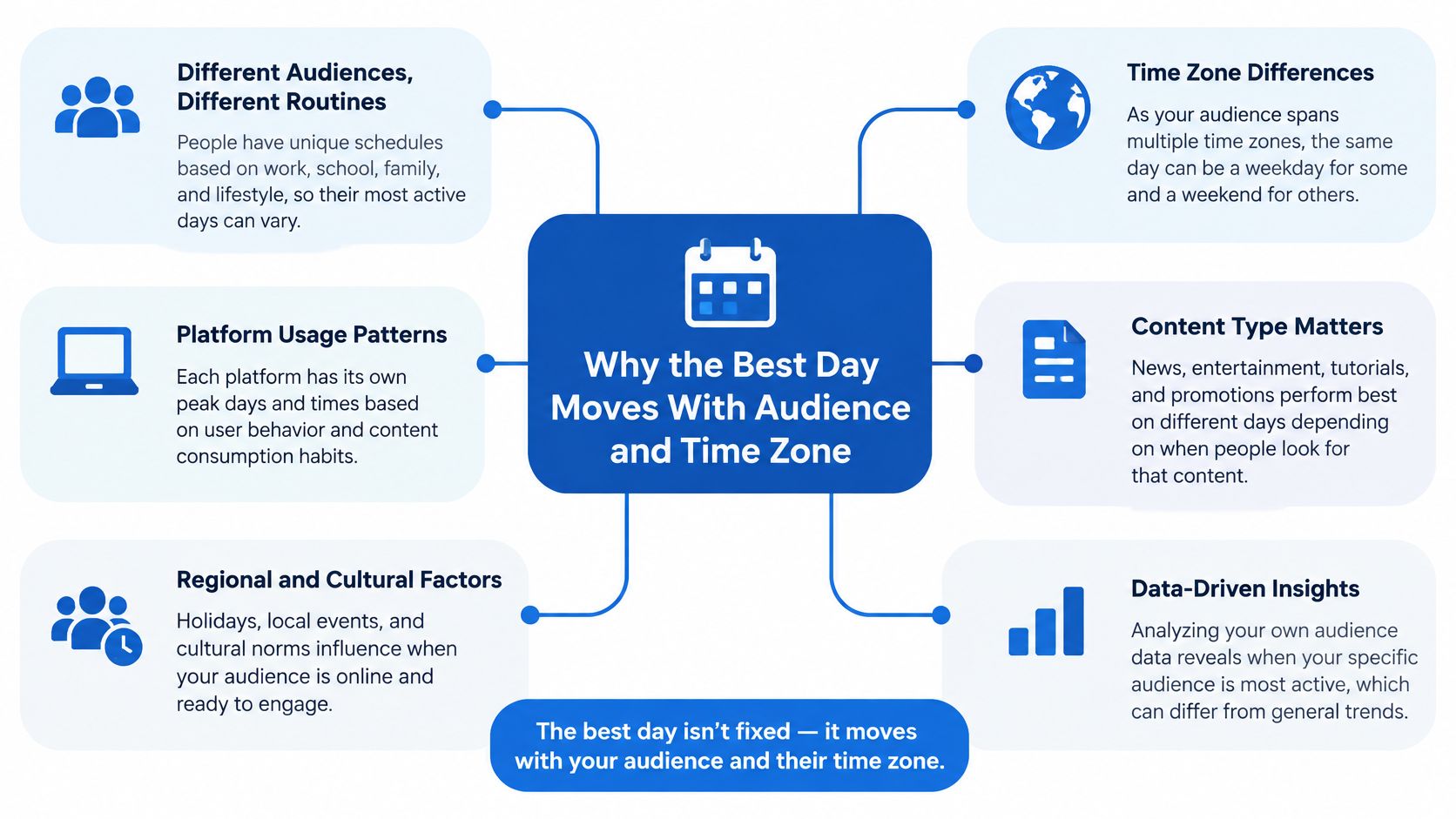
Local activity matters more than your office clock
Early interaction velocity means how quickly people begin reacting, commenting, and sharing after publication. A sensible hypothesis is to publish shortly before a substantial portion of followers becomes active, giving the post an opportunity to gather interactions while more people are arriving.
That doesn't mean there's a precisely measurable magic minute. Follower activity identifies a useful testing neighborhood, not a guaranteed distribution outcome. A post still needs to give those followers a reason to respond.
Historical benchmarks also deserve an expiry check. The academic discussion of Facebook engagement and News Feed changes describes research tracking 1 million Guardian news articles published between 2011 and 2020, and discusses the January 2018 ranking shift toward meaningful social interactions, including comments and reshares.
The important distinction is that distribution changes didn't affect every content category equally. Hard-news engagement was more sensitive than lifestyle, sports, arts, and opinion content. An old timing rule can therefore become less useful without every page experiencing the same change.
Match the schedule to the audience's shape
Use geography to design the comparison rather than treating it as a footnote:
- Single-city audience: Start with a local midweek afternoon. Record the audience time zone explicitly, including any seasonal clock changes.
- Audience split between countries: Name a primary and secondary market. Alternate comparable posts between their local activity windows rather than always favoring the market where the team works.
- Dispersed international audience: Group followers into practical time bands. Look for overlapping activity, and avoid a window when all priority groups are largely inactive.
- Mixed age groups: Check age segments against actual account behavior. Don't assume that a demographic label proves a morning or evening preference.
A split audience also changes what success means. If the primary market generates more interactions overall, that doesn't necessarily make its slot better for reaching the secondary market. Keep market-level objectives visible when the available reporting supports them.
A published day is a starting hypothesis, not a house rule. Compare local time, audience segment, format, and objective before freezing the slot.
The best day to post on Facebook is therefore partly a question of which audience you intend to serve with that post. Without that decision, an apparently precise clock time can conceal an imprecise strategy.
Midweek Lifts and Industry Hours
The strongest argument for a midweek starting point is measurable, but its scope matters. In a 2024 peer-reviewed study of university Facebook pages, Wednesday–Friday posts generated 1.28 times as many reactions, 1.93 times as many comments, and 1.67 times as many shares as Monday–Tuesday posts, with all three effects statistically significant at p < 0.001.
Those are relative engagement differences within a university-page sample, not promised results for a bakery or software brand. The comparison supports a candidate window; it doesn't establish that changing publication day alone will reproduce the lift.
Use the visual as a guide to the comparisons, not as proof that Wednesday individually beat every other weekday.
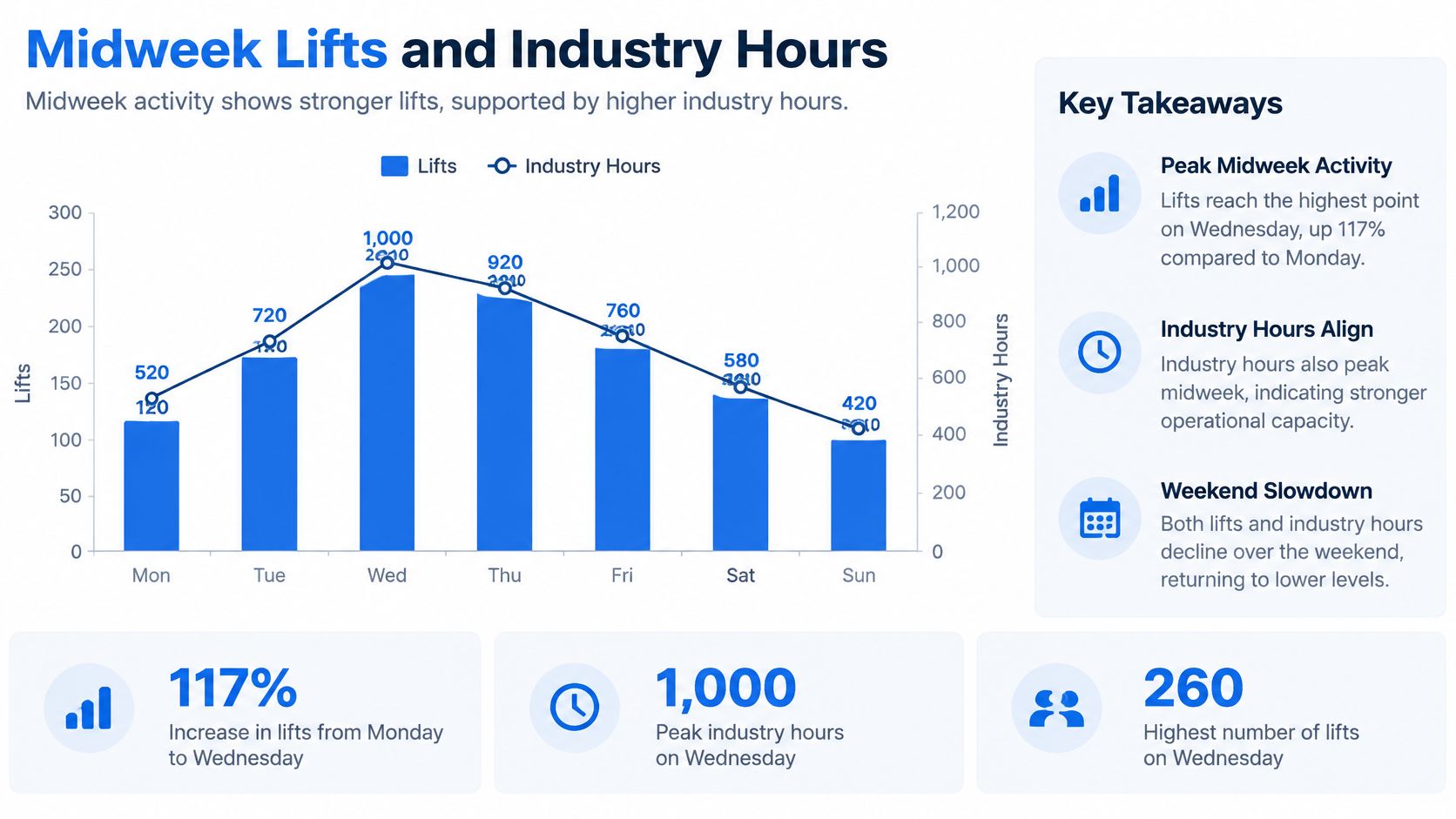
Engagement lifts and industry starting hours
The academic comparison also found stronger weekend results than early-week results, and stronger afternoon results than morning results. Separately, ContentStudio's discussion of analysis normalized across 118 countries identifies a morning preference for technology, healthcare, and media, versus midday or afternoon for finance, marketing, and retail.
| Comparison | Reactions | Comments | Shares or note |
|---|---|---|---|
| Wednesday–Friday versus Monday–Tuesday | 1.28 times | 1.93 times | 1.67 times the shares |
| Weekend versus Monday–Tuesday | 1.32 times | 1.29 times | 1.21 times the shares |
| Afternoon versus morning | 22 percent more | 52 percent more | 56 percent more shares |
| Technology, healthcare, media | Morning starting hypothesis | Pair with the weekday morning activity cluster | Test before copying retail hours |
| Finance, marketing, retail | Midday or afternoon starting hypothesis | Compare late morning with midweek afternoon | Don't assume the earliest published hour fits the sector |
The first group of rows reports measured university-page outcomes. The industry rows translate a separate benchmark into testing choices; they aren't reaction or comment multipliers.
Read the outcome before copying the hour
A clinic or technology brand could compare a morning slot with its midweek afternoon control. A retailer or marketing agency has less reason to adopt that morning because a neighboring sector's chart favors it.
The size of the comment and share differences matters when those actions are the objective. Similar reach would not make the slots equivalent if one consistently generated more substantive discussion or redistribution.
This video offers another perspective on choosing a Facebook publication window.
Choose one industry-relevant contrast, not every named hour. For example, compare late morning with mid-afternoon using similar retail content. Keep the question narrow enough that the result can change a calendar decision.
Comments, Reach and Format Tradeoffs
A product link, a community question, and a shareable video shouldn't automatically inherit the same winning slot. Even on the same brand's page, their success measures differ.
Consider a retailer publishing all three. The product link needs qualified clicks, the question needs actual replies, and the video needs people to watch and share. Ranking their publication times by reactions alone would answer the wrong question.
Match the format to the decision
- Product link: Begin with a weekday midday or midweek afternoon hypothesis, then assess clicks and relevant downstream actions alongside reach. A reaction isn't evidence that someone visited the product page.
- Community question: Include an evening or weekend challenger if followers are active then. A less crowded slot may be useful for a sustained discussion, but lower competition is a hypothesis to test, not an established advantage.
- Video or image: Judge redistribution and later reach separately from the initial burst of reactions. A post that starts slowly may still deserve its slot if it achieves the intended distribution outcome.
Hootsuite's cross-platform timing discussion identifies weekday morning and midday opportunities and generally weak 12–4 a.m. windows, but those benchmarks don't establish that the highest first-hour engagement produces the greatest 24- or 48-hour reach.
That distinction prevents a common analytical mistake: treating an early signal as the final outcome. A lively opening period can be useful without proving that the post ultimately reached more people or generated more valuable actions.
Keep a separate score for each outcome
For a practical scorecard, record early engagement, later reach, engagement rate, comments, shares, and follower actions in separate fields. Choose the main decision metric before publishing, and use a consistent observation window for comparable posts.
Keep the opening copy comparable too. A stronger hook can change response independently of timing; use hooks that stop the scroll when developing creative, then avoid changing hook style halfway through a slot comparison.
Decision rule: Optimize for the objective, not a single engagement percentage.
A scheduler should be allowed to recommend different hours for a link, a video, and a discussion post on the same page. That's not inconsistency. It's a more precise definition of success.
Timing Questions Answered
How many posts make a result useful?
Repeated, comparable results are more useful than an isolated winner. Set a review period before starting, rotate similar content through the candidate slots, and treat an early result as provisional rather than statistically conclusive.
A viral post should trigger inspection, not an immediate calendar rewrite. Check whether its topic, format, promotion, or external attention differed from the rest.
Does posting frequency change the answer?
Yes, frequency can complicate the comparison because you're changing the surrounding publishing conditions. Keep the overall cadence steady while testing timing, rather than adding a burst of posts only to the slot you favor.
Also record unusual activity, such as a campaign launch or paid promotion. Otherwise, you may credit the hour for attention generated elsewhere.
Is an overnight post worth testing?
Only when there's an audience-based reason. International follower activity can justify an hour that looks unusual in the team's home time zone.
Keep the metric distinction intact: an hourly view leader isn't automatically an engagement leader. Test overnight publication against the outcome you need, not because an impressive viewing figure appeared in a headline.
Should weekends be included?
Yes, as a distinct challenger rather than an automatic replacement for weekdays. The conflicting published findings make weekends a particularly useful account-level question.
Keep the content mix comparable. A weekend entertainment video versus a weekday product announcement mostly tests different content, not different days.
Can a scheduler choose automatically?
A scheduler can rank candidate slots using account history, but the recommendation is only as informative as the history behind it. Sparse results, inconsistent formats, and exceptional campaigns make the ranking harder to interpret.
- With limited history: Use a relevant benchmark to establish a control.
- With repeatable results: Prefer account-level performance by format and objective.
- After audience changes: Reopen the timing question instead of assuming the old recommendation still applies.
The useful automation isn't an unexplained winning hour. It's a recommendation you can connect to the audience, content type, and outcome.
Test the Slot and Lock the Calendar
Build a small experiment that can remove a weak slot, not a sprawling calendar that can explain any outcome after the fact. Your audience activity identifies where to investigate; comparable post results determine what deserves to stay.
Meta's Business Suite Insights guidance explains that Insights can show when followers are more active, while Page Insights helps identify content that resonates. Use that first-party signal to challenge generic recommendations.
Run the comparison
Record audience activity. Open Business Suite Insights and note the strongest local activity blocks available for the page. Record the time zone alongside them so another team member can reproduce the schedule.
Write down competing hypotheses. Use Wednesday and Thursday afternoons as the initial control unless follower activity gives a clear reason to start elsewhere. Select a relevant challenger, such as a creator's weekend midday slot or a morning-leaning industry's weekday morning.
Hold the important inputs steady. Compare equivalent formats, similar copy lengths, comparable media, and the same promotion status. Rotate publication assignments rather than reserving the strongest creative for your preferred window.
Score the intended outcome. Separate links, videos, images, and community posts. Record reach, engagement rate, comments, shares, and time to first engagement, then judge each format using its preselected objective.
Review repeatability before committing. Require another comparable result before treating a win as actionable. This is an operating safeguard, not a statistical guarantee; when results are mixed, retain uncertainty rather than declaring a winner.
A clear workflow helps keep the experiment separate from the permanent schedule.
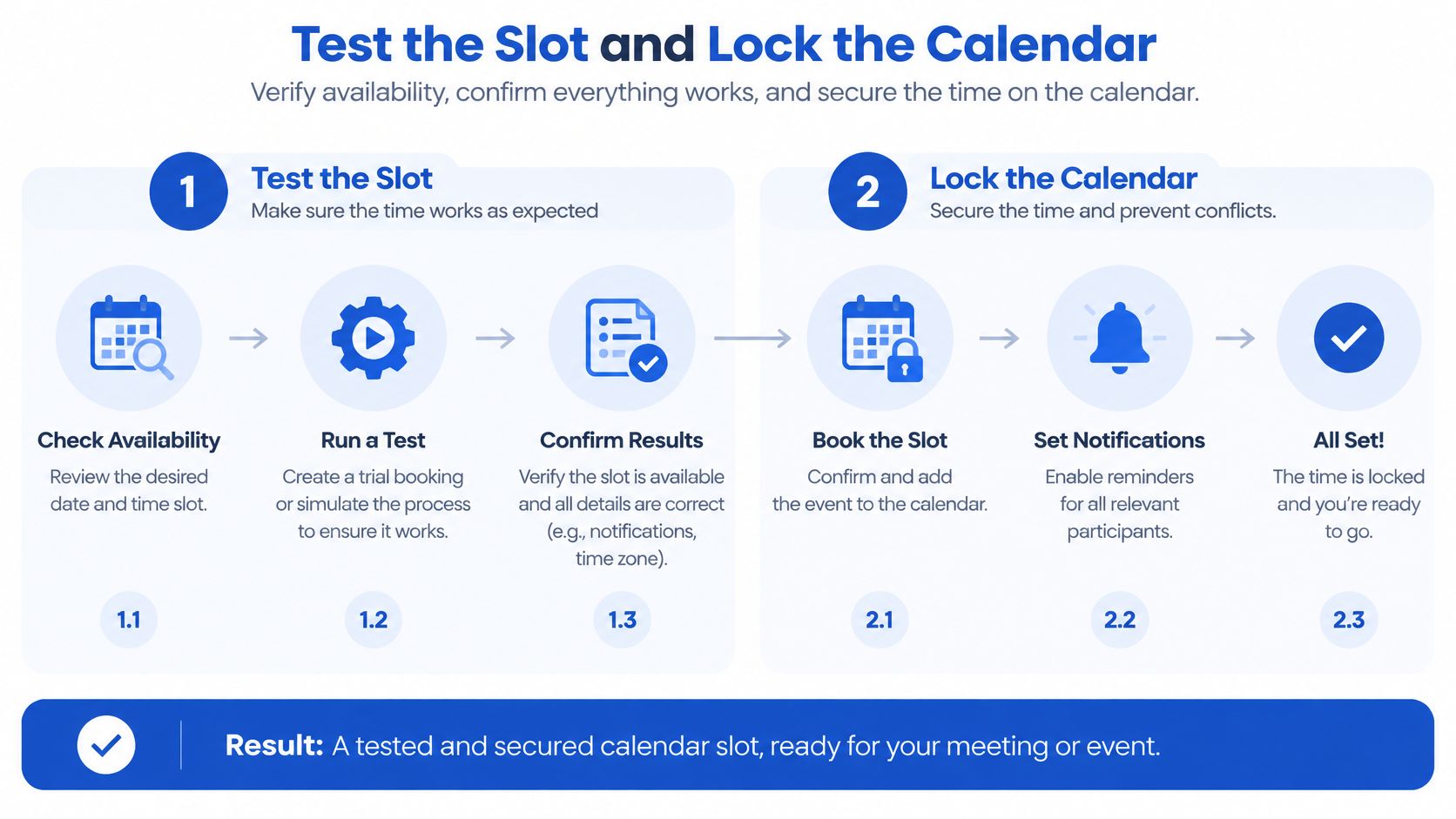
Starting calendar by account type
These are proposed test calendars, not measured promises. Use the audience's main time zone, and let actual follower activity move the proposed hours.
| Account type | Primary slots | Challenger | Backup |
|---|---|---|---|
| Local or business page | Wednesday and Thursday afternoon | Saturday midday when conversation matters | Friday afternoon |
| Morning-leaning industry, including technology, healthcare, and media | A weekday morning primary, plus Wednesday or Thursday afternoon | Tuesday morning | Friday afternoon |
| Creator page | Wednesday and Thursday afternoon | Saturday noon | Friday afternoon |
A backup isn't another mandatory publishing appointment. Use it when a primary slot becomes unsuitable or when a planned comparison calls for it. Adding hours indiscriminately makes the experiment harder to interpret.
Once a pattern is repeatable, remove the weaker candidate rather than indefinitely expanding the schedule. Keep a challenger available so the calendar can adapt without turning every week into a new experiment.
Make the chosen schedule operational
Put the approved windows into a shared calendar, with each post's format and objective visible. Replace a slot because comparable content repeatedly underperforms on the chosen metric, not because a different day produced an unrelated viral post.
Our Facebook scheduling workflow lets you put those decisions into practice. In Social Media Scheduler, the calendar shows every post for every channel in one week view or list view, and drafting can draw on what already performed for the account.
After the agent is connected, ask it to plan the week: the agent drafts the posts, our platform tailors them for each channel, and schedules them. Review the proposed posts against the test design before letting a creative change blur the comparison.
Our analytics show impressions, engagement, clicks, and top posts for every channel, compared with the last period. Use those comparisons alongside Meta's audience signals, while keeping reach and impressions distinct.
Lock the publishing process, not the belief that a weekday is permanently best. A useful calendar makes your current evidence easy to act on and your next timing decision easier to evaluate.
Social Media Scheduler brings planning, per-channel drafting, scheduled publishing, and performance measurement into a shared calendar. Visit Social Media Scheduler to organize your midweek control and audience-led challenger, then use your account's results to decide which Facebook slots to keep.