How Often Should You Post on Instagram in 2026
Nov 2, 2026 · 14 min read
The advice to post on Instagram every day confuses a production target with a growth strategy. A useful schedule starts with your account size and available production time, changes according to one primary goal, and earns its place through a measured test. If adding posts doesn't improve the metric you chose, the extra work hasn't justified itself.
Why One Weekly Number Misleads
Rival IQ's 2026 benchmark reported that brands posted a median of 3.69 times per week on Instagram, as cited by SocialPilot's Instagram statistics. That's a description of the middle brand account, not a quota for a solo creator, a startup, or every client on an agency roster.
The question how often should you post on Instagram sounds as though it should have a single answer. But an empty calendar, a selective publishing schedule, and a high-volume operation represent different decisions about resources and audience attention. You need to choose between them, not approximate the industry median.
Planning principle: Use a benchmark to choose a starting point, then let your own results reject it.
Your account's audience size provides a more useful starting reference than a platform-wide average. Your objective then determines whether additional publishing opportunities are worth the work, or whether you should concentrate effort into fewer pieces.
Before assigning slots, clarify what each post contributes. Carlos Alba Media's social content guide is a useful companion for that editorial decision: a calendar needs substantive topics, not just available dates.
The important distinction is between discovery and response. You might reach more people while earning less interaction from each person reached. Copy a size-based starting row first, choose which outcome matters, and only then decide whether to increase volume.
Posting Ranges by Account Size
Feed posts per week by account size
| Account band | Feed posts per week | How to use the row |
|---|---|---|
| Nano, 0 to 10,000 followers | About 2 | A rational feed floor when production time is limited |
| Micro, 10,000 to 100,000 followers | About 3 | Typical observed feed pace in this band |
| Mid-sized, 100,000 to 500,000 followers | About 5 | Higher pace where audience demand and capacity exist |
| Can only post once or twice | 1 to 2 | Still rational if the account stays consistent and each post is distinct |
| Common planning band when quality holds | 3 to 5 | Use only when it matches capacity, not as a universal rule |
The size-band observations above come from Later's analysis of more than 19 million Instagram feed posts: nano accounts with 0 to 10,000 followers published about 2 feed posts weekly, micro accounts with 10,000 to 100,000 published about 3, and mid-sized accounts with 100,000 to 500,000 published about 5. The capacity-based rows are planning options rather than additional observed account categories.
Choose by capacity as well as followers
Audience size helps you select a reference group. It doesn't tell you how much time you have for scripting, photography, editing, approvals, or replying to comments.
A solo creator should count the whole production process before committing to a publishing target. A carousel that requires original analysis and custom graphics isn't interchangeable with a photograph that already exists. If the calendar assumes those tasks cost the same amount of time, the schedule will be unrealistic before publishing begins.
Use finished, publishable work as your capacity measure. Draft captions without approved visuals don't constitute a content reserve. Neither do video ideas that still need filming.
The broader 3 to 5 weekly posts planning band is also recommended by Hootsuite's posting-frequency guide, but its usefulness rests on maintaining quality rather than filling every possible slot. Treat that range as an option for a functioning production process, not a prerequisite for having an Instagram strategy.
Know what the chart cannot establish
The chart doesn't prove that audience growth requires a corresponding increase in publishing. Larger accounts may have editorial teams, more source material, or established content series. Their observed pace doesn't establish what caused their audience size.
It also doesn't tell you how many Stories to publish or how to allocate video production. Those decisions require separate format accounting.
- Limited production time: Choose the row you can deliver without borrowing time from essential work.
- Available content reserve: Check that the next publishing period contains distinct, finished ideas.
- Approval constraints: Include review time in the schedule rather than treating it as an unexpected delay.
Circle the row that matches both your follower band and your actual weekly production hours. Carry that starting number into your goal choice unchanged, rather than upgrading it because a larger account publishes more.
Reach and Engagement Want Different Cadences
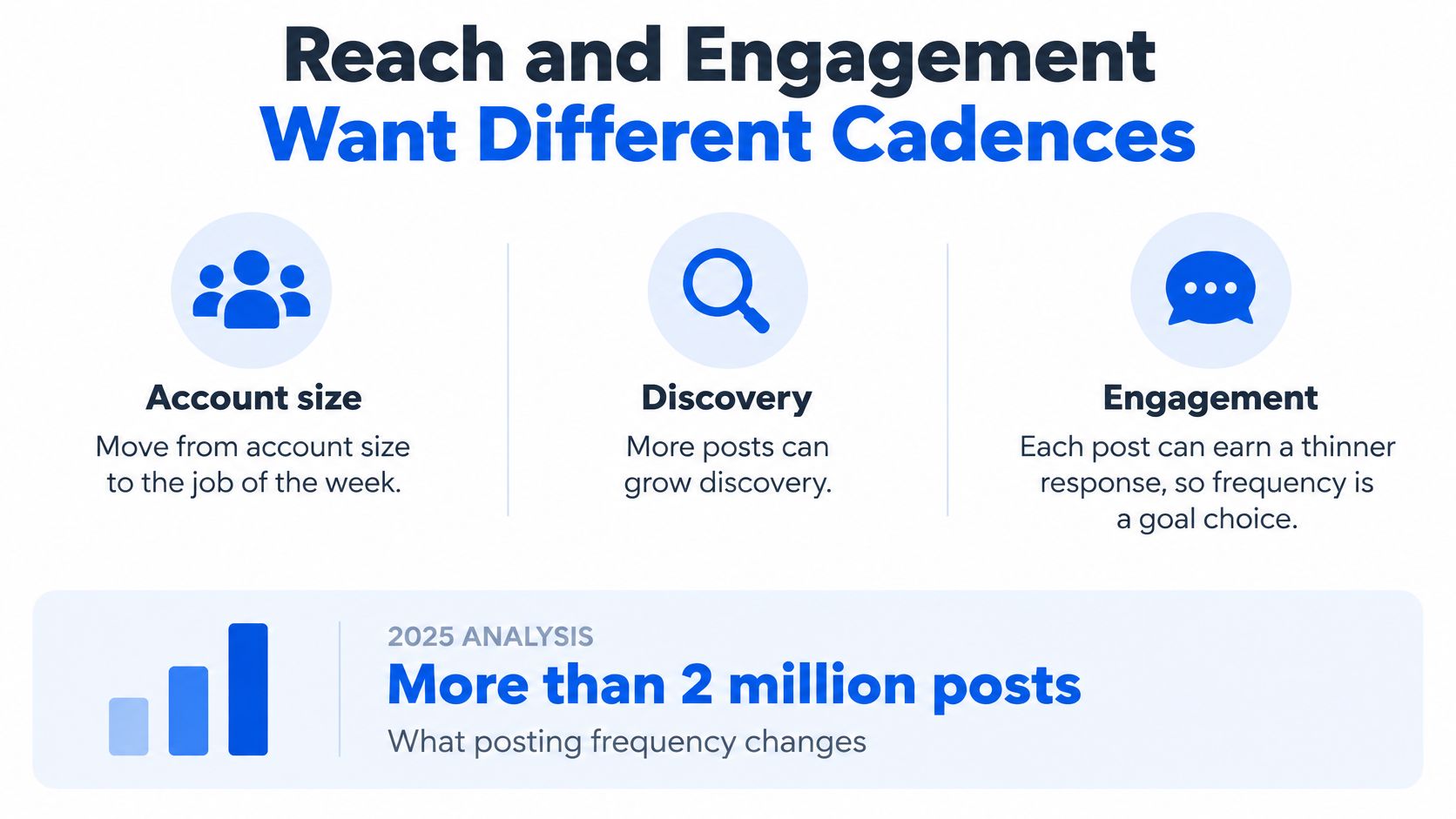
More publishing can improve discovery without producing a deeper response to every post. That's not necessarily a failure. It becomes a failure when you wanted meaningful interaction or sales but judged the schedule only by audience exposure.
A 2025 analysis of more than 2 million posts from over 100,000 Instagram accounts, reported by Social Media Today, associated publishing 3 to 5 times weekly with roughly 12% higher reach per post than publishing 1 to 2 times, and 10 or more times weekly with about 24% higher reach per post and substantially faster follower growth; the same report discussed another large analysis in which brand engagement was strongest at 1 to 2 weekly posts.
Cadence by primary Instagram goal
| Primary goal | Weekly publishing band | Associated finding | Metric to judge |
|---|---|---|---|
| Reach | 3 to 5 | About 12 percent higher reach per post than 1 to 2 | Reach per post |
| Follower growth | 10 or more, only if quality holds | About 24 percent higher reach per post and faster follower growth | Follower growth and reach per post |
| Engagement or conversion | 1 to 2 | Strongest engagement for brands in another large analysis | Saves, shares, comments per reach, profile visits |
These are the associations summarized in the cited analysis, not guaranteed returns from choosing a row.
The distinction is easiest to see when account size, discovery, and response are separated.
Apply the goal as an adjustment
Don't average the goal rows. Write one primary goal beside your account-size starting point.
For discovery, consider moving toward the reach band if your production capacity supports it. A nano account shouldn't abandon its manageable floor because a higher-volume group performed well on average.
For follower growth, a high-volume schedule is a candidate for a well-resourced team, not a default assignment. Reject it if follower gains don't improve enough to justify the added production effort, even if the calendar looks more active.
For engagement, use the low-volume brand finding as a signal worth testing. Don't generalize it into proof that every creator should publish less.
Conversion needs its own evidence
Strong engagement isn't proof of conversion. If your goal is sales or inquiries, add completed purchases, qualified inquiries, or another business outcome to the table's diagnostic metrics.
A brand planning to capture qualified leads through social ads also needs to separate paid acquisition from organic cadence testing. A change in campaign spending shouldn't be credited to a change in posting frequency.
Your chosen metric must be capable of disproving your recommendation. If you choose reach, judge reach per post. If you choose conversion, more comments won't rescue a schedule that produces fewer qualified outcomes.
Feed Reels and Stories Are Not One Slot
Assign each format a job before placing it on the calendar. Otherwise, a feed target can become an obligation to publish at the same pace everywhere.
This format split provides a practical way to allocate creative effort.
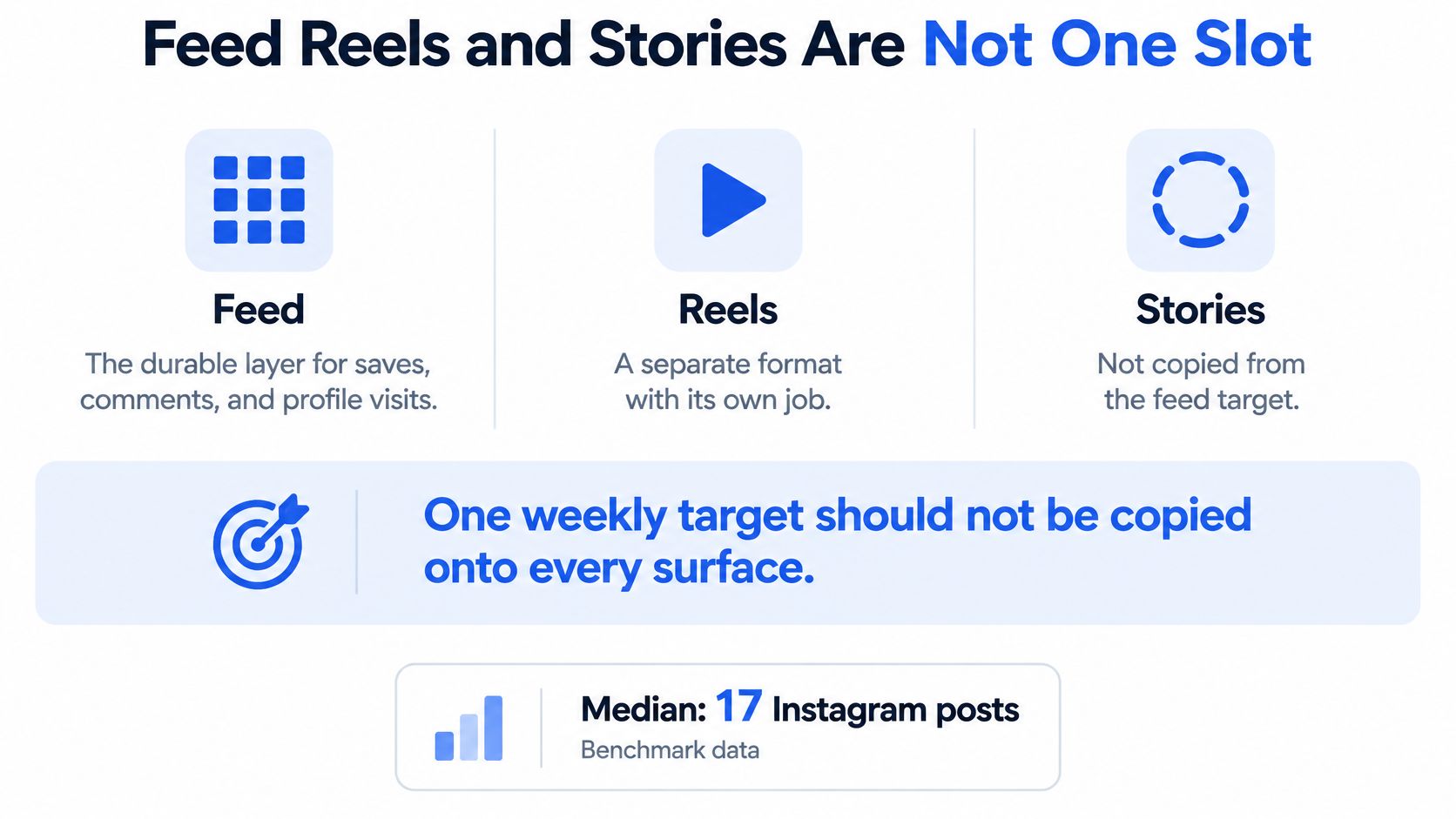
Buffer's social media benchmarks report a median of 17 Instagram posts per month and identify Reels as Instagram's strongest format for maximum reach. The monthly median is a volume check, not another quota, while the format finding gives discovery-focused accounts a reason to prioritize video production.
How feed, Reels, and Stories count in one week
| Format | Job | How it counts |
|---|---|---|
| Feed | Saves, comments, and profile visits | Keep the size-and-goal number already chosen |
| Reels | Maximum reach | An extra count when discovery or follower growth is the goal |
| Stories | Presence between posts | Support on publish days, not a replacement for feed or Reels |
Keep the accounting explicit
For planning purposes, use “feed” here for static images and carousels, and track Reels separately. Instagram can also distribute Reels in the feed, so don't assume a study's definition of feed posts necessarily excludes them.
That distinction prevents double-counting. Record each published item once in your total, then tag its format so you can compare like with like. Separating Reels operationally doesn't mean every account must add video on top of an already full workload.
A discovery-focused creator can shift effort toward Reels instead of adding another static post. A Reel-led account with constrained production time can retain a modest static-feed presence while video handles discovery.
For a practical demonstration alongside your calendar planning, use the video below.
Give Stories a supporting assignment
Use Stories on existing publish days for a poll, a behind-the-scenes clip, or a relevant link. Set their workload by those days rather than borrowing a weekly quota that the cited benchmark doesn't establish.
Judge Stories through replies, link taps, and poll votes. Don't treat those actions as interchangeable with carousel saves or Reel reach.
For video preparation, check usage rights before scheduling. If you're sourcing a soundtrack, reviewing LesFM's pricing for individual music tracks can help you budget, but confirm the applicable license separately.
Use an Instagram scheduling calendar to record the allocation clearly. Finish with separate planned counts for static feed content, Reels, and Story publish days, plus a total that doesn't count any Reel twice.
Cadences for a Creator a Brand and an Agency
A workable week should resemble someone's actual working conditions. The following calendars are hypothetical examples, not additional benchmark findings.
The production setup matters as much as the publishing grid.

A creator with a batching evening
Say a creator near 8,000 followers has a single evening available for production. They prepare two feed posts and one Reel, then use Stories only on those publish days.
Monday's carousel explains a recurring audience problem. Thursday's photograph adds a concrete example, while Saturday's Reel demonstrates the solution. All of the material comes from the same production session, but each item gives the audience a different reason to watch or respond.
The schedule avoids a specific mistake: promising daily feed posts and abandoning the plan when editing takes longer than expected. A weekly content system should begin with that production constraint, not with empty calendar cells.
A small brand seeking useful actions
Consider a brand that values saves and site visits more than broad exposure. It schedules one feed post and one Reel, separated by a couple of days, with Stories reinforcing the same offer.
The feed post answers a buying question. The Reel shows the product in use. Stories address an objection or direct interested viewers toward the relevant page rather than introducing an unrelated topic.
A fuller grid isn't the goal. A clearer path from content to the intended action is.
This week is built to avoid adding material until meaningful responses become harder to interpret. The brand evaluates whether people take the intended next step, not whether every weekday contains a post.
An agency with unlike clients
An agency might keep a nano client on two feed posts, give a mid-sized client with an established content bench about five feed posts plus separately planned Reels, and restart a silent client with one reliable post. These are illustrative calendar choices, not a uniform service promise.
The account manager should document the reason for each allocation: production capacity, objective, and available creative. Client approval deadlines belong beside those assignments.
The agency mistake is averaging unlike accounts into a single target. Copy the scenario that matches the client's working conditions, then evaluate that account on its own objective.
Run the Four-Week Test and Lock Cadence
A four-week test is a practical operating window, not a statistically guaranteed route to the optimal schedule. Use it to make a bounded decision about your next publishing period, not to declare a permanent rule.
Consistency deserves attention: Buffer's Instagram algorithm guide cites an analysis of more than 100,000 users in which consistent publishers received nearly five times more engagement per post than occasional publishers. That association supports protecting a repeatable schedule, but it doesn't establish that frequency alone caused the difference.
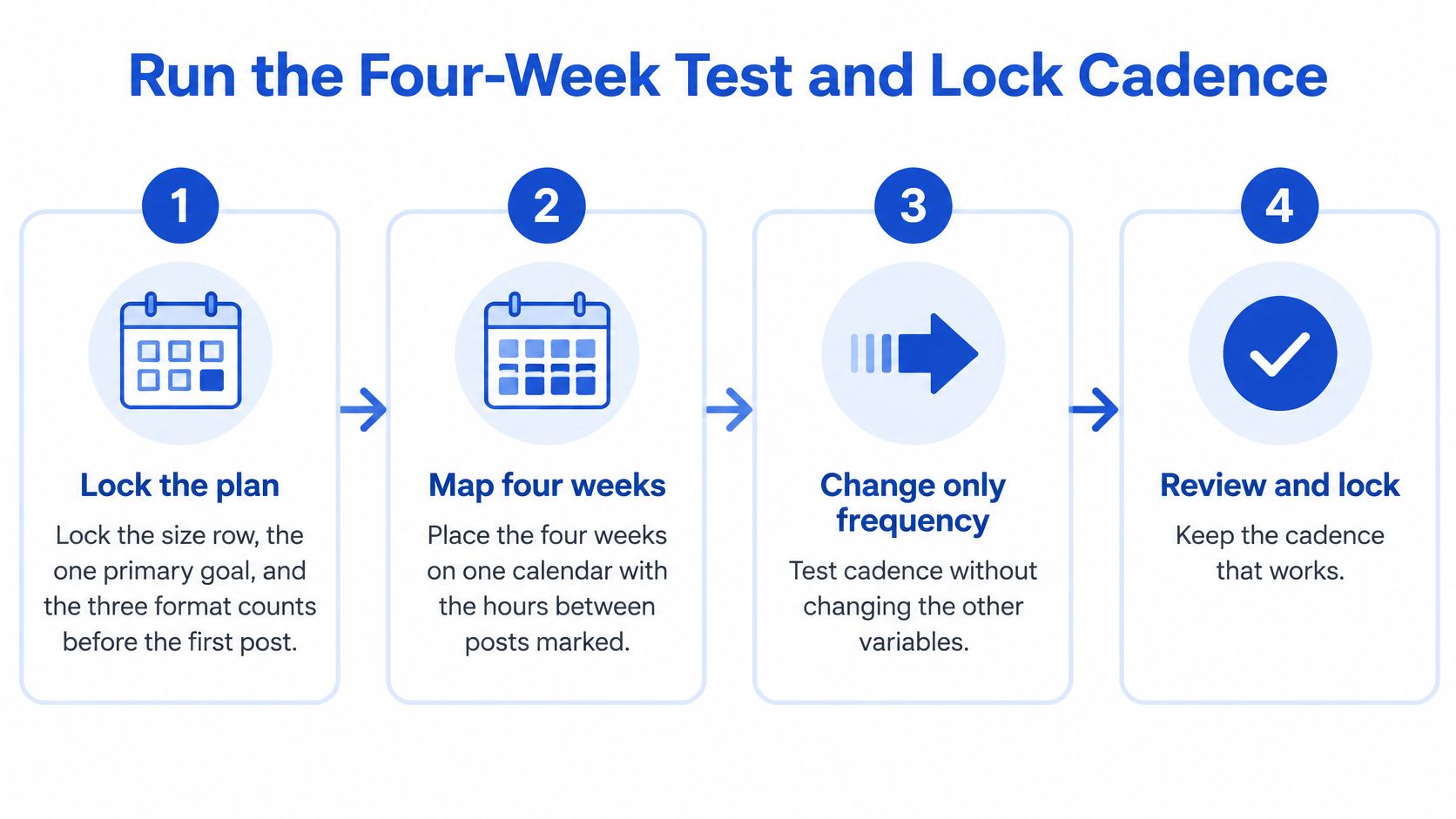
Use the following process to distinguish a useful increase from extra work.
Set the comparison before publishing
Lock the starting plan. Record your size row, primary objective, and separate format counts before the first post. Name the metric that would make you reject a higher cadence, such as declining median reach per post for a discovery-focused account.
Map the test period. Place the proposed schedule and the prior comparison period on a calendar. A workflow for planning a month of content helps you check whether the material exists before committing to the slots.
Change frequency, not the entire strategy. Move to the next feasible cadence while keeping topics, offer, creative standards, and format proportions as stable as possible. Separate publication windows rather than releasing the batch as soon as production finishes.
The control is your existing workable schedule, not necessarily the lowest row in a benchmark chart. If you're restarting after silence, establish a repeatable baseline before trying to isolate the effect of a volume increase.
Mark the time between uploads so the test doesn't accidentally become a test of clustered posting. Keep your normal response routine, too. A month with active comment replies isn't directly comparable with one in which you left the account unattended.
Measure the outcome you selected
Run the planned window and log exceptions. Maintain the test cadence for four weeks, noting promotions, unusual publicity, stock shortages, or missed approvals. The period may contain uneven weeks, but it won't necessarily include every condition your account encounters.
Compare distributions, not just totals. Record reach per post, non-follower reach, engagement rate per post, and follower growth against the prior four weeks. Include saves, shares, profile visits, clicks, or completed outcomes when they relate to your chosen goal.
Use the median reach per post alongside total reach so an unusually successful upload doesn't dominate your interpretation. Keep the engagement-rate formula consistent, including the denominator, across both periods.
Weekly reach needs careful labeling. Adding the reach of individual posts can count the same person repeatedly, so don't call that sum unique account reach. Use the platform's account-level measure when you need a deduplicated audience figure.
Let the result determine the next move
- Choose an action before adding more slots. Apply the following decision rules rather than selecting whichever metric improved.
| Result pattern | Interpretation | Next action |
|---|---|---|
| Total reach rises, but median reach or engagement rate per post falls | Added volume may be helping exposure while weakening individual performance | Keep it only if the selected objective improves enough to justify the work |
| Reach and engagement both deteriorate | The added workload hasn't earned its place | Remove a slot or improve creative before increasing again |
| Reach and engagement hold or improve | The increase remains a viable candidate | Consider the next feasible step for another bounded test |
For a conversion objective, apply the same discipline to qualified outcomes. Stable reach doesn't justify extra production if the schedule produces fewer useful inquiries or purchases.
Reject a comparison that changes the topic, offer, format mix, and frequency together. You can still learn which posts worked, but you can't confidently attribute the difference to cadence.
Stop condition: Don't add the next slot if meeting it requires lowering your creative standard or skipping essential review.
Use Social Media Scheduler as the calendar and comparison surface, not as a substitute for the decision. Our calendar shows every post for every channel in a week view or list view, while analytics show impressions, engagement, clicks, and top posts for every channel compared with the last period. Keep reach-specific and qualified-outcome measurements alongside that comparison wherever you track them.
Lock the cadence that meets your objective within your production capacity. Reopen the decision when your resources, format strategy, or business goal changes, not merely because another account publishes more.
Social Media Scheduler brings planning, channel-specific adjustments, scheduling, and performance comparison into one workflow. After connecting the agent, ask it to plan the week, then review the drafted and adapted posts against your chosen cadence before they're scheduled. Visit Social Media Scheduler to put your test calendar and publishing routine in one place.