Content Based Recommendations Explained and Applied
Oct 18, 2026 · 15 min read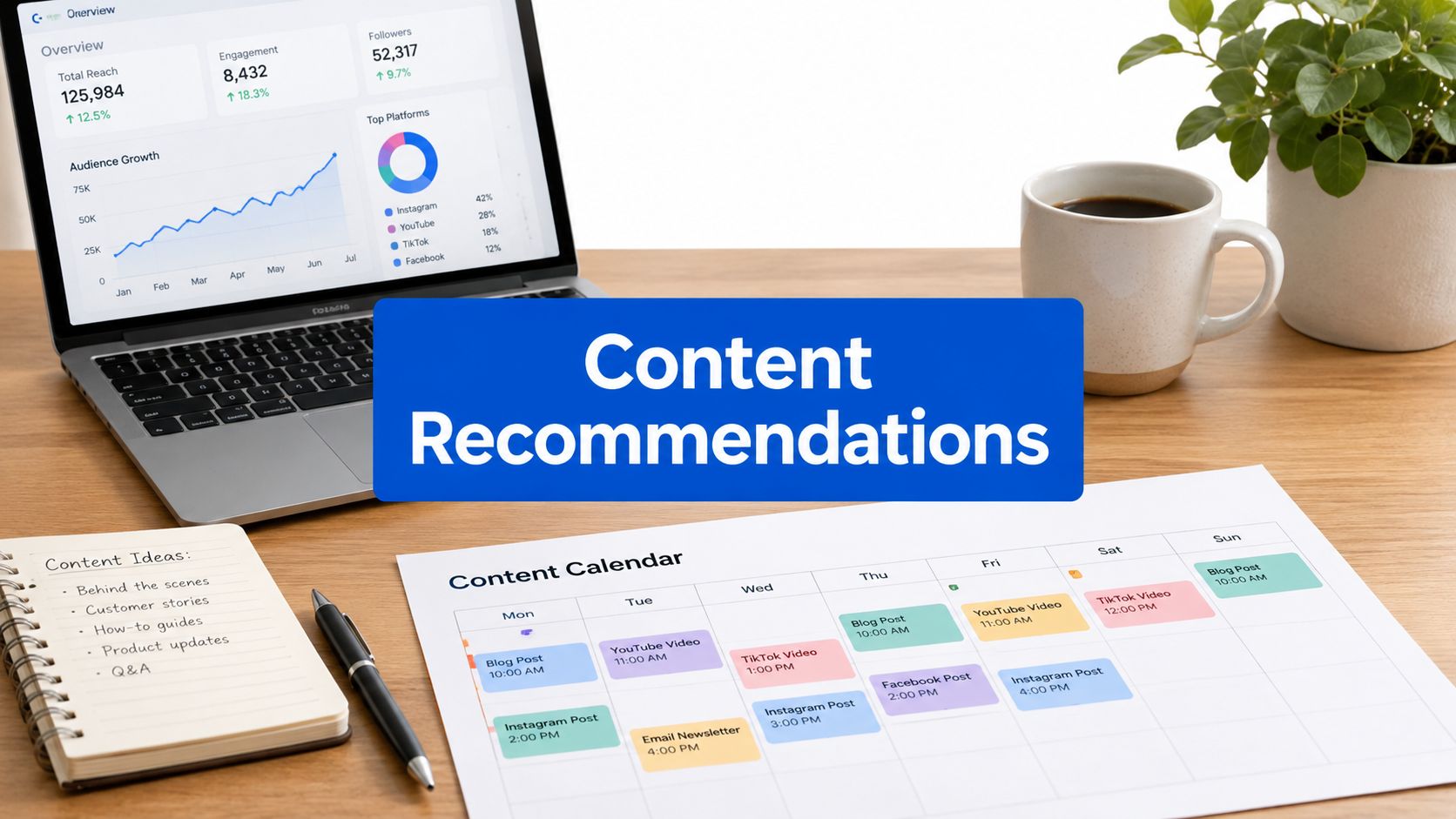
You've finished a LinkedIn draft, opened your publishing calendar, and hovered over a Tuesday morning slot. The post sounds right. The timing feels plausible. But you can't tell whether you're making a decision from evidence or repeating a habit.
Content based recommendations can help you turn that uncertainty into a testable publishing decision. The useful question isn't whether an algorithm likes your draft. It's whether you can inspect the evidence behind its suggestion, correct the assumptions, and leave room for something your account hasn't tried before.
Why Content Based Recommendations Matter to Your Posting Calendar
An empty calendar slot creates several decisions at once. You need to choose the subject, adapt the format, select the channel, and decide when to publish. Without a clear connection to your own results, those choices can become guesses dressed up as a content strategy.
Think of a recommendation tool as a curator reviewing submissions. You give it a draft and a record of previous posts. You want it to identify useful precedents, not just approve whatever resembles your most popular campaign.
Start with the publishing decision
For a practical planning exercise, separate the questions you want answered:
- Content fit: Does this draft support a topic your audience has responded to?
- Channel fit: Which version belongs on LinkedIn, TikTok, or another network?
- Scheduling evidence: What historical results support the proposed slot?
- Discovery value: Does the post introduce something your calendar currently lacks?
- User control: Can you see and change the reasons behind the recommendation?
Those are different capabilities. A strong topic match doesn't establish the right publishing time, and a promising format doesn't justify sending a draft without approval.
Make the calendar your decision surface
When you plan a month of content, treat recommendations as annotations beside your drafts. Keep the proposed action, its supporting evidence, and your final decision together.
For example, a scheduler might suggest turning an educational draft into a carousel. Before accepting, ask whether the supporting posts share the subject, audience, and channel, or merely contain similar words.
The gain is a more defensible planning process, not certainty about future engagement. You should finish a planning session knowing why you selected a post and what you intend to learn when it publishes.
How Content Based Recommendations Work
Suppose your scheduling tool has a draft about a customer problem and a record of posts your account has published. It can describe the draft's topic, format, and wording, then compare those features with patterns in your past content. Like a librarian matching a new book to a reader's interests, it uses similarities to suggest what may fit.
That approach is called content-based filtering. Its roots include information filtering and selective dissemination of information, where incoming documents were matched against stored interests, as described in the history of content-based recommender systems.
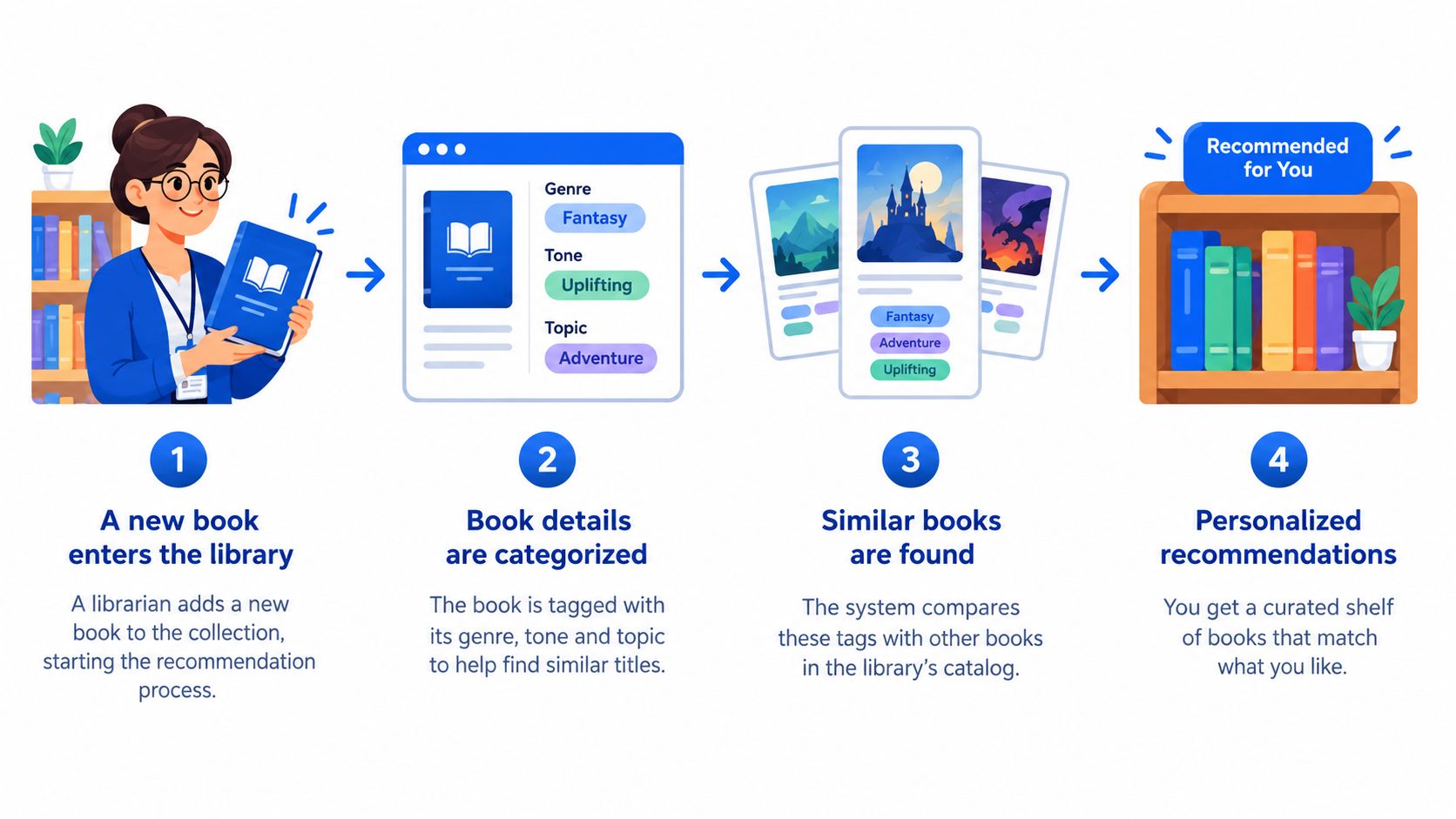
From a library shelf to a publishing calendar
A scheduler follows three steps. First, it turns observable post attributes into a machine-readable description, often called a feature vector. Next, it builds a preference profile from the content an account has selected or performed well with. Finally, it uses similarity ranking to compare drafts with that profile and sort them by how closely they match.
The labels behind that profile matter. If a team distinguishes product education from customer stories, those categories need to be clear enough for the system to use. A content pillar strategy for agencies can help teams define editorial categories before relying on an algorithm to distinguish them.
What the matching can and cannot tell you
Two common methods represent content in different ways. TF-IDF gives more weight to distinctive terms, making it useful when exact vocabulary matters. Embeddings place content in a numerical space designed to capture relationships in meaning, so posts with different wording can still be considered related.
Neither method decides which attributes matter to your audience, brand voice, or campaign goal. A draft about the same subject as a successful post may still have a different purpose or tone.
A similarity score measures resemblance, not future performance. Treat it as a reason to review a draft, then check whether the match makes editorial sense. That distinction lets small teams audit recommendations against their own historical posts instead of accepting a ranking at face value. The system compares draft features with an account-interest profile; your publishing workflow decides whether the suggestion belongs on the calendar.
Four Capabilities a Scheduler Needs From Content Signals
A useful scheduling feature must do more than find related text. It needs to translate content evidence into decisions about drafts, formats, channels, and the composition of a calendar.
The diagram below groups the publishing decisions that a scheduler may support.
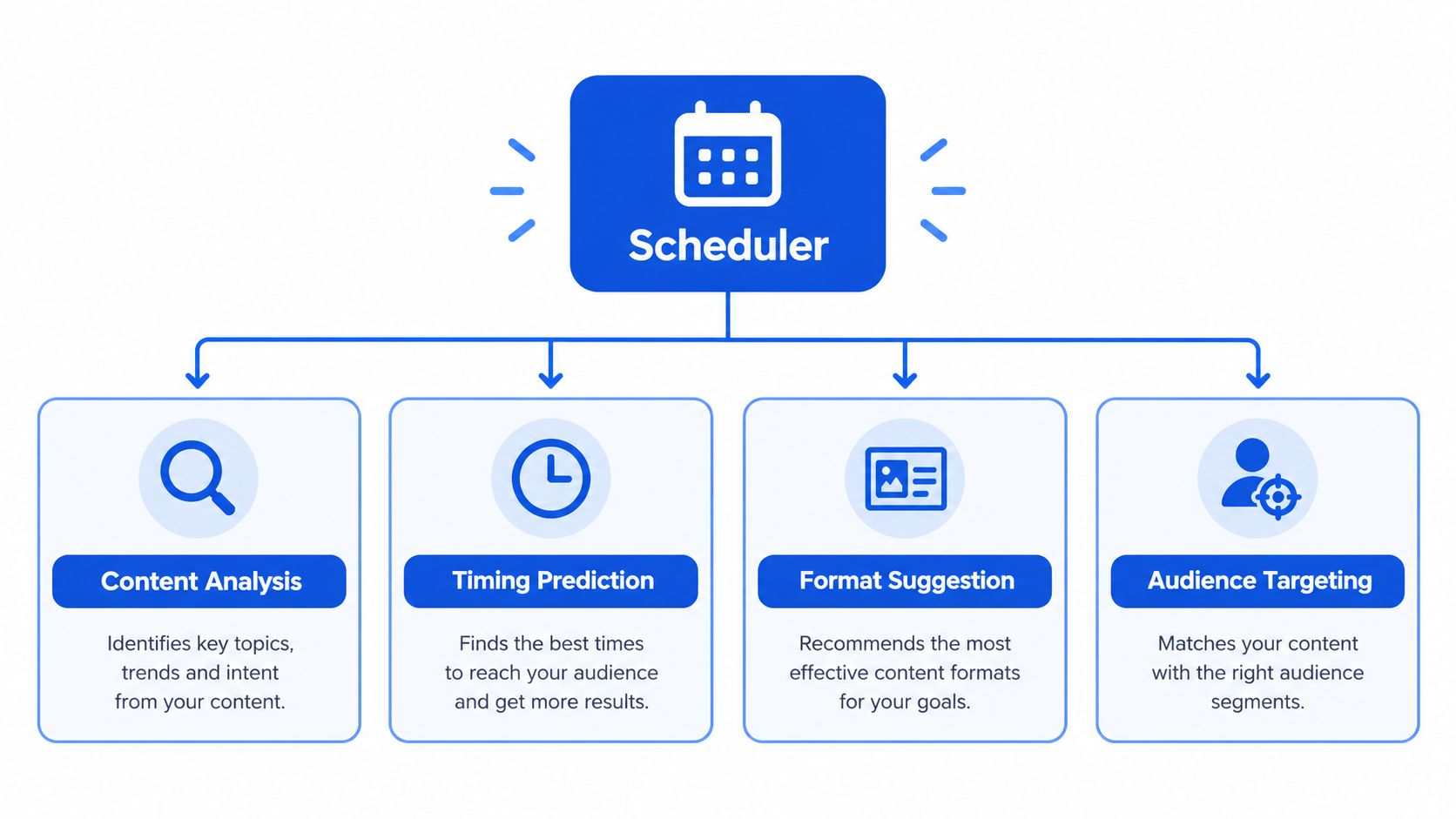
Rank new drafts without pretending they have results
Cold-start ranking means evaluating an item before it has accumulated interactions. Content features provide a direct mechanism for this, as demonstrated by the RecSys Challenge work on cold-start recommendation.
Suppose you draft a LinkedIn explanation of a customer problem. The scheduler can compare its subject and structure with relevant historical posts before the draft receives any impressions. It should describe that result as a content-based estimate, not observed performance.
The boundary matters: a new-item problem isn't the same as a new-account problem. If an account has no useful history, there's no proven account profile to match against. Declared goals and editorial preferences can provide a starting point, but the tool should make that limitation visible.
Preserve differences and narrow candidates carefully
Multimodal representation should keep the whole post in view. Consider hypothetical LinkedIn and TikTok versions of the same lesson. The text may convey the same subject, while a diagram and a demonstration video serve different editorial purposes.
A scheduler should preserve those distinctions rather than treating matching captions as interchangeable assets.
The processing pipeline also needs separate jobs:
- Retrieve candidates: Find plausible drafts or historical examples through semantic similarity.
- Rerank for context: Apply channel, audience, recency, format, and relevant performance evidence.
Timing belongs in that contextual decision. The meaning of a post alone can't establish when your audience will respond.
Judge the calendar, not just individual posts
Diversity and novelty controls provide the final capability. A set of individually relevant recommendations can still produce a repetitive week. The tool needs a calendar-level check, not merely a score beside each draft.
When comparing options, including this AI-native social scheduling platform, distinguish documented publishing features from technical mechanisms you'd need to verify with the provider. Scheduling suggestions don't, by themselves, prove that a product uses embeddings, multimodal fusion, or a particular ranking architecture.
Ask what each recommendation uses. That's more informative than the presence of an AI label.
Content Signals vs Behavioral Signals and When Each Wins
Behavioral signals aren't synonymous with collaborative filtering. Your own past clicks, likes, or published posts can help construct a content-based preference profile. Collaborative filtering instead draws on relationships across users and items, such as patterns of shared preferences.
That distinction prevents a common misunderstanding: using performance history doesn't automatically make a scheduler collaborative. A survey of research-paper recommender systems describes content-based profiles built from users' authored, tagged, browsed, or downloaded papers, alongside the method's explainability and narrowness.
Content Based vs Collaborative Filtering for Publishing Decisions
| Dimension | Content Based Filtering | Collaborative Filtering |
|---|---|---|
| Main evidence | Item attributes matched to an individual profile | Patterns of interactions across users and items |
| New draft | Can assess available content features | Lacks direct interaction evidence for that draft |
| Specialized account | Can use its own interests and content | Depends on useful shared interaction patterns |
| Explanation | Can point to matching attributes | May require explaining cross-user relationships |
| Main constraint | Can overfavor familiar subjects | Needs suitable interaction data and overlap |
Choose signals that fit the evidence
Consider a hypothetical new Threads account with only a handful of published posts. Content features and declared editorial goals may be the most defensible basis for an initial suggestion. The scheduler shouldn't imply that sparse engagement establishes a reliable audience preference.
Now consider an established YouTube channel with a substantial interaction history. Behavioral evidence deserves more influence when it's relevant to the decision. However, aggregated comment counts alone don't constitute a collaborative model, nor do they explain which viewers preferred which items.
For an editorial review of the engagement tactics you're testing, see Bulk Image Generation's tips. Keep those tactics separate from the question of which recommendation method your tool uses.
Use content signals when you need a defensible starting point. Give behavior more influence when the interactions are relevant, sufficiently informative, and connected to the outcome you care about.
A hybrid approach combines these sources deliberately. Ask the provider whether a suggestion reflects content similarity, your account's performance patterns, cross-user interactions, or some blend. Those explanations imply different strengths and different limitations.
Turning Post Analytics Into Scheduling Suggestions
A creator preparing a LinkedIn calendar can start with a practical question: which past posts offer useful evidence for this week's choices? In an analytics workspace, they review post text, format, publication time, reach, engagement, and engagement rate. These fields form a comparison set, much like sorting similar recipes before choosing one to cook again. The example describes a workflow, not a reported customer result.

Before asking the scheduler for suggestions, choose the outcome that matters. A creator reviewing content analytics insights can use the metrics as a companion reference, then decide which measurements fit their own publishing goal. Reach may matter for awareness; engagement may suit a different objective.
The comparison set needs an editorial check, too. A post can look similar on the surface while providing poor evidence for today's decision.
- Relevant examples: Keep posts that fit the current channel, audience, and objective.
- Outdated campaigns: Give less weight to material that no longer reflects the account's priorities.
- Unusual distribution: Flag promoted or otherwise atypical posts instead of treating them as ordinary results.
- Incomplete measurements: Exclude records that cannot be compared, or label their limitations.
This filtered set becomes a task-specific preference profile, not an average of everything the creator has published.
For a Tuesday draft, the scheduler might surface related posts, suggest adapting one as a carousel, and offer a publishing slot associated with those examples. The creator should check the evidence behind each part of the proposal. Related posts may support a topic choice, while format and timing need their own review.
Historical association isn't proof of causation. If similar carousels performed well during a particular period, topic, distribution, and timing may all have contributed. Treat the proposed format and slot as hypotheses to test, rather than guarantees.
The video below is a separate viewing resource for the calendar review.
Sortable top-post views help creators inspect recommendations: filter by channel and period, open the actual posts, and record why a suggestion was accepted or changed. After publishing, compare the result with the chosen objective. Keep the evidence beside the editorial decision, so the next review can build on a record rather than memory.
Diversity Controls That Stop Recommendations From Going Stale
A scheduler may keep recommending the same familiar topics because past engagement makes them look like safe choices. For a small team, that can fill the calendar with reliable posts while leaving little room to test new formats or reach people beyond the usual audience. Diversification controls make those experiments part of the workflow.
The IBM survey on fairness and diversity in recommender systems distinguishes item-level diversity from user-level diversity. In a posting calendar, item-level variety means mixing topics or formats. User-level breadth asks whether the content serves different audience groups. They are related, but a new format does not automatically bring in new people.
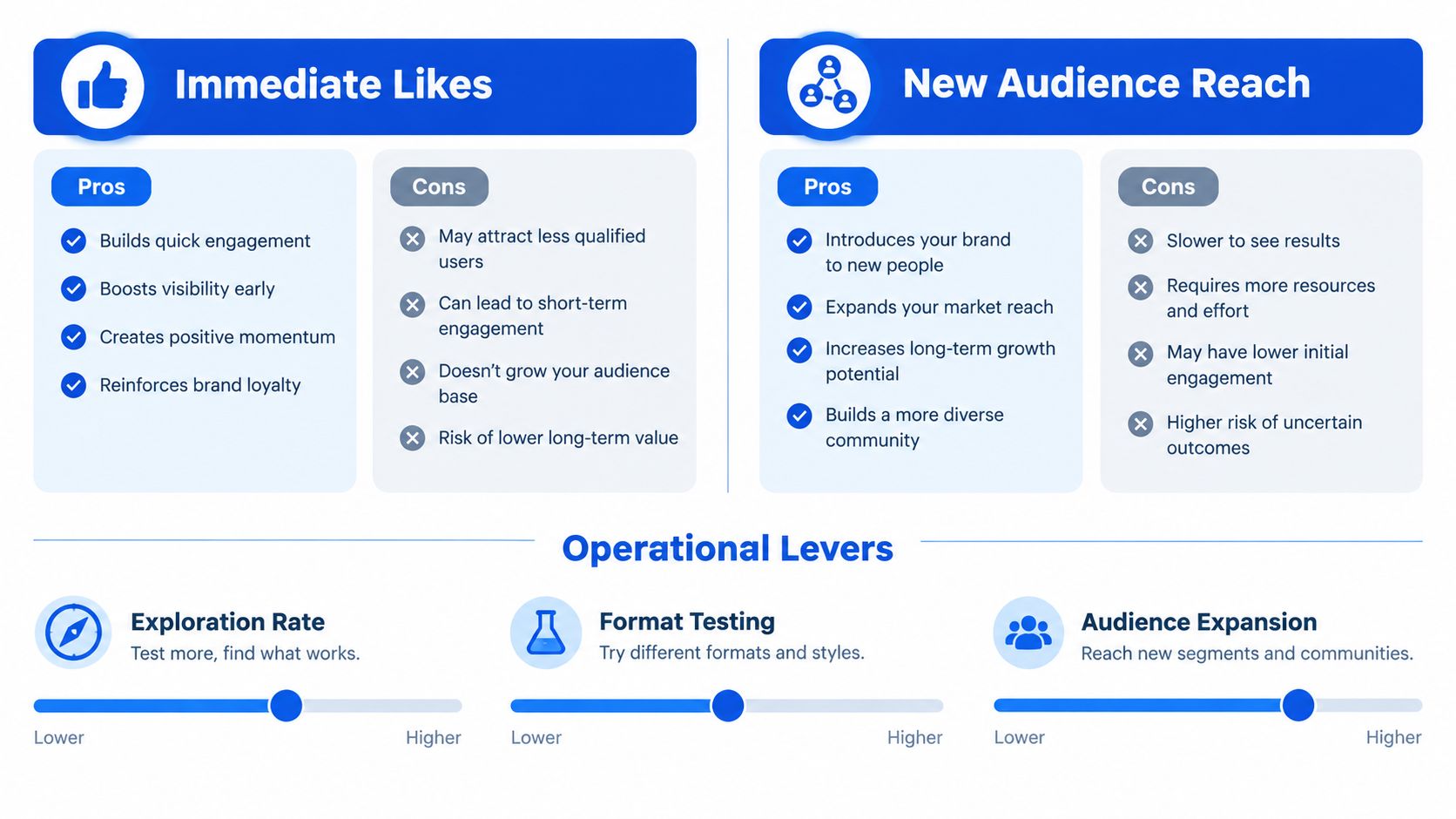
Set a few editorial guardrails before choosing posts. A scheduler can limit how many slots go to a familiar topic, reserve space for formats the team wants to test, or mark a new angle as worth exploring even when it has little historical evidence. It can also show distance from recent posts separately from predicted short-term engagement, so novelty is visible rather than hidden in one score.
These controls should fit the team's capacity and learning goals. A quota that crowds out work the team can't produce is no help. Review the limits as the calendar and goals change.
Consider a week filled with carousel posts. Replacing one carousel with a video creates format variety, but the audience may remain unchanged. Different topic labels can also mask posts that share the same assumptions. Review the actual content and ask whether someone unfamiliar with the account would find a reason to follow.
Calendar test: Ask whether an unfamiliar reader has a reason to follow this week, not just whether an existing follower will recognize it.
Compare short-term engagement with audience expansion when your analytics support both views. If the scheduler cannot identify whether new audience segments saw a post, don't treat higher reach as proof of discovery. Record the gap, then use your own historical results to decide which experiments deserve another slot.
The aim is controlled exploration: keep material that performs, while reserving calendar space to learn about interests your past posts may not reveal.
How to Audit the Recommendations Your Tool Is Making
An explanation and a control solve different problems. An explanation helps you understand a suggestion. A control lets you change what happens next.
A survey of social-media users' transparency experiences found continued demand for greater transparency despite existing explanation cues. For a scheduling workflow, the practical response is to require inspectable evidence and reversible actions, rather than assuming a readable explanation is enough.
Inspect the evidence trail
Use this checklist before allowing recommendations to shape a campaign:
- Influential posts: Can you open the historical examples behind the suggestion?
- Time window: Can you see which period informed the profile?
- Outcome used: Was the recommendation based on reach, engagement, engagement rate, or another objective?
- Excluded data: Are omitted channels, campaigns, promoted posts, and incomplete records identified?
- Reason accuracy: Do the cited examples share the attributes described?
An explanation can sound convincing while pointing to irrelevant evidence. Check the posts themselves, not just the generated summary.
Test what your feedback changes
Reject a suggestion and inspect the consequence. Does the tool remove only that draft, reduce interest in its topic, or alter future calendar proposals?
You should also be able to distinguish rejection because of poor timing from rejection because of tone or campaign fit. Otherwise, the system may interpret an editorial constraint as dislike of the underlying subject.
Reversible controls should let you exclude topics, down-weight old campaigns, preserve tone, and require approval where those options are supported. If a control isn't available, keep the corresponding decision outside automation.
Bring these verification prompts to your next planning meeting:
- Show the evidence: Which historical posts and outcomes justify this suggestion?
- Expose the boundary: What data was excluded, and where is the recommendation uncertain?
- Demonstrate control: What changes if we reject it, and how can we undo that change?
Don't approve an opaque recommendation merely because its wording sounds confident.
Putting It All Together for Your Next Publishing Week
Treat each recommendation as a publishing hypothesis with an evidence trail. The draft is the candidate, the analytics provide context, and your editorial objectives determine whether the proposed action belongs on the calendar.
The practical standard is straightforward: the system should support useful candidate selection, preserve channel and media distinctions, account for operational context, and leave room for exploration. Its explanation should make the evidence inspectable without turning every planning session into a technical investigation.
Carry a compact routine into planning
Use a weekly content system to keep the decisions repeatable:
- Select the objective: Decide what the upcoming calendar needs to accomplish.
- Review the evidence: Inspect relevant historical posts before accepting format or timing suggestions.
- Protect exploration: Keep space for drafts that test an editorial hypothesis.
- Record the decision: Save what you changed and why, then review the outcome after publishing.
This routine gives you something more useful than a calendar filled with algorithm-approved posts. It creates a record of decisions that your team can challenge and improve.
Watch semantic methods without skipping verification
For planning in 2026, evaluate semantic methods by the decisions they support, not their terminology. Research on multimodal content representation and recommendation describes Transformer-based representations and contrastive approaches that align content with collaborative signals.
These methods offer a direction beyond exact keyword matching. They don't remove the need to verify evidence, preserve explicit metadata, or define what successful publishing means for your account.
Your next planning session doesn't need a perfect model. It needs a clear objective, inspectable suggestions, and a deliberate way to learn from what you publish.
Social Media Scheduler brings drafting, cross-platform scheduling, and performance measurement into a single calendar, with recommendations informed by historical post results. Visit Social Media Scheduler to review how its planning and analytics workflow could help you choose your next drafts, formats, and publishing slots with clearer evidence.