What Is the Best Time to Post on LinkedIn in 2026
Oct 28, 2026 · 15 min read
The best time to post on LinkedIn for most B2B accounts is Tuesday to Thursday, 8 to 11 a.m. in the audience's local time. Treat that as your control slot, not as a universal rule, because the strongest studies agree on the day range more than they agree on the exact hour.
That disagreement is the useful part. If you copy one headline hour, you're borrowing another account mix, another geography, and another definition of success. A better approach is to start where the evidence clusters, understand why some datasets point to afternoon, and then let your own median results decide What Is the Best Time to Post on LinkedIn for your followers.
Why Tuesday to Thursday Wins in Most Studies
For most B2B accounts, the baseline is Tuesday to Thursday, 8 to 11 a.m. in the audience's local time. Published studies tend to favor midweek and working hours, though they differ on the best hour and on how they measure performance.
One large business-account analysis offers a useful reference point. Hashmeta's 2025 analysis covered 950,000 LinkedIn posts from more than 15,000 business accounts and found that Tuesday to Thursday posts from 9 a.m. to 12 p.m. EST received 38% more engagement than off-peak posts. Its scale supports using that window as a starting point, but its results describe a particular account mix and time zone.
Benchmark Posting Windows by Source
| Source | Sample | Best days | Best window | Headline finding |
|---|---|---|---|---|
| Hashmeta 2025 | 950,000 posts, 15,000+ business accounts | Tuesday to Thursday | 9 a.m. to 12 p.m. EST | 38% more engagement than off-peak posts |
| Hootsuite and Critical Truth | 1 million+ posts, 118 countries | Tuesday and Wednesday | 8 to 9 a.m. local time | Morning strongest for technology, education and healthcare |
| HubSpot (cited by LinkedIn) | Large social-media studies cited by LinkedIn | Monday, Wednesday, Tuesday | 9 a.m. to noon, noon to 3 p.m., 3 to 6 p.m. | Weekday daytime performs best |
| Sprinklr | Large social-media studies cited by LinkedIn | Tuesday to Thursday | 10 to 11 a.m. and noon to 1 p.m. | Mid-morning and lunch windows stand out |
| Buffer | Weekday analysis cited by LinkedIn | Monday to Friday | 4 p.m. Mon, Tue and Thu; 2 p.m. Wed; 1 p.m. Fri | Weekday 9 a.m. to 5 p.m. generally effective |
The studies converge more clearly on days than on hours. Tuesday through Thursday appears repeatedly, while the recommended windows range from early morning to late afternoon. Differences in audience, geography, post mix, and engagement measures can produce different peaks, so the table is a set of benchmarks, not a single universal schedule.
Analyst's read: Start with the recurring midweek pattern, then test the hour against your own account's results.
Use Tuesday to Thursday as your publishing core and 8 to 11 a.m. in your audience's local time as the initial comparison window. Include an afternoon slot in your test rather than assuming morning is best; the published recommendations do not settle the question of which hour will perform best for your audience.
What Actually Drives Your Peak Posting Window
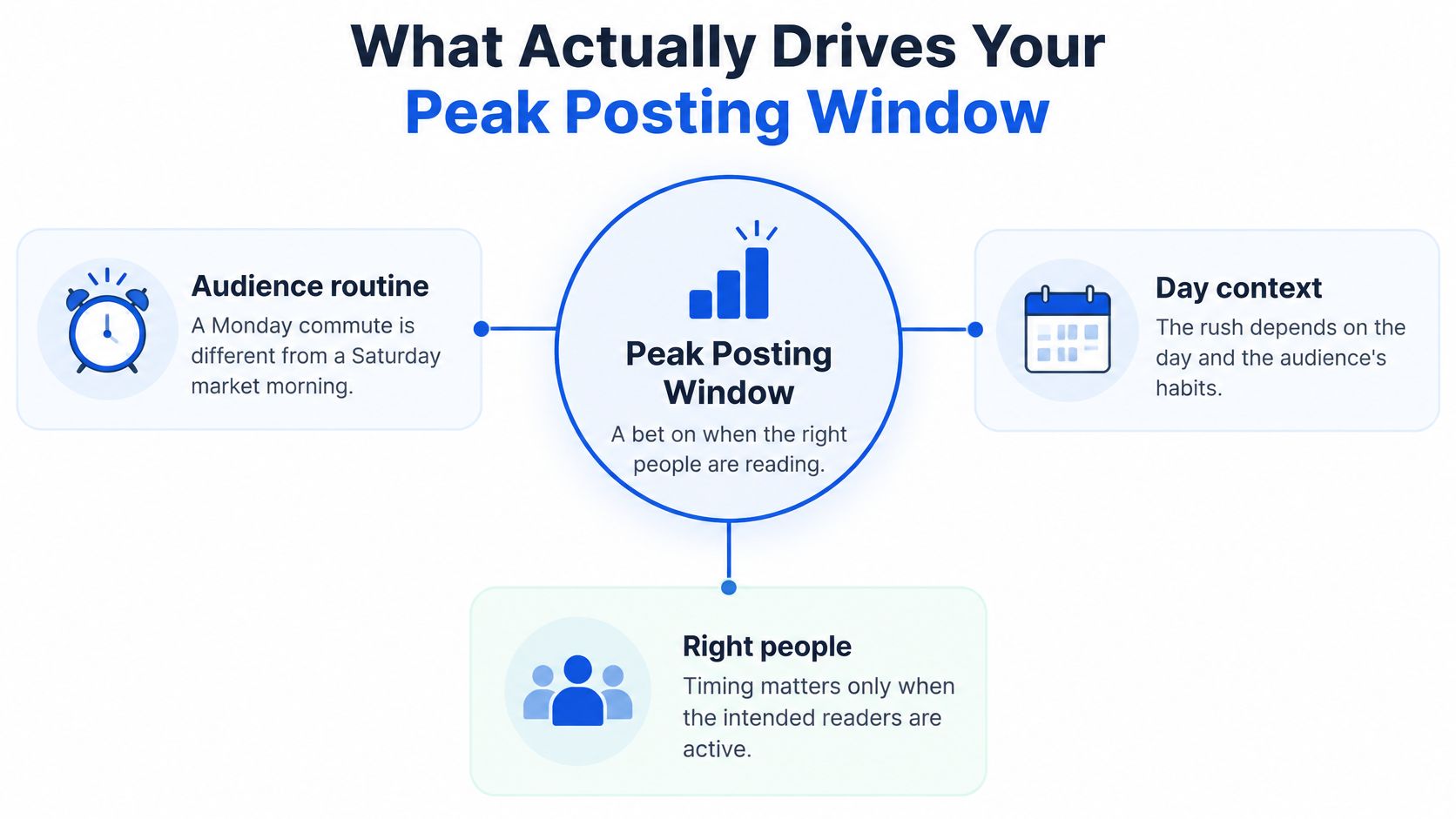
A posting time is a bet on when the right people are reading. LinkedIn's foot traffic is professional attention, and it arrives in waves shaped by workdays, time zones, and job roles rather than by one global clock.
Audience Availability and Early Velocity
Audience availability comes first. Professionals often encounter industry content while beginning the workday or between early meetings, which creates a larger initial pool of potential readers. That pattern makes LinkedIn's summary of posting-time research reporting 13% to 16% higher average engagement for Tuesday and Thursday posts around 7 a.m. to 9 a.m. plausible, even if your own account peaks later.
Availability alone doesn't explain distribution. Engagement velocity matters because reactions, comments, and shares shortly after publication can signal relevance and increase the chance a post reaches additional feeds. A post published while readers are present but left without replies wastes part of that advantage, so schedule only for slots where the author or community manager can respond while the thread is still fresh.
Geography, Industry, and Format
Geography breaks any single global clock. Midday in New York is already late afternoon in London, so a benchmark quoted in Eastern Time has to be converted into the reader's day, not copied. If you're choosing slots for commercial conversations rather than vanity reactions, choosing slots that drive sales conversations is a useful reminder to anchor timing to the buyer's routine.
Industry and seniority shift the curve again. In the Hootsuite and Critical Truth analysis of more than 1 million social posts across 118 countries, morning publishing was especially strong for technology, education, and healthcare audiences, with Tuesday and Wednesday 8:00 to 9:00 a.m. local time as the strongest general window. A founder audience, a clinical audience, and a school leadership audience don't start the day with the same constraints.
Format and objective complete the picture. A short update asks for seconds, a carousel asks for a pause, video asks for sound or captions and sustained attention, and an event post asks for a calendar decision. Impressions, comments, clicks, and qualified leads can therefore peak in different slots for the same account, which is why the studies behind any benchmark disagree whenever they measure different outcomes.
The best time is when your specific readers are present and able to respond, not when the platform is busiest overall.
Your peak window is a function of who reads, what they read, and what you measure. Change any one of those, and the right hour can move without any dataset being wrong.
Which Day Wins for Each Goal
Wednesday leads on raw interactions while Thursday leads on rate and reach, so picking a day before picking a metric puts the decision in the wrong order. Those are different wins with different business value.
Best Day and Window by Goal
| Goal | Best day | Window | Evidence |
|---|---|---|---|
| Average interactions per post | Wednesday | 7 to 9 a.m. | Highest average in a large post-level dataset |
| Engagement rate | Thursday | 7 to 9 a.m. | Top overall rate in the same dataset |
| Impressions | Thursday | Full-day Thursday average | Kapwing's 2024 experiment |
| Single top slot | Thursday | 5:12 p.m. | Influencer Marketing Hub's 2025 study |
| Business reach with engagement | Tuesday to Thursday | 9 a.m. to 12 p.m. EST | Hashmeta's 2025 analysis |
Wednesday's lead is narrow and specific. The largest dataset behind these findings, covering hundreds of thousands of posts, gave Wednesday the highest average interactions per post, and morning publishing beat the lunch and late-afternoon bands on engagement rate. If discussion volume is your goal, Wednesday morning earns the first test slot.
Thursday looks stronger when the denominator changes. The same dataset put Thursday on top for overall engagement rate, and Kapwing's 2024 experiment found Thursday was the best day for impressions, averaging more than 12,000 views per post. A post can collect fewer interactions and still reach more of the feed. For reach goals with engagement attached, Hashmeta's 2025 analysis favoured Tuesday to Thursday between 9 a.m. and noon EST over off-peak publishing.
The late slot needs careful handling. Influencer Marketing Hub reported in 2025 that posts published at 5:12 p.m. on Thursdays produced the highest engagement in its referenced LinkedIn study. Precision like 5:12 looks decisive, but a single top slot is more vulnerable to account mix and format mix than a broad band repeated across studies.
Buffer's per-day peaks complicate the morning case. Its strongest slot for each weekday falls in the afternoon, which shows the disagreement across studies is structural: datasets built on different account mixes peak at different hours. Read the afternoon peaks as test candidates rather than a rival calendar. A weekly content system that assigns each goal its own day is a practical way to hold those candidates in one schedule instead of forcing every post into a single slot.
Choose the day by the metric tied to the outcome you're judged on. Reach campaigns, discussion posts, and click-driven assets shouldn't share a winner by default, and your own history gets the final vote.
How to Find Your Peak Window in Your Own Analytics
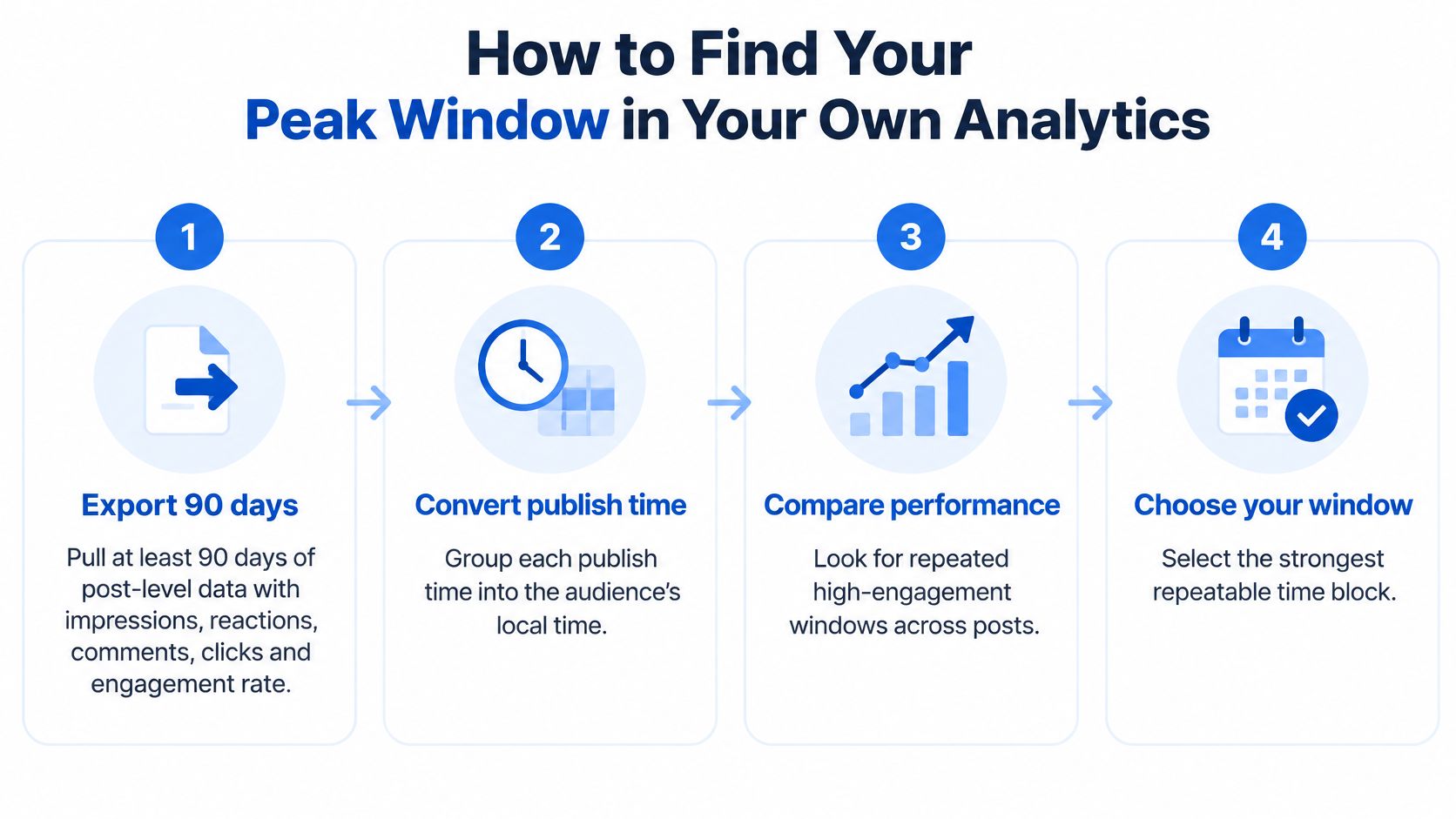
Your exports answer a narrower and more valuable question than any benchmark. They show when your followers responded to your topics, in your formats, from your account. The method matters because raw totals mislead fast.
Seven Steps From Export to Ranked Bands
- Export 90 days: Pull at least 90 days of post-level data with impressions, reactions, comments, clicks, and engagement rate. A shorter window lets one campaign or news cycle pose as a pattern.
- Convert to audience time: Restate every publish time in the audience's dominant time zone, not the account manager's. This step alone can move a post across bands.
- Group into bands: Use 6 to 9 a.m., 9 a.m. to noon, noon to 3 p.m., 3 to 6 p.m., and after 6 p.m. Bands are wide enough to accumulate posts and narrow enough to schedule against.
- Compare medians: Rank bands by median engagement rate, not the average. One viral outlier can pull an average upward and send a quarter of posts into a weak slot.
- Normalise for audience size: Calculate reach per follower for each post. Older posts competed with a smaller follower base, so raw impressions favour recent content.
- Check sample size: Require at least five posts per band before you trust a ranking. Below that, label the band untested rather than poor.
- Split by format and weekday: Repeat the ranking for text, carousel, video, and link posts, then by weekday. A blended winner often hides two different format-specific windows.
Social Media Scheduler supports that work directly. Our analytics show impressions, engagement, clicks and top posts for every channel, compared with the last period, so you can compare bands without rebuilding the view each month. We also learn from your docs and what you've published, then tailor every post and send it to all your channels, which keeps the tested LinkedIn version distinct from versions built for other networks.
Treat any automated recommendation as a hypothesis drawn from past posts. It can rank likely windows quickly, but it can't prove causality if your best topics always happened to run on Wednesdays. The same discipline applies on other platforms, and these Instagram Reels timing tips make a useful contrast because short video has a different attention pattern from a professional feed.
Output to aim for: A ranked list of three time bands for each format, each with a median, a sample count, and a reach-per-follower figure.
Don't finish with a single magic hour. Finish with ranked bands you can test. That's the bridge between historical description and a scheduling decision you can defend.
How to Run a Four-Week Slot Test
A controlled test beats guessing because it separates time from topic. If your strongest idea runs at 8 a.m. and a routine update runs at noon, the result tells you about the ideas, not the slots. Hold topic type, format, and weekday mix as steady as you can while comparable posts rotate.
Use three candidate slots in audience-local time, 8 to 9 a.m., 10 to 11 a.m., and 12 to 1 p.m. That design follows the practical structure in Buffer's LinkedIn timing guidance, where weekday peaks differ by day and a single benchmark shouldn't be converted blindly for every audience. Plan the rotation in advance with a monthly content plan so matched posts don't drift into whichever slot is free.
Four-Week Slot Test Plan
| Week | Focus | 8 to 9 a.m. | 10 to 11 a.m. | 12 to 1 p.m. |
|---|---|---|---|---|
| Week 1 | Baseline with matched posts in every slot | Tue, Wed, Thu | Tue, Wed, Thu | Tue, Wed, Thu |
| Week 2 | Swap posts to new slots to rule out topic effects | Tue, Wed, Thu | Tue, Wed, Thu | Tue, Wed, Thu |
| Week 3 | Repeat with video or carousel format | Tue, Wed, Thu | Tue, Wed, Thu | Tue, Wed, Thu |
| Week 4 | Confirm leader on fresh topics against control | Leader or control | Runner-up | Control |
Week 1 establishes whether any slot separates from the pack. Week 2 swaps topics into different slots, which is the step that many teams skip and the step that protects you from crediting timing for a strong subject. Week 3 checks whether the pattern survives a format change, and Week 4 asks the leader to win again on fresh material.
Measure four things for every post:
- 24-hour engagement rate: This keeps the comparison window equal.
- Qualified comments: Count replies from the roles and companies you want, not every reaction.
- Reach per follower: This controls for audience growth during the month.
- First 60 to 120 minute velocity: This shows whether the slot creates early discussion.
Raw impressions can crown a slot that produces reach without the leads or conversations the business needs. Require a winner to lead in at least two of the four weeks, and keep a morning control even if an afternoon band looks exciting. If the slots tie on business-relevant measures, keep the baseline and retest next quarter rather than inventing a winner.
Timing for Global Audiences and Special Cases
One global hour fails as soon as your followers don't share a workday. Say a B2B software firm has 60% of followers in New York, 25% in London, and 15% in Singapore. A New York morning post lands in London's afternoon and Singapore's evening, so the same timestamp is three different publishing decisions.

Three Options for a Global Audience
| Option | Best for | Trade-off |
|---|---|---|
| Publish in each audience's local time with staggered versions | Awareness across all regions | Multiplies workload per post |
| Prioritise the largest segment | Lead generation with limited staff | Ignores smaller regions' peak windows |
| Test overlapping windows that reach two regions | Reach across two regions at once | Harder to read results cleanly |
Staggered local posts fit awareness work, but they need distinct copy or a clear reason to repeat. Prioritising New York fits lead generation when one person must reply quickly, because the largest segment also gets the live follow-up. An overlapping New York and London window can work for reach, but Singapore may need its own slot rather than being treated as a rounding error.
Recent large-scale analysis makes the global problem sharper. Buffer's broader social timing analysis describes a dataset of nearly 5 million posts where engagement built during the afternoon and top slots included Wednesday at 4 p.m. and Friday at 3 to 4 p.m., while early-day posts from 6 to 11 a.m. performed comparatively worse. Without knowing the audience geography inside that dataset, you can't safely convert those hours into local time for three regions.
Daylight saving adds a quiet error twice a year. A fixed UTC schedule shifts by an hour in local terms, so re-check your top band each March and November and keep the audience's zone separate from the account manager's zone in every report. Agencies should set windows per client account, because one rule across clients imports the wrong audience into every calendar.
A global benchmark is a hypothesis to convert into local time, not a timetable to copy.
Should a B2B brand abandon morning posting for afternoon? No. Keep morning as the control, add afternoon slots, and judge by format and objective, since thought leadership, video, and event promotion don't ask for the same attention at the same moment.
Confirm Your Window Before You Schedule the Week
Set the Tuesday to Thursday, 8 to 11 a.m. audience-local baseline, run the four-week test, then lock the slot with the best median engagement rate that also serves the business outcome. If you want a second reference while building candidates, use a tool to find better times to post on LinkedIn, then let your controlled result overrule it.
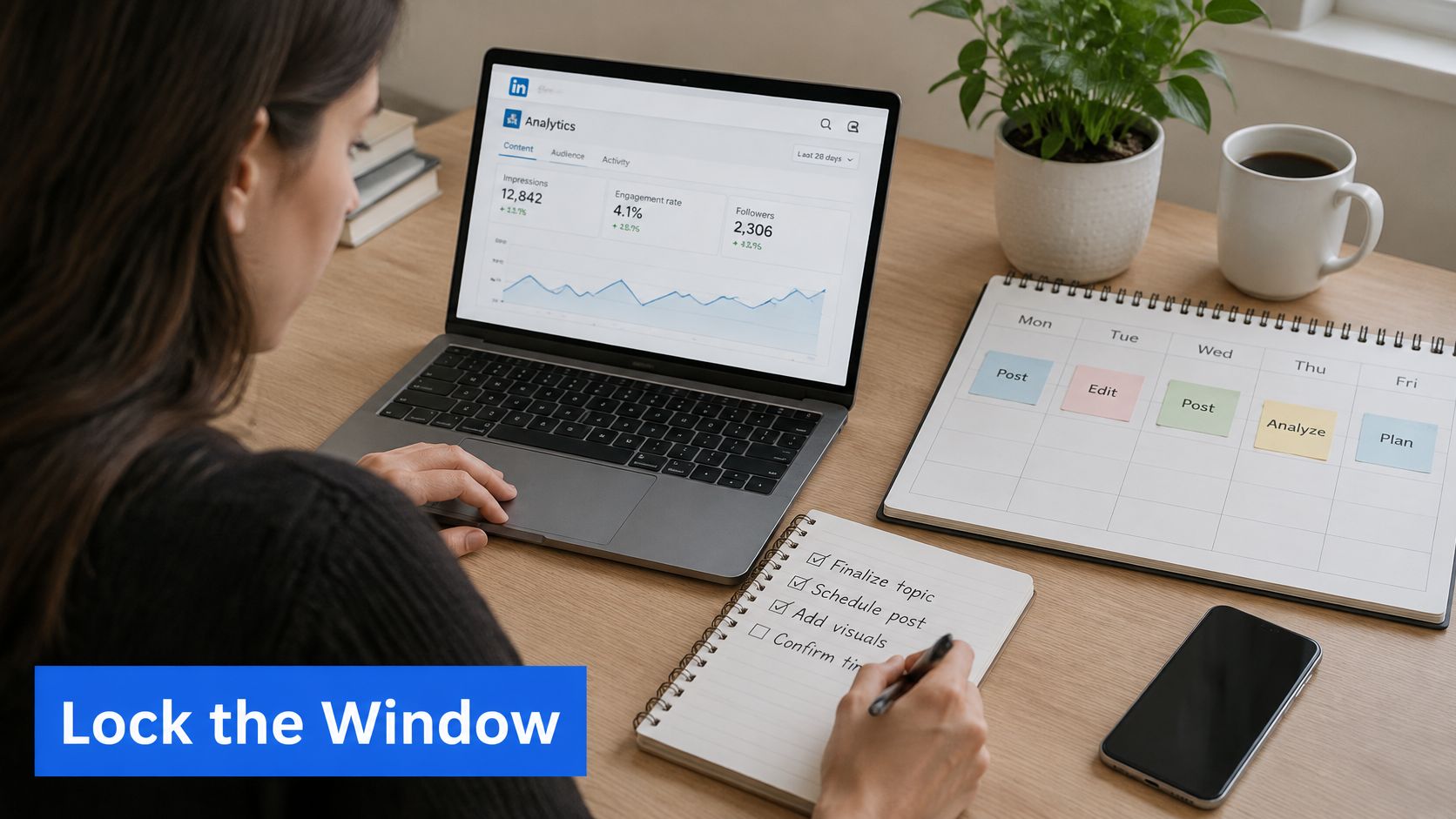
Follow five steps before the recurring calendar takes over. Confirm the dominant audience time zone, set the baseline band, schedule matched posts in each candidate slot, review four weeks against the morning control, and lock the winner into the weekly rhythm. Our LinkedIn post scheduler places that work in one calendar across eight networks, with per-channel slots, drag-and-drop moves when a test slot changes, and automated publishing at the chosen local time.
Watch how a test calendar turns into a repeatable weekly schedule:
For planning, the Pro plan costs $39 per month, billed yearly, is labelled as the most popular plan, and is for creators posting every day. The Studio plan costs $79 per month, billed yearly, and is for teams and agencies. Every plan starts with a 7-day trial for $0, with no charge until the trial ends and cancellation available before then.
The best time is the one your own data confirms. If your candidates tie, keep the baseline until next quarter and spend the effort on stronger topics and faster replies.
Put your Tuesday to Thursday baseline into one calendar, run the four-week slot test in your audience's local time, and let median engagement rate pick the recurring window. Visit Social Media Scheduler to schedule LinkedIn alongside your other channels, compare each post's performance, and lock in the slot your followers reward.