Whats the Best Time to Post on Instagram: 2026 Guide
Oct 8, 2026 · 12 min read
Buffer's analysis of nearly 10 million Instagram posts identified Thursday at 9:00 a.m. as its strongest single slot, while also finding 6:00 p.m. to be a recurring engagement spike on most weekdays (Buffer). Sprout Social, by contrast, places Instagram's broadest high-engagement windows on Tuesday afternoon and Wednesday from noon into the evening (Sprout Social). The disagreement isn't a flaw to eliminate. It's the most useful evidence that there is no universal best time to post on Instagram.
The practical answer to “whats the best time to post on instagram” is therefore conditional. Use benchmark windows as hypotheses, translate them into your audience's local time, then run controlled tests against your own reach, saves, shares, comments, and engagement rate.
The Myth of a Universal Best Time
Search for the perfect Instagram publishing hour and you'll find confident recommendations that point in different directions. One benchmark highlights Thursday at 9:00 a.m., another sees recurring strength around 6:00 p.m., and Sprout Social identifies broad midweek afternoon and evening periods. These results can't all be a single universal rule, because they measure different populations, formats, industries, locations, and definitions of success.
That variation is the central finding. A benchmark average describes the behavior of its sample, not the schedule of your followers. Treating one published time as a command encourages a false sense of precision, especially when the underlying studies normalize time zones and group audiences differently.
Why the averages diverge
A feed post, Reel, and Story can accumulate attention differently. An educational carousel may depend on saves and shares over time, while a Reel may be judged more heavily by reach or watch time. A study that combines formats can produce a different “best” hour from one that isolates a specific content type.
Audience composition creates another distortion. An account serving students, commuters, retail shoppers, or international professionals won't share one activity curve. Even within one niche, follower routines can vary by location and working pattern.
Strategic interpretation: conflicting benchmarks aren't noise. They're evidence that posting time should be treated as an account-specific testing variable.
Time-zone handling matters just as much. A single global benchmark can mislead international accounts because studies commonly report times in each audience's local time, meaning one post may need multiple localized schedules rather than one headquarters time (Buffer's social media benchmarks). Publishing once from a central office may reach one market at an active hour and another while its followers are asleep.
Timing also competes with the quality of the opening seconds or first line. A carefully selected hour can't rescue content that fails to earn attention, so timing research belongs alongside creative testing. For ideas that improve initial attention, review hooks that stop the scroll, then test the hook and publication window as separate variables.
Benchmark Studies and Their Conflicting Insights
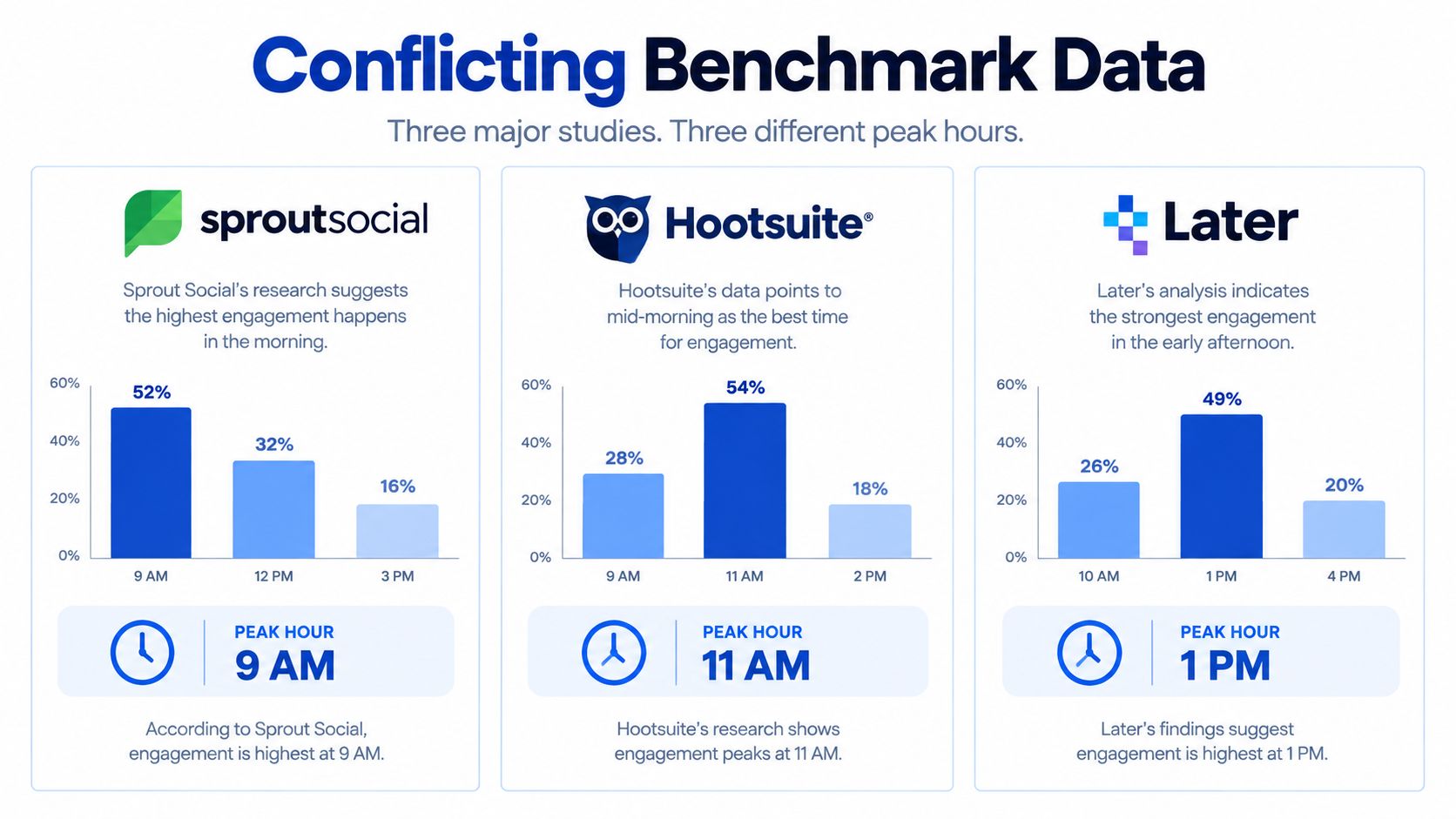
Two widely cited datasets produce different answers. Buffer analyzed nearly 10 million posts and found 6:00 p.m. as a recurring weekday engagement spike, while Thursday at 9:00 a.m. ranked as the strongest single slot in that analysis (Buffer's Instagram timing analysis).
Sprout Social identified a different pattern, with high-engagement periods on Tuesday from 1:00 p.m. to 7:00 p.m. and Wednesday from 12:00 p.m. to 9:00 p.m. Thursday also performed well from 12:00 p.m. to 2:00 p.m. (Sprout Social's Instagram timing analysis). Those midweek windows suggest a test range, not a fixed appointment, which makes methodology more useful than copying an hour.
Read the methodology before copying the hour
Reports may normalize results to local audience time, include different account mixes, or prioritize different outcomes. A peak average engagement rate does not necessarily identify the strongest period for reach, saves, shares, profile actions, or sales intent.
Buffer's dataset identified both a recurring evening spike and a single strongest morning slot, giving two test hypotheses rather than one rule. Sprout Social's wider midweek concentration supplies another set of hypotheses. The disagreement reflects differences in samples and measurement, not a problem that needs one definitive answer.
| Benchmark signal | What it suggests testing |
|---|---|
| Buffer's recurring evening spike | Weekday early-evening publication |
| Buffer's strongest single slot | Thursday morning |
| Sprout Social's midweek concentration | Tuesday afternoon and Wednesday from noon through evening |
| Sector-specific variation | A separate schedule for the audience's professional routine |
The table is a set of competing test cells, not a schedule to follow in full. Keep local time consistent within each market and compare equivalent content, so one unusually strong post does not determine the conclusion.
The contradiction is the conclusion
A benchmark study can show what performed most often in its sample. It cannot establish what will perform best for a specific account. Treating an aggregate pattern as a causal law confuses a starting hypothesis with evidence.
Use the overlap between reports as the first experiment range, then try to disprove it with account-level results. Midweek and early-evening windows may be sensible starting points, while Thursday morning offers a competing hypothesis. The objective is not to choose the most persuasive benchmark. It is to identify which local-time cells produce stronger results for your audience.
Why Audience Geography Dictates Your Schedule
A posting time has no meaning until you define whose clock it follows. The same slot can reach one region during afternoon browsing and another during sleep, school, or work. For international accounts, using headquarters time can favor one audience segment while limiting exposure among others.
Benchmark windows expressed in local time are more useful than a single centralized schedule. The reported midweek concentration from earlier research becomes a set of starting hypotheses, not a universal answer. Localizing those windows to your primary audience clusters produces a more useful schedule than repeating the same benchmark. Compare the timing against your follower locations, then test whether each region responds differently.
Build the schedule around audience clusters
Begin with the largest meaningful location groups in your Instagram audience data. Size alone should not determine priority. A smaller regional audience may warrant its own publishing slot if it represents an important commercial market.
A global account generally has three scheduling options:
- One localized slot: Publish for the largest audience cluster when resources or content volume are limited.
- Staggered regional slots: Adjust publication times for major markets when the same content can be distributed separately.
- Overlapping window: Select a time that reaches several priority regions, while accepting that it will not be optimal for every follower.
The right choice follows the post's objective. Content intended to generate immediate conversation may perform better when activity is concentrated in one market. Evergreen educational content can support broader regional distribution because saves and shares may continue after publication.
Geography interacts with format and objective
A morning post may match pre-work or pre-school browsing, while an evening post can fit discretionary use. Brandwatch reports recurring spikes in early morning and early evening, and Hootsuite's Instagram timing analysis identifies similar periods, linking them to commuting and discretionary browsing behavior.
Format changes how geography affects timing. A short update may depend heavily on local activity soon after publication, while educational content can gain value through later saves and shares. The same audience cluster may therefore need different schedules for different content types.
Industry can narrow the pattern further. Education organizations have a reported peak on Tuesdays and Wednesdays at 11:00 a.m., differing from broad midweek averages. That finding should not replace one universal time with an industry-wide rule. Geography, sector, format, and objective interact, so conflicting benchmarks are useful precisely because they define testable local-time hypotheses rather than settle the question.
How to Run Controlled Posting Experiments
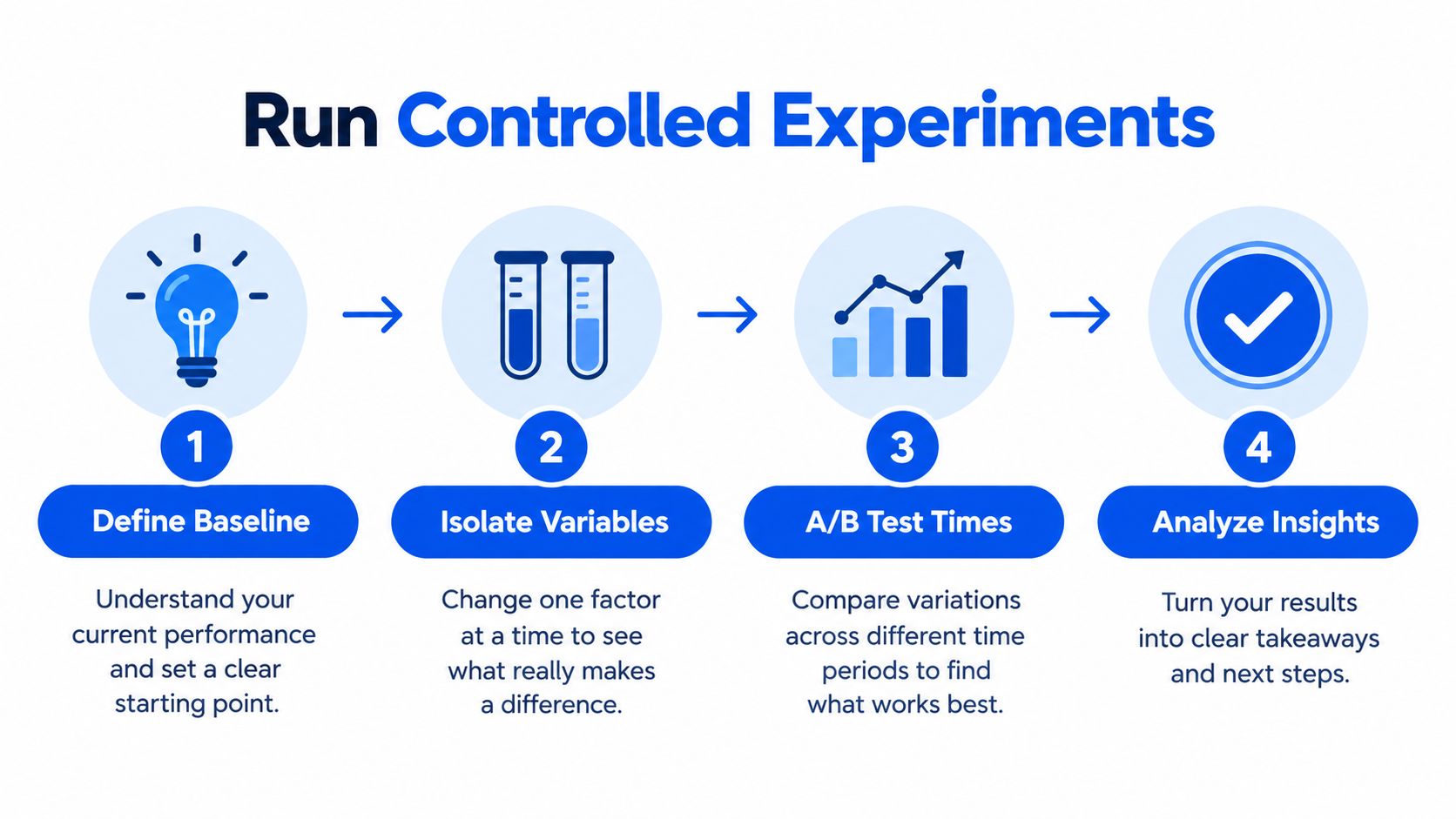
A controlled timing test changes the publication window while holding other meaningful variables steady. A product Reel in the morning and an educational carousel in the evening cannot show whether timing caused the difference. Match the content type, quality, objective, and surrounding campaign conditions before comparing results.
Define the test cells
Use benchmark findings as hypotheses in the audience's local time. Conflicting studies are useful here: they suggest candidate windows, while their disagreement signals that your account needs local testing. A practical design can compare:
- Morning: Test an early window around 7:00 a.m. to 9:00 a.m..
- Midday: Test a midweek afternoon slot, such as Tuesday at 1:00 p.m..
- Evening: Test an early-evening window around 6:00 p.m. to 8:00 p.m..
Evening spikes reported across several analyses may reflect discretionary browsing, but the strongest hour can vary by industry, audience, and content purpose. Treat these cells as starting points, not conclusions.
Isolate what timing can and can't explain
Keep the content class, posting frequency, campaign objective, and creative standard consistent. A launch announcement should not be compared with a routine tip and then attributed to the hour of publication.
Select metrics based on the post's job:
- Evergreen education: Prioritize saves and shares, then review reach and engagement rate.
- Reels: Track reach and watch time alongside engagement rate.
- Conversation-led posts: Examine comments, shares, and profile actions.
- Awareness content: Focus on reach, impressions, and the quality of resulting actions.
Record performance by audience region where possible. A global average can hide strong results in one market and weak results in another, making a single account-wide schedule misleading.
Use a rolling control
Retain some posts in the weaker window instead of removing it immediately. That control helps separate a timing effect from seasonal changes, shifting follower behavior, or differences in creative performance.
One viral post should not determine the calendar. Look for repeated differences across comparable posts, then adjust the schedule gradually. Log local time, format, objective, audience region, reach, saves, shares, comments, and engagement rate.
For a visual demonstration of the controlled experimentation workflow, watch this short guide:
The aim is to estimate which window gives each content class the strongest chance of reaching an active, relevant audience, not to identify one universal answer to the question of when to post on Instagram.
Leveraging Scheduling Tools for Precision
Manual scheduling becomes fragile when one account needs localized time slots, matched experiments, and separate formats. A spreadsheet can record hypotheses, but it won't publish reliably across regions or keep performance data connected to each scheduled post.
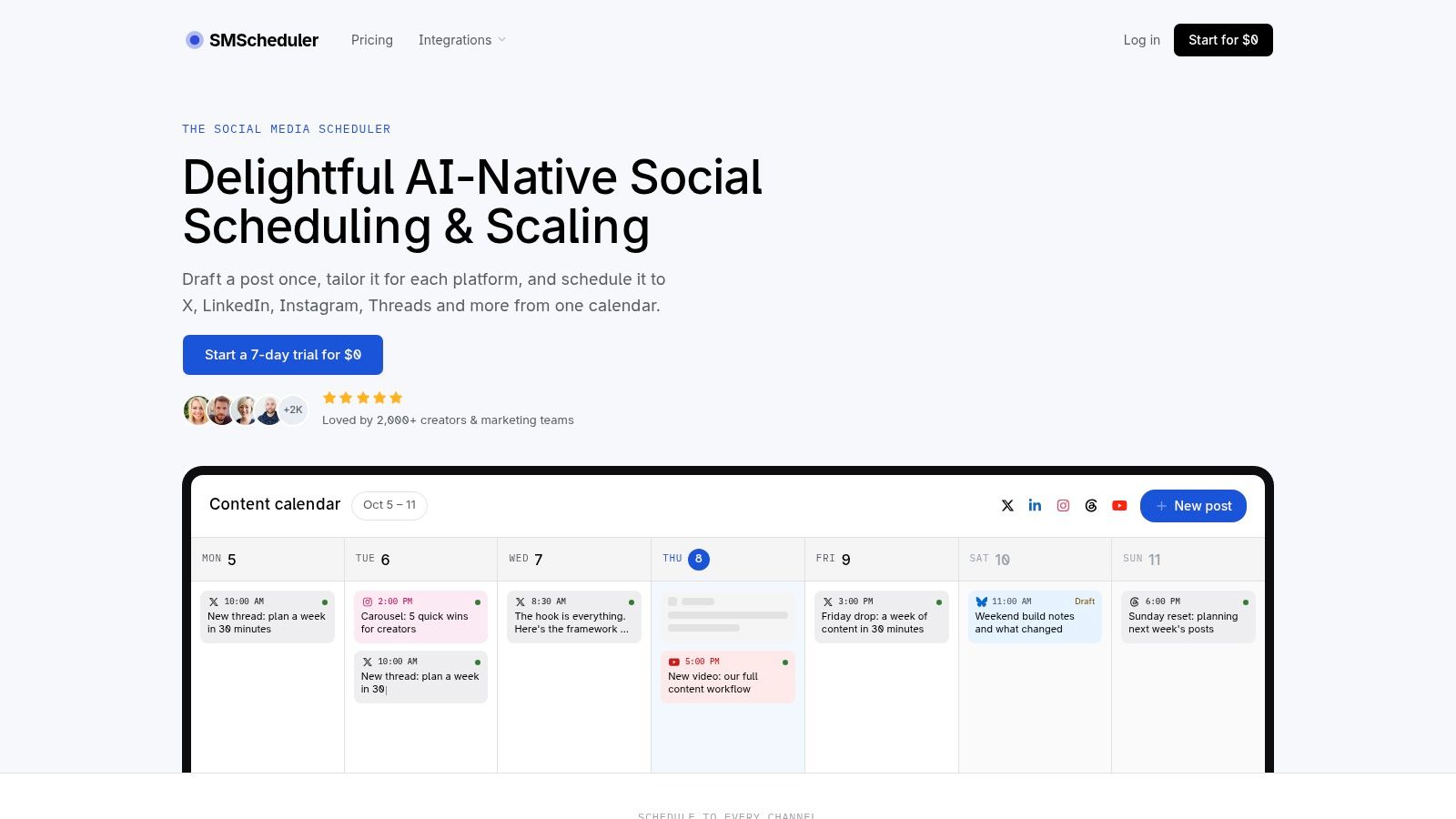
A scheduling platform adds operational control. A visual calendar lets a team place posts into time cells, review the cadence, and adjust publication windows without rebuilding the plan. Automated publishing reduces the risk of missing an early-morning or evening test just because no one is available to press publish.
Manual control versus assisted recommendations
Manual workflows provide flexibility and transparency, but they require more coordination. AI-assisted tools can analyze historical reach and engagement, suggest scheduling windows, and help compare formats, provided the team treats recommendations as hypotheses rather than unquestionable answers.
Social Media Scheduler combines a visual content calendar with drafting, per-channel tailoring, automated publishing, and analytics for reach, engagement, and engagement rate. Its Instagram workflow is available through the Instagram scheduler, which can help teams execute localized tests while keeping publication and measurement in one workspace.
API access can also affect tool selection and operating costs. For a practical explanation of how Instagram API pricing works, consult Instagram API costs explained.
The tool should handle the repetitive mechanics, not replace interpretation. You still need to decide whether a higher engagement rate matters more than reach, whether a region deserves a separate slot, and whether the result holds across comparable content.
Building a Sustainable Posting Strategy
The best schedule is a learning system, not a permanent answer. Audience routines change, formats evolve, and a slot that performs well for one objective may be weaker for another. Consistency gives your tests enough structure to produce interpretable evidence, while periodic adaptation keeps the schedule aligned with current behavior.
A sustainable workflow has three layers:
- Baseline: Keep a dependable publishing rhythm using the strongest tested windows for each audience cluster.
- Experiment: Reserve selected posts for alternative morning, midday, or evening cells.
- Review: Compare performance by objective, format, region, and local time before changing the baseline.
Don't increase volume just to create more activity. A smaller number of well-matched posts can produce cleaner learning than a crowded calendar where every day, format, and objective changes at once.
Review the schedule as a strategist
At each review, ask whether the evidence supports a timing change:
- Are comparable posts repeatedly stronger in another local-time cell?
- Does the pattern hold for the metric that matters, such as saves for education or reach for Reels?
- Is the result visible across the priority audience region, or only in a smaller segment?
- Did a seasonal event, campaign, or unusual post distort the comparison?
- Can the team maintain the new slot without reducing creative quality?
A schedule should move when repeated evidence supports the move, not when one post produces an unusual spike. Keep weaker windows in rotation at a controlled level so your system can detect behavioral change instead of locking itself into yesterday's pattern.
For a repeatable planning routine, use a structured process to plan a month of content, then assign each post a format, objective, region, and test slot before publishing. That turns “whats the best time to post on instagram” from a search query into a measurable operating question.
Social Media Scheduler gives creators and teams one calendar for drafting, tailoring, publishing, and measuring social content across channels. Use it to schedule Instagram posts in localized test windows, compare reach and engagement, and refine your publishing rhythm from account-level evidence. Visit Social Media Scheduler to start building a data-first schedule.