AI Social Media Marketing: A Practical Guide for 2026
Sep 29, 2026 · 16 min read
AI social media marketing has already moved past the pilot phase. A 2026 Sociality.io report found that 89.7% of social media marketers use AI daily or several times a week, while 78.4% still apply moderate or extensive editing before publishing (Sociality.io's 2026 AI report). That combination tells the whole story. Marketers aren't choosing between AI and human work. They're building workflows in which AI produces speed, while people protect judgment, distinctiveness, and trust.
The practical question for 2026 isn't what AI can generate. It's whether your team has designed the review-and-tailor loop that turns a plausible draft into a piece of channel-native content. AI can help with research, ideation, copy, visuals, scheduling, audience analysis, and reporting, but its value depends on the quality of the inputs and the decisions made before publication.
Why AI Now Defines Social Media Marketing in 2026
94% of social media marketers use AI in their workflows in some capacity, according to HubSpot's social media marketing report. HubSpot's report puts ideation and brainstorming at 42.9%, captions or short-form text at 41.5%, image generation at 38.35%, and image editing at 34.78%. These figures place AI across the content lifecycle, from the first concept to the final visual adjustment, rather than in one isolated experiment.
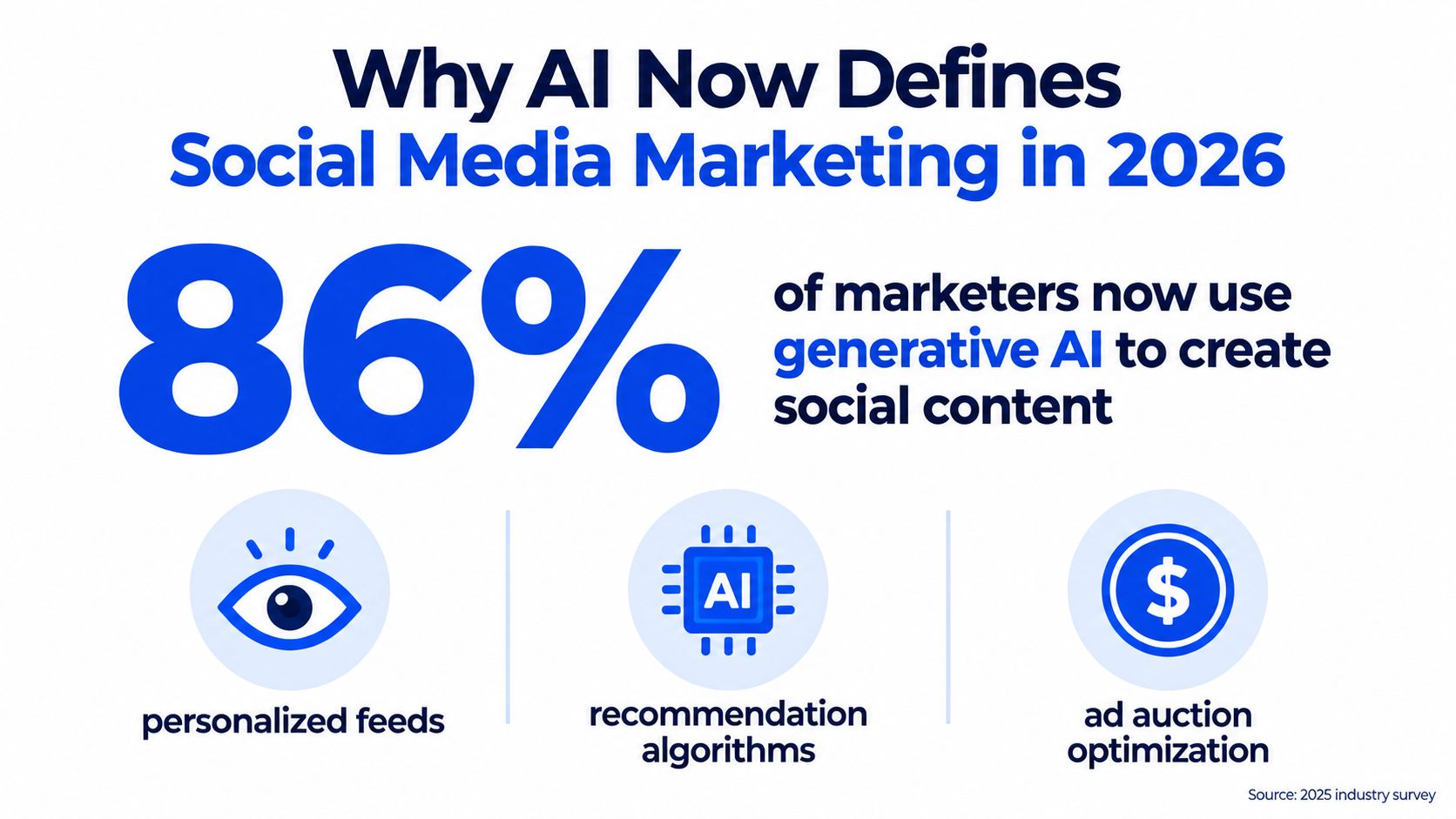
The shift has two causes. Marketing teams can produce workable drafts quickly, while social platforms use machine learning to determine which posts receive attention. Feeds personalize recommendations, ranking systems estimate likely interest, and advertising systems adjust delivery based on competing bids and predicted outcomes. A brand that creates every variation manually has less capacity to respond to these conditions.
Speed alone does not create a strategy. It changes the operating requirements around one.
Adoption creates a new bottleneck
A 2026 Sociality.io report found that 59.5% of marketers use AI for analytics and reporting, 59.5% use it for content ideation and trend research, 69.2% use chatbots or conversational AI tools, and 59% use visual AI tools. This range matters because each capability creates a handoff. Research becomes a brief, the brief becomes a draft, the draft becomes channel variants, and the published post becomes performance evidence.
Heavy adoption therefore creates a review problem. Without a defined editing and tailoring stage, teams can publish generic language faster. With one, AI handles repetitive production while editors add specific observations, brand knowledge, factual checks, and platform context. The review loop is the mechanism that converts volume into useful content instead of sameness.
For teams formalizing this system, guidance on implementing AI marketing with tools can clarify how separate capabilities fit into an operating process. The practical distinction is between adding software and redesigning the sequence of work around human judgment.
How AI Fits Into a Modern Social Media Workflow
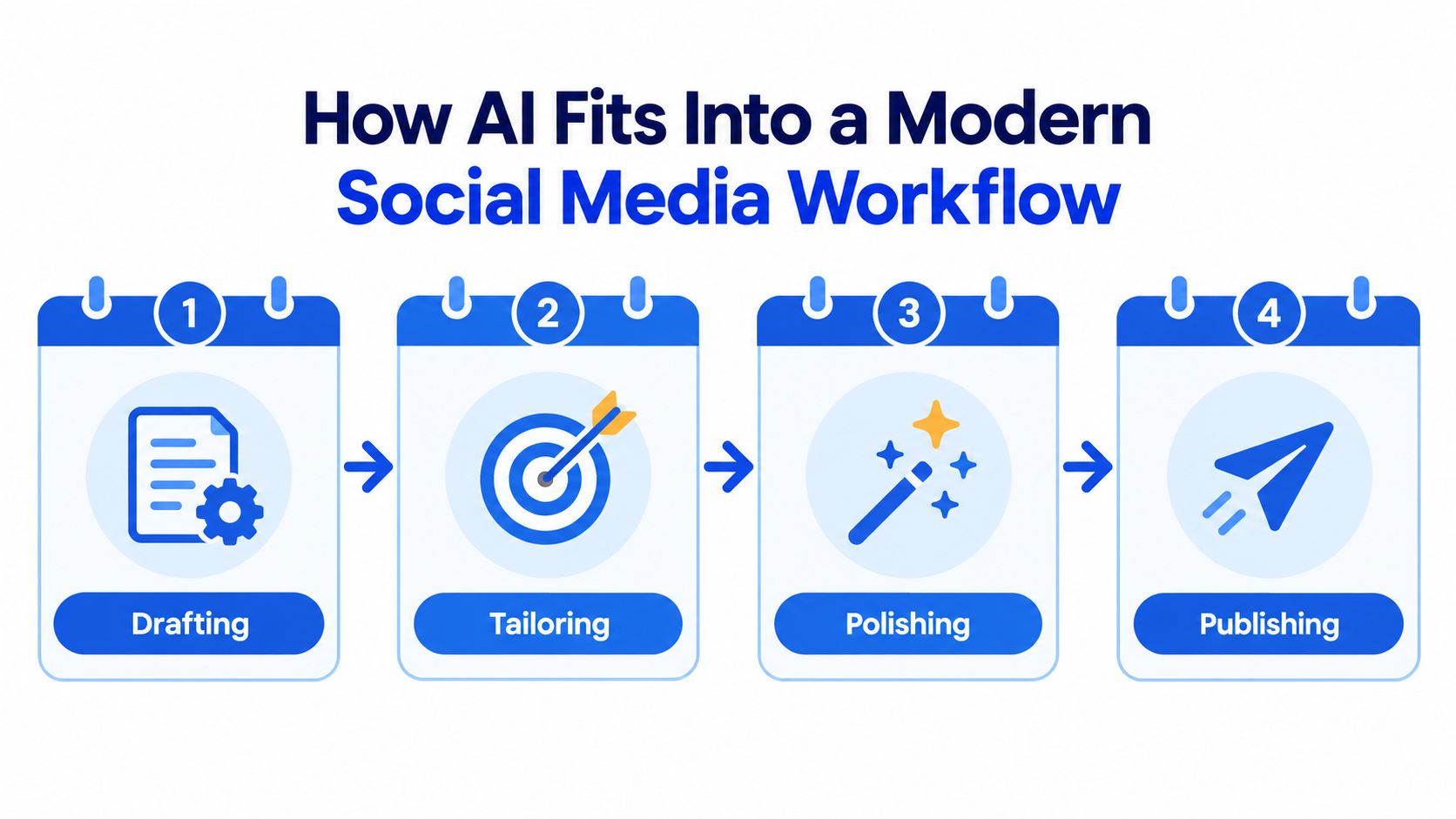
Treat the social calendar like a production line, but not a conveyor belt that removes people. It's a shared operating board where one idea passes through four connected jobs: drafting, tailoring, polishing, and publishing. Analytics then sends evidence back to the next idea.
One idea, four jobs
Start with a weekly theme, such as a recurring customer problem. AI can turn the source material into a set of hooks, angles, captions, or scripts. It performs best when the brief includes audience context, the intended action, examples of approved brand language, and phrases the brand avoids.
The second job is tailoring. A useful system doesn't paste the same caption everywhere. It changes the artifact to match the platform. A LinkedIn post may need a developed argument, an X post may need compression and a sharper point, Instagram may require a visual sequence and caption, while TikTok may need a spoken hook and shot list.
Polishing is the human checkpoint. An editor verifies factual accuracy, removes predictable language, adds a real observation, and checks whether the post sounds like the brand's actual people. Here, the draft gains lived experience rather than merely matching a tone descriptor.
Publishing is the operational handoff. A scheduler places approved variants into channel-specific time slots, records status, and reduces the chance that a finished post remains trapped in a document. Teams that want to tighten this stage can use a practical system for cutting posting time without treating speed as the only success measure.
The loop needs a commercial objective
Analytics closes the circuit. Reach and engagement can show which posts attracted attention, but the editor still has to decide why. A high-performing post may have succeeded because of its topic, format, timing, audience fit, or a combination of those factors.
A conversion-oriented workflow should connect the calendar to a clear business action, not just output volume. Guidance on conversion-focused AI marketing is useful here because it keeps content production tied to intent, audience movement, and measurable outcomes.
The Four Core Capabilities Every Team Should Understand
Buying an AI social media tool without separating its capabilities creates false expectations. “AI-powered” may describe a caption generator, an audience model, a publishing optimizer, or a reporting assistant. Those systems need different inputs and require different forms of human control.
| Capability | What the AI Does | Human Judgment Still Owns |
|---|---|---|
| Content generation | Produces ideas, drafts, variants, scripts, and visual concepts from prompts and reference material | Brand point of view, factual validation, originality, and final approval |
| Targeting | Groups audiences by behavioral or contextual signals and supports segmentation or lookalike modeling | Which audience matters commercially, what exclusions apply, and whether the segment fits the strategy |
| Scheduling optimization | Estimates useful publishing windows from historical activity and post performance | Whether timing supports the campaign, news cycle, audience behavior, and operational availability |
| Analytics-driven recommendations | Detects anomalies, summarizes patterns, and suggests potential next-post directions | Whether a pattern is meaningful, what caused it, and which experiment should follow |
Content generation depends on context
At the model layer, generation predicts a plausible continuation from the instructions and examples provided. It doesn't possess your brand's unwritten standards unless you make them explicit. A useful input set includes a voice guide, approved posts, audience description, campaign objective, platform, format, and prohibited claims.
Human review then tests whether the output says something distinctive. A fluent caption can still be strategically empty. Editors should ask whether the post contains an actual observation, a defensible claim, or a specific benefit that a competitor couldn't publish unchanged.
Targeting is not just better creative
Targeting systems analyze audience attributes and behavior to identify groups that resemble a selected audience or share relevant signals. That can make media delivery more precise, but it doesn't decide whether the audience is commercially valuable or ethically appropriate.
The marketer still defines the audience problem. If the brief is vague, the model can optimize toward activity rather than relevance. Human owners should approve segmentation logic, exclusions, messaging boundaries, and the evidence required before expanding reach.
Timing and analytics are recommendations
Scheduling optimization usually means estimating when a particular audience is more likely to be active or responsive. It isn't a guarantee that a post will perform. A timely idea can matter more than a historically favorable slot, and a sensitive announcement may need immediate publication.
Analytics assistants are most useful for finding anomalies and reducing the time needed to inspect many posts. They can flag an unusual result or suggest a next test, but interpretation remains a strategy task. A strong team treats recommendations as hypotheses, not instructions.
Practical rule: Let AI narrow the decision set. Keep the decision itself with a person who understands the campaign.
A Cross-Channel Workflow From Idea to Insights
A small team can run a cross-channel workflow without turning one idea into four copies. The artifact changes at each stage, and the human checkpoint decides whether the transformation preserves the original strategic point.
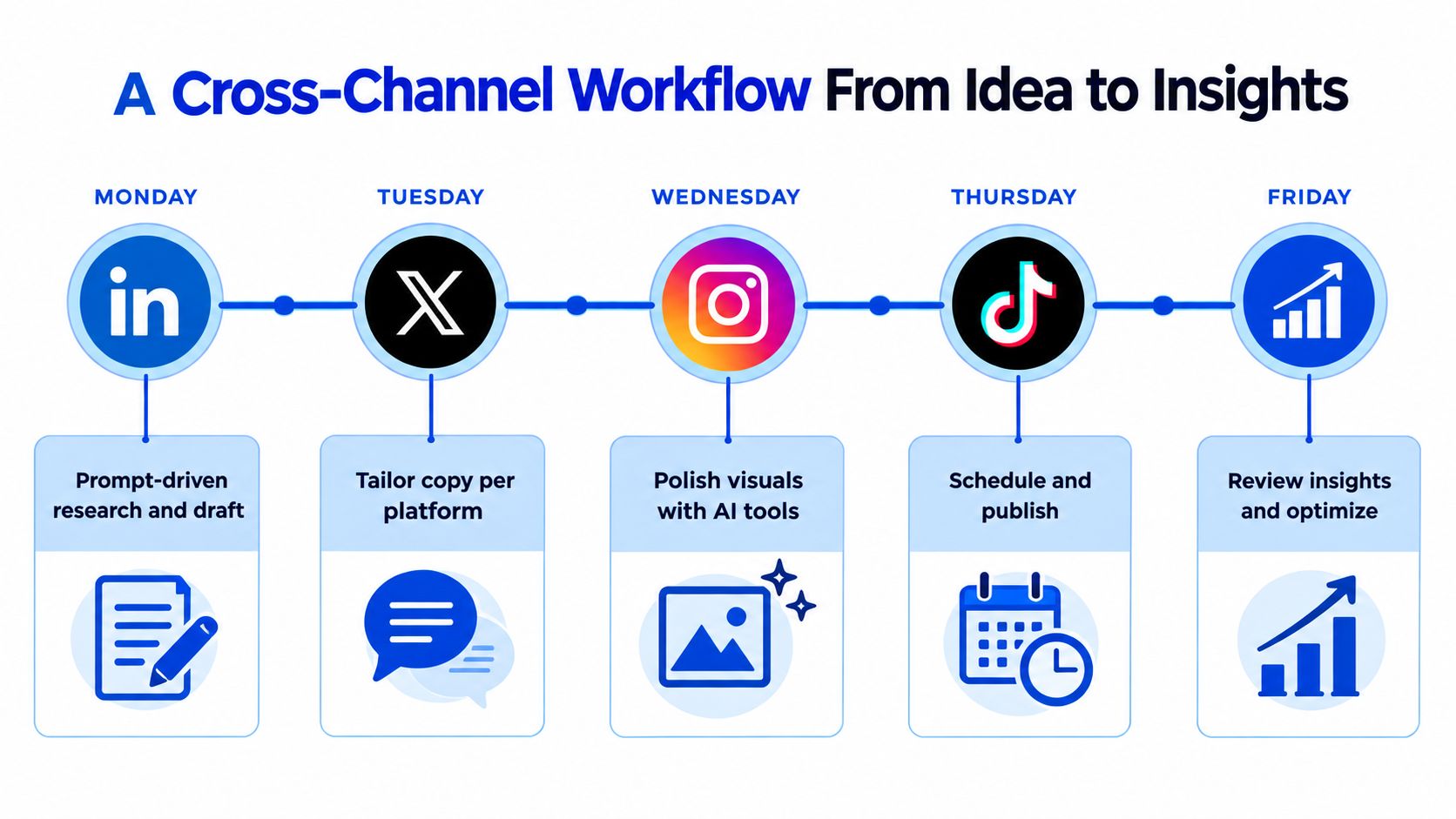
Monday, research and draft
Begin with a customer question, product insight, or observed friction. Feed AI the source notes and ask for competing angles, objections, and possible formats. The human checkpoint selects the idea that has the strongest relationship to the audience and the week's business objective.
The output is a campaign brief, not a finished post. It should state the audience, point of view, desired response, supporting evidence, and the detail that makes the idea specific.
Tuesday, tailor the message
Turn the brief into native drafts:
- LinkedIn: Build an argument around a professional observation, with enough context to make the author's perspective credible.
- X: Reduce the idea to a sharp claim, then expand it into a thread only if the sequence adds reasoning.
- Instagram: Convert the argument into a carousel structure, caption, or visual prompt that works with the image rather than repeating it.
- TikTok: Translate the point into a spoken hook, scene sequence, or demonstration that depends on performance and pacing.
AI handles the transformations. The editor checks whether each version belongs on its platform. A monthly planning framework such as planning a month of content can provide the larger structure, while this weekly process handles adaptation and learning.
Wednesday, polish the assets
Visual AI can propose layouts, image directions, edits, or video treatments. It shouldn't decide what the brand is willing to imply. The human checkpoint checks representation, claims, accessibility, rights, and whether the visual carries the intended emotion.
The artifact at the end of Wednesday is an approved package, including copy, media, alt text where relevant, links, and platform-specific instructions.
Thursday, schedule and publish
Queue the approved versions in their appropriate channels and time slots. The scheduling step should preserve the differences created during tailoring, not collapse them into one universal post. Someone should also verify mentions, links, captions, and media before the posts go live.
Friday, review performance
Inspect post-level results alongside the original objective. Look for meaningful differences between formats, audience responses, and creative angles. The output is a short learning note that changes the next brief, such as a stronger objection to address, a format to test, or a phrase to retire.
The Quality and Authenticity Trade-Offs Nobody Talks About
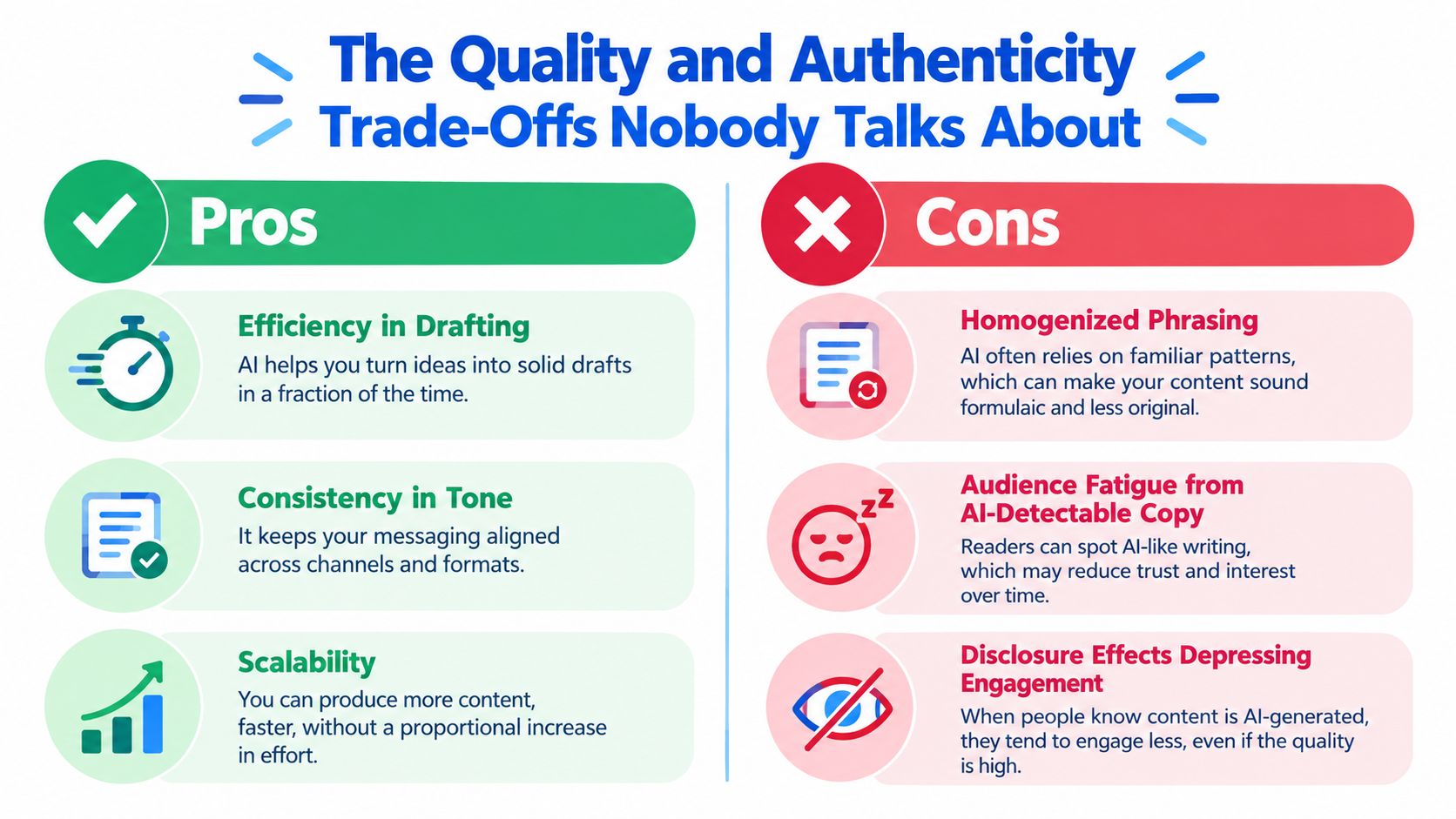
High AI adoption does not guarantee high-quality social content. The 2025 global study from Social Angels found that 96% of social media professionals use AI tools, 72.5% use them daily, and 68% use AI to adapt content for different channels and tones. Yet only 60% said AI content quality matches or beats human posts (Social Angels' 2025 industry report). The gap points to a workflow problem: AI removes production friction, while human review still determines whether the result has judgment, specificity, and platform fit.
The same study found that 62% said they wouldn't increase AI budgets the following year, while 52% rely only on free tools. Free-tool dependence creates a governance problem. Teams can build important processes around products whose limits, terms, or output behavior may change, without recording how those changes affect brand work. Heavy use therefore often coexists with heavy editing. The review loop is not evidence that AI failed. It is the mechanism that turns a fast draft into usable communication.
Why sameness appears
AI learns recurring language patterns and tends to produce familiar structures when prompts remain broad. If competing brands request an “engaging caption” in a “professional but friendly tone,” they may receive wording that differs grammatically but says little that is strategically distinct.
A stronger process starts with a voice bank containing customer language, clear opinions, approved examples, real stories, banned phrases, and details only the brand can credibly use. Each draft should then receive a human rewrite that adds a concrete observation, customer tension, or lived experience before approval. That edit is where generic output becomes owned brand material.
Disclosure changes the audience context
Visible AI labeling can affect how audiences receive content. An experimental study found that delaying disclosure until after people experienced emotionally charged content reduced the negative effect by about 13 percentage points, while fully AI-generated content remained penalized regardless of disclosure timing (the Copenhagen Business School study on AI labels and engagement). The finding does not support hiding meaningful AI involvement. It shows that disclosure, timing, emotional context, and the degree of generation can interact.
Teams need a short usage policy covering disclosure, sensitive topics, factual review, privacy, escalation, and final approval. Write it before the workflow scales, so editors know which decisions require judgment rather than another prompt.
Does AI Content Outperform Human Content
The evidence supports a narrower conclusion than many tool pages imply. AI helps teams produce and adapt content faster, while marketers increasingly associate AI-assisted content with stronger results. Earlier reporting found that 72% of marketers said their social content created with AI performs better than content created without AI. That is a meaningful adoption signal, not proof that the model caused the improvement.
Teams that adopt AI may already have clearer testing habits, more content resources, or stronger production processes. Faster output can improve consistency without improving originality. A fair comparison therefore separates throughput, reach, engagement quality, and editorial effort.
| Metric | AI-Assisted Content | Human-Only Content | Notes |
|---|---|---|---|
| Production speed | Usually stronger for first drafts, variants, and repurposing | Limited by available writing and production time | Speed matters only if review remains rigorous |
| Cross-channel consistency | Strong when the same brief and voice references guide each version | Depends on coordination and documentation | Consistency can become sameness |
| Platform adaptation | Useful for producing multiple starting points | Often stronger when a specialist has deep platform knowledge | AI needs channel-specific constraints |
| Originality | Uneven without distinctive source material and rewriting | Often stronger when creators use lived experience | Human specificity is difficult to automate |
| Emotional resonance | Can identify emotional angles and draft language | More reliable when context, vulnerability, or humor matters | A human should control the final expression |
| Measurement | Can summarize patterns and surface anomalies | Better positioned to connect results to strategy | Neither system proves causation from one post |
What the evidence supports
The Sociality.io report cited earlier found that 71.1% of respondents saw time savings as the biggest improvement from AI. Throughput is therefore the clearest defensible advantage. AI gives teams more drafts to compare and a repeatable route from idea to calendar, but those gains matter only when editors use the extra capacity to improve the work.
Performance depends on where AI enters the workflow. Research on generative AI and social strategy quality found that it can improve brand fit, problem framing, and strategic flexibility (the study on generative AI and social strategy quality). The finding points to a less obvious conclusion: planning support may matter more than automatic copy production.
AI-assisted content is most likely to outperform human-only production when people use it upstream for exploration, then add evidence, platform judgment, and brand-specific detail before publication. Heavy AI use can therefore coexist with heavy human editing. That is not workflow failure. It is the review-and-tailor loop that prevents efficient production from becoming efficient sameness.
Practical Implementation Tips for Creators and Teams
You don't need a large operations department to build a disciplined workflow. A solo creator can document the same controls a small team uses, then assign each control to a person or a recurring calendar task.
Drafting
Create one reusable prompt brief with five inputs:
- Audience: Describe the problem, sophistication, context, and desired next action.
- Voice: Provide approved examples, sentence preferences, emotional range, and words the brand avoids.
- Evidence: Supply verified facts, customer language, product details, and links that the draft may use.
- Format: State the platform, length, asset type, and whether the post should educate, provoke discussion, or drive action.
- Variation: Ask for distinct angles, not cosmetic rewrites. One version might challenge an assumption, another might explain a process, and another might answer an objection.
The editor should reject any sentence that sounds plausible but lacks evidence or a clear reason to exist.
Tailoring
Start from one strategic idea, then create native versions. Don't ask AI to “post this everywhere.” Ask what the audience expects on each channel and what the format can carry.
For Instagram, the visual may do most of the explanatory work. For LinkedIn, the author's experience may carry the argument. For TikTok, the hook and performance need to work before the viewer understands the full context. For X, compression and sequencing matter. The human checkpoint confirms that the adaptation changed the expression without changing the promise.
Scheduling
Use a calendar that shows all channels together, but preserve separate slots and approval states. AI can recommend windows from historical performance, yet the team should test those recommendations against campaign timing, audience behavior, and real-world events before making them permanent.
Keep a record of the hypothesis behind each timing test. Otherwise, the calendar becomes a list of timestamps rather than a learning system.
Analytics
Separate automatic observation from human interpretation. AI can sort top posts, identify unusual changes, summarize engagement patterns, and suggest candidate formats. People should review comment sentiment, the quality of followers attracted, saves or other high-intent actions, and whether the response supports the business objective.
Use the result to update the next prompt. A weak post shouldn't only produce a lower score. It should produce a better question about the audience, angle, format, or distribution.
Governance and ownership
Assign three owners, even if one person holds all three roles:
- Prompt owner: Maintains the brief, examples, constraints, and approved inputs.
- Review owner: Checks voice, accuracy, originality, accessibility, and platform fit.
- Escalation owner: Decides what requires legal, compliance, client, or executive review.
A documented weekly content system helps turn those responsibilities into recurring work instead of informal expectations. Social Media Scheduler can serve as one workflow option for drafting, tailoring, scheduling, publishing, and reviewing reach and engagement from a unified calendar.
The Operating Principle Behind Sustainable AI Workflows
Sustainable AI social media marketing depends on controlled human judgment, not maximum automation. AI can accelerate production, but its value depends on whether the workflow preserves brand distinction, platform fit, and useful feedback.
Volume is a weak success measure. More posts may fill the calendar while making the brand easier to overlook. Publishing similar AI-generated language across channels creates consistency at the cost of recognition, especially when teams skip audience-specific tailoring.
The division of labor is clearer in practice. Marketers apply AI to ideation, analytics, visual work, conversation tools, and adaptation, while substantial human editing remains normal, as shown by Sociality.io's 2026 findings. Editing is not failed automation. It is the control that turns fast output into relevant communication.
The strongest workflow isn't the one with the fewest human touches. It's the one where every human touch changes the quality of the decision.
Test one workflow stage before adding another tool. Log the input, generated output, editorial changes, and performance signal. The purpose is not to prove that AI works. It is to identify where human judgment changes outcomes enough to justify its cost.
A shared system can support that discipline. Social Media Scheduler provides one place to draft ideas, tailor posts for different networks, schedule from a shared calendar, and review reach and engagement. Start with a recurring workflow, define the approval point, and let the resulting evidence determine what AI should handle next.