10 AI Social Media Tools for Smarter Content Workflows
Oct 2, 2026 · 20 min read
Most buying advice for AI social media tools starts with a misleading question: “Which platform is best?” There isn't one universal winner, because social teams rarely have one universal problem. A creator may need faster drafting, an agency may need approvals and client workspaces, a visual brand may need asset planning, and an established organization may care more about listening, governance, and reporting than caption generation.
The better approach is to match the tool to the bottleneck. This comparison maps ten platforms to distinct workflows, including creation, visual planning, analytics, agency operations, evergreen publishing, and recommendation-led optimization. Each entry considers practical use case, automation depth, network coverage, reporting, pricing structure, and the amount of human review still required.
AI adoption makes this distinction more important. A 2026 survey cited by Human Agency's overview of AI social media tools found that 89.7% of social media marketers used AI several times a week and 64.1% used it daily. The question is no longer whether AI belongs in social operations. It's whether the tool improves the part of the workflow that limits your team.
1. Social Media Scheduler
Best for draft-once, platform-specific publishing and recommendation-led optimization
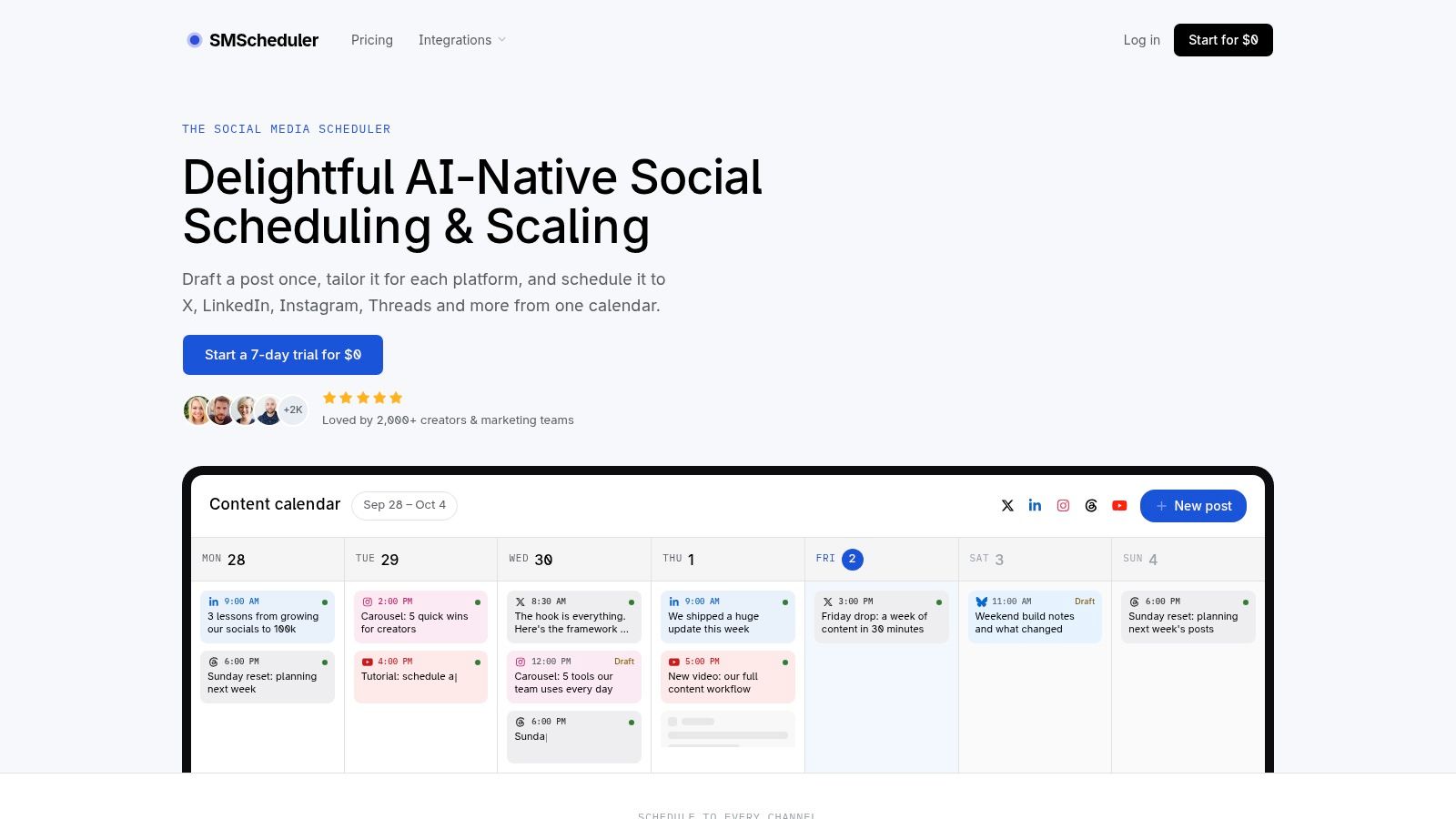
Social Media Scheduler is built around a problem that many tools treat as separate tasks: turning one idea into useful, channel-specific content, scheduling it, and learning from the result. You can draft a post once, then tailor its copy, media, and format for X, LinkedIn, Instagram, Threads, Facebook, TikTok, YouTube, and Bluesky from one visual calendar.
That workflow matters because cross-platform publishing isn't the same as copying and pasting. A LinkedIn post may need a more explanatory structure, while an Instagram version may depend more heavily on visual context and a shorter caption. The platform's AI-assisted rewriting is designed to preserve the original intent while adapting the execution to each network.
Where the workflow compounds
The calendar combines drag-and-drop planning, week views, per-channel time slots, and automated publishing. That reduces the operational cost of maintaining a publishing rhythm, especially when a team manages established and emerging networks from the same workspace.
Analytics cover reach, engagement, and engagement rate, with sortable views for posts and profiles. In particular, historical performance feeds recommendations about what to publish, when to post, and which format performs best. That connects the drafting layer to the measurement layer instead of leaving analytics as a report someone checks after the campaign has ended.
Practical rule: Treat AI-generated copy as a strong first draft, not as an approval decision.
The main limitation is human review. Brand-sensitive claims, regulated topics, client requirements, and platform-specific nuances still need a person who understands the context. Pricing beyond the 7-day free trial isn't detailed on the product page, so teams should verify plan limits before committing.
This is the strongest fit for creators, social managers, mid-market teams, agencies, and video publishers that want one operating surface rather than a collection of disconnected AI tools. Its data handling policy says it stores what is needed to publish and report and doesn't sell user data, which is relevant for teams assessing workflow risk.
2. Sprout Social
Best for enterprise analytics, listening, and governed collaboration
Sprout Social is better suited to organizations that treat social as a source of customer intelligence, not merely a publishing channel. Its proprietary Trellis AI supports planning, content, engagement, and reporting through chat, studio, and assistant experiences. That breadth makes it a credible option when several teams need to work from shared data and approval processes.
The platform's strongest distinction is the depth around analytics, listening, competitor insight, and collaboration. Listening and premium analytics are available as add-ons, as is influencer discovery and management. This creates a clear trade-off. Sprout can cover a complex social operation, but the total configuration may be more involved than a lightweight scheduler.
The governance trade-off
Trellis uses monthly AI credits, with Trellis Plus available for higher limits. Buyers should therefore evaluate not only whether the AI features exist, but how often different roles will use them. A team that wants occasional ideation may not need the same configuration as an organization using AI for reporting, engagement triage, and planning across multiple brands.
Sprout's collaboration, security, and governance capabilities are valuable when several people create, review, and publish content. They're less compelling if the main problem is one creator rewriting captions for several channels.
The platform's enterprise orientation also affects cost. Per-seat pricing is higher than many SMB-focused tools, and listening or advanced analytics may require paid additions. That isn't a flaw, but it changes the buying question. Sprout is appropriate when the organization needs the operating controls and intelligence that justify a broader social management investment, not just because it has an AI assistant.
3. Hootsuite
Best for broad channel coverage and extensible enterprise operations
Hootsuite remains a practical choice for teams that need a mature social management environment with a large ecosystem around it. Its AI offering supports post ideas, caption writing, and repurposing of proven posts, while the unified calendar handles bulk scheduling and best-time guidance.
The important distinction is extensibility. Hootsuite's App Directory lets organizations add adjacent functionality, although some apps are paid add-ons. That can help a team adapt the platform to an existing stack, but it also means the initial feature list may not represent the final cost or complexity of the workflow.
Where Hootsuite fits
Hootsuite is strongest when channel breadth, enterprise options, and integrations matter more than a narrowly focused AI experience. Certain plans offer unlimited post scheduling, which can suit teams that publish frequently across several accounts. The platform also supports a unified calendar and workflows designed for larger social programs.
Its weakness is proportionality. If a small team only needs a calendar, basic drafting, and straightforward analytics, the broader ecosystem may add overhead rather than remove it. App add-ons can increase total cost, and pricing sits above many SMB-focused tools.
For teams trying to cut preparation time, the practical implementation question is whether AI-generated drafts move cleanly through approvals. Hootsuite can support the larger system, but people still need documented brand rules and a clear review owner. The platform won't decide which claims require legal scrutiny or which client nuances the AI must avoid.
A useful operating model is to use Hootsuite as the publishing and governance layer, while connecting specialist tools only where the core platform doesn't cover a specific need. Teams evaluating alternatives can also review this guide to cutting posting time, especially if their central problem is repetitive preparation rather than enterprise listening.
4. Buffer
Best for accessible per-channel publishing and lightweight content adaptation
Buffer keeps the workflow comparatively simple. Its AI Assistant supports ideation, rewriting, repurposing, and AI replies, while the publishing system adds drafts, approvals, first-comment scheduling, and a cross-platform calendar.
That combination suits creators, small teams, and agencies that want a low-friction operating system. Buffer's support for Threads and Bluesky is also useful for teams that don't want emerging networks to sit outside the main calendar. Threaded posts are supported on the web, although some mobile thread capabilities are more limited.
The pricing model is a major part of the fit. Per-channel billing can control costs when a team only needs a small set of profiles. It can become less attractive as the number of connected channels expands, so buyers should model the actual account mix rather than judging the entry plan in isolation.
Why simplicity can be strategic
Buffer's AI features aren't positioned as a substitute for enterprise intelligence. They help a person produce and adapt content, then keep the publishing process organized. That narrower scope can be an advantage when the team doesn't need listening, complex governance, or a large analytics operation.
Its analytics are solid for the price, but teams seeking deep competitor analysis or advanced measurement may eventually need another reporting layer. Human review remains important because rewriting for a channel doesn't guarantee that the message is appropriate for the audience, offer, or current context.
Buffer works best when the team has a clear content strategy already and needs execution support. It's less suitable when the organization expects the platform to generate the strategy, produce rich visual assets, and explain performance at enterprise depth.
5. Later
Best for visual planning, Instagram-first campaigns, and asset-heavy calendars
Later is a natural fit for brands that plan content visually before they publish it. Its visual planner uses a drag-and-drop grid for multi-profile scheduling, while AI Ideas and Caption Writer help reduce the blank-page problem. Future Trends insights add a planning layer for teams that want to think beyond the next post.
The platform supports Instagram, Facebook, Threads, TikTok, LinkedIn, Pinterest, YouTube, and other networks. That coverage makes it more than an Instagram tool, but its strongest workflow remains visual campaign planning, particularly for brands whose calendar depends on coordinated images, short-form video, and profile presentation.
AI usage is metered through monthly credits across tiers. That creates a different trade-off from tools that emphasize broad or unlimited generation. A team that uses AI occasionally may find the model manageable, while a high-volume operation should calculate expected usage before selecting a plan.
Planning is not the same as measurement
Later's clean calendar and team approvals are valuable for campaign coordination. Historically narrower analytics than enterprise suites mean that teams with demanding reporting requirements may need a separate measurement solution or a platform with deeper analytics.
The best use case is a content team that needs to see how a grid, campaign sequence, or asset library fits together before publishing. If the core bottleneck is visual organization, Later is more relevant than a tool that prioritizes predictive recommendations but makes asset planning cumbersome.
Teams comparing visual scheduling workflows can also review this Instagram scheduling guide. The key evaluation question is whether the calendar helps people make better publishing decisions, not merely whether it displays posts attractively.
6. Metricool
Best for reporting depth without an enterprise-first operating model
Metricool is aimed at freelancers, agencies, and teams that want strong reporting alongside scheduling. Its cross-network calendar includes best-time suggestions and approvals on higher tiers, while reporting covers organic and paid analytics, competitor tracking, and exports.
That makes Metricool particularly useful when the person publishing is also responsible for explaining performance. The platform's brand-based pricing can scale differently from per-seat systems, and optional add-ons allow teams to pay for specific requirements rather than adopting the entire enterprise stack.
The reporting advantage
Metricool supports Threads and Bluesky and includes an AI social media assistant. Its mobile app offers AI text generation and push-to-publish where platform APIs require that step. Some advanced features are web-only, and X requires a paid add-on per connected account, so channel requirements should be checked before rollout.
The platform is a strong choice for a reporting-led workflow. A freelancer can manage several brands, an agency can export client reports, and a marketing team can compare paid and organic results without moving immediately to a high-cost enterprise suite.
It isn't necessarily the best choice for deep content generation or visual asset production. Metricool's value comes from helping teams understand what happened and organize the next decision. Human interpretation still matters, particularly when a post's reach or engagement changes because of timing, creative differences, audience mix, or paid support.
Choose Metricool when the main unresolved question is what should we learn from our publishing activity? Choose a creation-first platform when the harder problem is producing enough differentiated content to publish.
7. Publer
Best for account-level flexibility, bulk publishing, and emerging networks
Publer combines wide network coverage with a flexible account and user-based pricing structure. Its AI Assist can write and rephrase captions, generate images, and support blog blocks. Bulk upload, recycling, link-in-bio tools, analytics, and thread scheduling extend the workflow beyond simple post creation.
The platform supports threads and previews across X, Threads, Mastodon, and Bluesky. That breadth can be valuable for creators and agencies that need to manage newer networks without maintaining separate tools for each one.
Pricing configuration is both an advantage and a complication. Teams can align the subscription with the number of accounts and members they need, but the resulting calculation is less immediately simple than a flat per-seat plan. Some AI functions require the Business plan or a user-provided AI key on lower tiers.
A flexible stack needs a clear owner
Publer works well when an agency has uneven account requirements across clients. One client may need bulk recycling, another may need Threads and Bluesky, and a third may need more users for approvals. Account-level flexibility can help avoid paying for capabilities every client doesn't use.
The limitation is operational maturity. When teams combine AI generation, image creation, scheduling, and recycling, someone must own brand instructions and review standards. The platform can make production more flexible, but flexibility can also produce inconsistent output if every account follows a different process.
Publer is a sensible fit for cost-conscious operators who value network breadth and configurable access. It's less compelling for organizations that need the deepest listening, formal enterprise governance, or a single predictive model connecting every publishing decision to business outcomes.
8. ContentStudio
Best for agencies combining creation, approvals, and client operations
ContentStudio brings content creation and publishing into one agency-oriented environment. Its AI Studio supports ideation, on-brand captions, AI image and video generation, and clip-making from long video. The planner adds bulk tools, approvals, and multi-brand workspaces.
This is a different proposition from a scheduler with a writing assistant. ContentStudio is designed to reduce the number of separate creation tools an agency needs to coordinate. It supports Facebook, Instagram, TikTok, YouTube, LinkedIn, Pinterest, Threads, Telegram, Bluesky, Google Business Profiles, and other destinations.
The agency trade-off
Client workspaces and reporting can simplify handoffs, especially when the agency needs to separate brands, reviewers, and publishing responsibilities. The workflow is strongest when the same team handles ideation, asset production, approvals, and distribution.
The limitation is specialization. Advanced analytics and listening are lighter than specialist enterprise tools, so agencies with advanced social intelligence requirements may need a dedicated reporting or listening platform. ContentStudio also has paid tiers after a trial rather than a perpetual free plan.
Its AI image and video features reduce tool switching, but they don't eliminate the need for creative direction. An agency still needs approved claims, visual references, campaign objectives, and review rules. Otherwise, faster production can increase the volume of content that requires correction.
ContentStudio suits agencies that want one workspace for content operations. It's less suitable for a team whose principal need is only predictive optimization or deep audience listening.
9. SocialBee
Best for evergreen publishing, category-based calendars, and accessible operations
SocialBee organizes social work around consistency. Its AI Copilot can help generate a strategy, configure categories, create posting schedules, and draft posts. Evergreen recycling then keeps approved content in circulation, while approvals, bulk tools, analytics, and multi-workspace support give teams an operating structure around that library.
This approach is useful for solopreneurs, SMBs, and agencies that have a durable set of educational, promotional, or brand-building content. Instead of treating every publishing day as a blank page, the team can create categories and decide how each category should recur.
The risk of recycling without judgment
Evergreen automation is only as good as the library it recycles. A post can become outdated, commercially irrelevant, or poorly suited to a current audience even if it performed well in the past. Human review should therefore include content expiry rules, claim checks, and periodic category cleanup.
SocialBee lists unlimited AI generation across its Pro tiers and offers scalable profile and user add-ons. That can keep the entry point accessible for smaller teams, although buyers should still examine how the plan handles the number of profiles, users, and approval requirements they need.
The interface and analytics are more SMB-oriented than enterprise-grade. Teams that need advanced listening, complex governance, or extensive competitive intelligence may outgrow the platform's center of gravity.
SocialBee is the practical choice when the primary bottleneck is maintaining a consistent publishing system. It isn't the first choice when a team needs rich visual planning, large-scale social listening, or recommendations based on a broad analytics environment.
10. Predis.ai
Best for rapid AI asset generation from idea to scheduled post
Predis.ai is the most creation-first option in this comparison. Its prompt-to-post workflow can produce scripts, visuals, voiceover, and captions, then move the output into multi-platform publishing. Multiple AI image and video models, competitor analysis credits, SDK and API options, and brand or channel add-ons make it relevant to creators and agencies producing high volumes of assets.
The advantage is speed across the asset pipeline. A team can start with a concept and move toward a post, carousel, Reel, or video without opening separate writing, design, and scheduling applications. That can reduce handoffs when the bottleneck is turning ideas into publishable media.
Production speed has boundaries
Predis.ai uses credits, with brand and channel limits that vary by tier. Lower plans may exclude auto-posting or cap the number of brands and credits. Editing controls and analytics are also lighter than those found in enterprise schedulers.
That means Predis.ai should be judged as a production engine with scheduling attached, not as a complete replacement for every social intelligence function. A creator who needs fast visual experimentation may value it highly. A regulated team that needs detailed approvals, audit trails, and deep reporting may need to pair it with another system.
Human review is especially important for generated visuals, voiceovers, claims, and platform-specific formatting. The faster the tool moves from prompt to publication, the more deliberately the team should define what must be checked before automation is allowed.
For teams exploring how to turn generated ideas into stronger openings, this guide to hooks that stop the scroll offers a useful editorial complement. Predis.ai is strongest when asset production is the constraint, not when measurement and governance are the primary requirement.
Top 10 AI Social Media Tools Comparison
| Product | Core features | Unique selling points (✨) | UX & Quality (★) | Target audience (👥) | Pricing & value (💰) |
|---|---|---|---|---|---|
| Social Media Scheduler 🏆 | Cross‑platform scheduling; AI draft + per‑channel tailoring; drag‑drop calendar; automated publishing; live analytics | ✨ AI‑native workflow; parity for Threads & Bluesky; strict data policy (no selling) | ★★★★★ (4.9/5 G2) | 👥 Creators, social managers, agencies, mid‑market teams | 💰 7‑day free trial; tiered plans, high ROI for creators/teams |
| Sprout Social | Enterprise publishing, approvals, Trellis AI, deep analytics & listening | ✨ Trellis AI agent + strong governance & collaboration | ★★★★☆ (enterprise‑grade) | 👥 Mid‑large teams, enterprises, agencies | 💰 Higher per‑seat; add‑ons for listening/advanced analytics |
| Hootsuite | Unified calendar, bulk scheduling, AI ideation, app ecosystem | ✨ Large app marketplace & enterprise extensibility | ★★★★☆ | 👥 SMBs to enterprises needing extensibility | 💰 Above SMB tools; add‑ons can raise cost |
| Buffer | AI assistant (captions/repurpose), cross‑platform calendar, first‑comment scheduling | ✨ Simple UI + flexible per‑channel billing | ★★★★☆ | 👥 Creators, small teams, agencies | 💰 Affordable, per‑channel pricing for cost control |
| Later | Visual planner, AI ideas & caption writer, Future Trends insights | ✨ Visual/asset‑first planner ideal for Instagram/TikTok | ★★★★☆ | 👥 Visual brands, influencers, content creators | 💰 Metered AI credits; plans by profile/features |
| Metricool | Cross‑network calendar, robust organic/paid analytics, competitor tracking | ✨ Deep reporting at competitive price; brand‑based scaling | ★★★★☆ | 👥 Freelancers, agencies focused on analytics | 💰 Competitive; add‑ons for advanced features/X |
| Publer | AI Assist (copy/image gen), thread scheduling, bulk/recycling, link‑in‑bio | ✨ Flexible pricing by accounts/users; wide network support | ★★★★☆ | 👥 Creators, small agencies seeking account control | 💰 Scales by accounts/users; efficient for specific needs |
| ContentStudio | AI Studio (captions, images, video), planner, client workspaces & approvals | ✨ Integrated creation + scheduling for agencies | ★★★★☆ | 👥 Agencies, client managers, content teams | 💰 Paid tiers after trial; no perpetual free plan |
| SocialBee | AI Copilot, evergreen recycling, approvals, multi‑workspace support | ✨ Unlimited AI generation on Pro; strong recycling features | ★★★★☆ | 👥 Solopreneurs, SMBs, agencies on a budget | 💰 Budget‑friendly; scalable profile/user add‑ons |
| Predis.ai | Prompt‑to‑post: scripts, images, video/Reels, voiceover & captions; auto‑post | ✨ Fast end‑to‑end AI asset creation (video + audio) | ★★★☆☆ | 👥 Creators & agencies needing rapid production | 💰 Credits‑based; lower tiers cap auto‑posting and brands |
Choose the Tool That Matches Your Publishing Bottleneck
The right choice depends on what slows the team down before, during, or after publication. If the problem is rewriting the same idea for every network, maintaining one calendar, and learning which formats perform, Social Media Scheduler is the most direct fit. Its workflow connects drafting, channel-specific adaptation, automated publishing, analytics, and recommendations instead of treating those as isolated functions.
Choose Sprout Social when governance, listening, collaboration, and enterprise-grade intelligence dominate the brief. Choose Hootsuite when broad channel coverage, an established operating environment, and an extensible app ecosystem matter more than a focused AI workflow. Both are more appropriate for complex organizations than for a solo creator who mainly needs a faster calendar.
For accessible publishing operations, Buffer and SocialBee serve different needs. Buffer is the cleaner choice for lightweight channel management, adaptation, and drafts. SocialBee is stronger when the team has a reusable content library and wants categories, evergreen recycling, and a structured cadence. Neither should be selected solely because it generates captions. The question is whether its operating model matches how the team already works.
Later is the better fit for visual calendars and asset-heavy campaigns. It helps teams plan how content appears across profiles and coordinate visual production with approvals. Metricool is the stronger reporting-led option for freelancers, agencies, and marketing teams that want organic, paid, competitor, and exportable analytics without starting with an enterprise-first platform.
For creation-heavy workflows, compare ContentStudio and Predis.ai carefully. ContentStudio makes more sense for agencies that need AI creation, approvals, client workspaces, and scheduling in one environment. Predis.ai is more focused on moving rapidly from prompts to visual assets, scripts, voiceover, and scheduled content. Publer fits teams that need account-level and user-level flexibility, especially when emerging networks and bulk tools affect the buying decision.
Adoption alone shouldn't determine the purchase. One 2026 survey of more than 700 creators and marketers found that 98% use AI in their work, while only 12% reported clear AI guidelines and 45% said they had no formal rules, according to CNET's coverage of the Metricool survey. That gap explains why a tool with impressive generation features can still create operational problems if permissions, review, and data handling remain undefined.
Use this implementation sequence:
- Connect only required channels: Start with the networks your team actively manages. Add emerging platforms after the core workflow is reliable.
- Define approval rules: Specify who can draft, edit, approve, schedule, and publish. Require additional review for regulated, sensitive, or client-critical content.
- Test AI against brand standards: Use representative examples, approved terminology, prohibited claims, tone rules, and platform-specific conventions.
- Establish baseline metrics: Record the current performance of relevant content before relying on AI recommendations. Measure improvement in outcomes, not only the volume of content produced.
- Review recommendations after enough history exists: Recommendation systems need publishing data to identify useful timing and format patterns. Don't confuse an early suggestion with a proven strategy.
- Document data handling: Confirm what the platform stores, what connected accounts can access, and which people or systems can export reports or content.
The most important measurement question is whether AI-assisted publishing works better, not merely faster. Recent coverage summarized by HubSpot's review of AI social media tools highlights the imbalance: adoption is widespread, while only 20% of marketers report using AI for performance analytics or tracking. Teams that close that measurement gap will make better decisions than teams that just generate more posts.
Start with the bottleneck, choose the narrowest tool that solves it, and expand only when the workflow proves reliable. The best AI social media tool is the one your team can govern, measure, and use consistently.
Social Media Scheduler combines AI drafting, platform-specific rewriting, unified calendar planning, automated publishing, live performance measurement, and learning recommendations in one workflow. If you want to reduce duplicate preparation while building a more measurable publishing rhythm, visit Social Media Scheduler and start with the 7-day free trial.