Best Time to Post Reels on Instagram: 7 Windows
Nov 6, 2026 · 13 min read
The most popular advice about the best time to post Reels on Instagram promises a precise hour you can copy into your calendar. That's more certainty than the evidence supports. A useful posting window is a hypothesis about your audience, not a guarantee that Instagram will distribute your next video.
Lunch breaks, midweek browsing, and Sunday planning are reasonable behaviors to test, but they aren't universal audience habits. A local bakery, a software company, and a creator with international followers shouldn't assume they share a schedule. Even your own audience may respond differently to a tutorial than to a time-sensitive announcement.
The windows below pair a primary slot with an alternative, suitable content, and a practical validation method. All proposed slots are experimental choices in your target audience's time zone, not measured daily peaks. For creators distributing video across platforms, Veo3 AI's YouTube upload timing guide offers a separate planning reference. Keep those platform experiments separate rather than assuming an Instagram result transfers to YouTube.
1. Monday Late-Morning Lunch Break Window
Test late morning against early evening. The hypothesis is that Monday viewers respond to useful content during a lunch pause, while a second group catches up after the working day ends. Treat both as unproven until your analytics separate them.
Benchmarks justify testing a morning slot, but they do not settle Monday against an evening check. Analysts at SocialPilot's Instagram timing analysis identified Monday through Thursday, from 8 a.m. to noon as its strongest broad Reels window. Use that finding as a reason to include late morning in the test, then compare it directly with 17:00-19:00 local time to see whether post-work scrolling changes completion and saves.
Set up the comparison
- Primary slot: Choose late morning, approaching your audience's usual lunch period.
- Alternative slot: Choose early evening, around 17:00-19:00 local time.
- Content match: Use concise demonstrations, weekly previews, or practical advice with an immediately visible payoff.
Say a fitness coach creates comparable exercise demonstrations. Schedule some near lunch and others in the 17:00-19:00 range, keeping format, difficulty, and call to action similar. A bakery could use weekly-special previews instead, judging whether viewers save the menu or share it with someone.
Use an Instagram scheduling workflow to reserve both slots before the week starts. Across the four-week test, alternate which slot receives each comparable content idea rather than consistently giving lunchtime your strongest material. That rotation matters. Evening reach often looks larger because more people are online, which can hide weaker retention.
Judge usefulness as well as exposure. Higher reach with weaker completion may mean more people encountered the Reel without finding it relevant. Keep the slot provisional if the results depend on a single unusually successful post.
2. Tuesday Mid-Morning and Mid-Afternoon Windows
A consultant's tutorial might fit a morning work break, while a product demonstration might attract attention later. Tuesday's useful comparison is between two parts of the working day, not between a supposedly good day and a bad one.
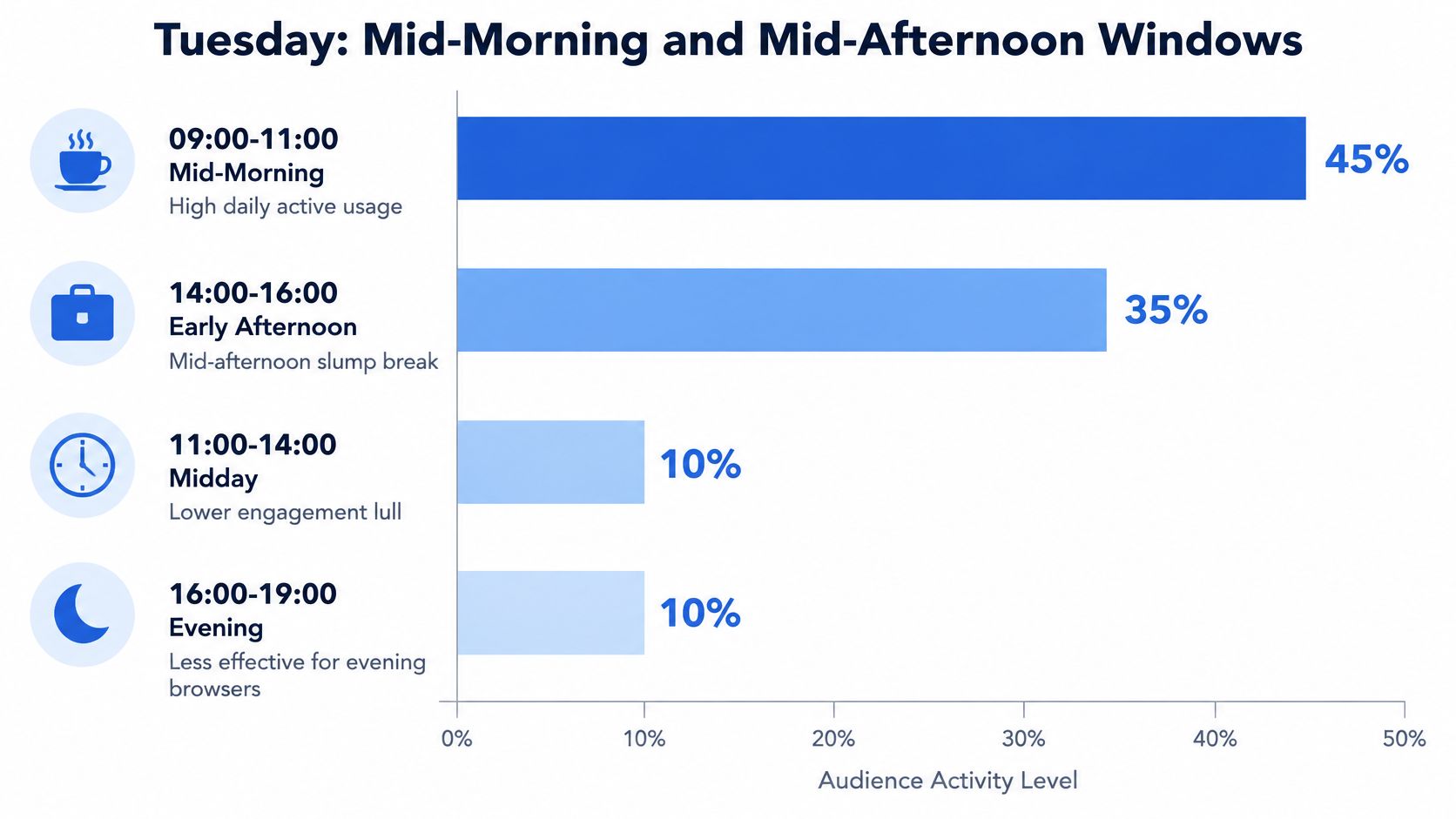
Make mid-morning your primary hypothesis and mid-afternoon your alternative. Tuesday timing advice from Sup Growth provides another planning perspective, but account-level results should determine which window you retain.
Treat the illustration below as a suggested testing range, not a measured activity curve for your followers.
Compare the same kind of value
Say a marketing consultant produces a series of practical editing tips. Distribute comparable tips between the morning and afternoon slots over the four-week test, rather than posting an identical video again and treating the repeat as a clean comparison.
Track completion, saves, and shares alongside reach. If afternoon posts attract fewer viewers but more saves relative to exposure, that window may suit reference material better than broad discovery.
Measurement rule: Choose your success metric before publishing. Otherwise, it's easy to declare whichever slot wins any metric the winner.
Keep the opening style and video length reasonably consistent. You're testing publication time, so avoid simultaneously changing the format, topic, and offer.
3. Wednesday Morning Engagement Window
Wednesday morning deserves a challenger, not an automatic victory. Pair a mid-morning primary slot with an evening alternative so you can test a different audience context.
The evening challenger has meaningful benchmark support: Buffer's analysis of 9.6 million Instagram posts found Reels performed best between 6 p.m. and 11 p.m., with Wednesday and Thursday identified as the strongest days. That makes an evening comparison particularly useful instead of assuming workday browsing is your best opportunity.
Keep creative quality comparable
A travel creator could alternate practical destination guides between morning and evening. Use a consistent structure, such as a clear destination reveal followed by actionable advice, and compare saves alongside completion.
Before starting, review your hooks that stop the scroll. Choose an opening approach and keep it stable throughout the timing experiment, rather than improving only the evening videos halfway through.
- Primary hypothesis: Morning viewers will find the advice useful during a browsing break.
- Alternative hypothesis: Evening viewers will give the guide more sustained attention.
- Validation: Alternate comparable guides across the four-week period and compare typical results, not just the top performer.
Plan how you'll handle comments in both slots. If you're available to answer questions only after morning posts, record that difference. You'd otherwise be testing timing and community management together.
4. Thursday Late-Morning and Early-Afternoon Windows
Say a skincare brand has a library of product demonstrations. Thursday offers a practical way to test whether those demonstrations work better before lunch or after it, without changing the broader weekday context.
Choose late morning as the primary slot and early afternoon as the alternative. These are deliberately close competitors: the question is whether a smaller scheduling adjustment makes a useful difference for your account.
Match the window to the objective
Different metrics can identify different winners. Adobe Express's Reels analysis found 6 a.m. Eastern Time produced the highest average likes, while Monday at 3 a.m. produced the highest average views. Neither finding proves a Thursday slot, but their contrast explains why likes alone shouldn't determine your publishing schedule.
For the skincare example, keep the product category, demonstration style, and purchase prompt comparable. A tutorial intended to answer customer questions should be evaluated differently from a teaser intended to introduce the brand.
- Discovery objective: Prioritize reach and whether viewers continue watching.
- Reference objective: Examine saves relative to exposure.
- Commercial objective: Include attributable clicks or inquiries where tracking is available.
Over the four-week test, distribute comparable demonstrations across both windows. Flag promotional launches separately because an offer can change viewer behavior independently of timing.
The trade-off is precision versus contrast. Nearby slots make the test operationally convenient, but similar results may mean either window is adequate. Don't manufacture a precise winner from a negligible difference.
5. Friday Late-Morning Pre-Weekend Window
Friday's most useful question may be when viewers can act, not when they're most likely to like a video. A café promoting a weekend special needs a different measurement plan from a creator publishing a relatable comedy sketch.
Test late morning as your primary slot against late afternoon. The working hypothesis is that earlier publication gives viewers time to make plans, while the alternative reaches them closer to a decision. Neither behavior should be assumed without account evidence.

Separate sharing from action
A café could alternate comparable previews of its weekend menu across the four-week test. Keep the offer's availability and caption clarity consistent so an unusually attractive special doesn't become mistaken for a timing effect.
- For entertainment: Compare shares relative to reach and completion.
- For local promotions: Record profile activity, attributable inquiries, and tracked actions where available.
- For both: Note whether the result supports your actual objective rather than merely increasing likes.
A widely shared Reel and a commercially useful Reel aren't necessarily the same post. Decide which outcome you're scheduling for.
Avoid comparing a general-interest morning video with an urgent afternoon offer. Urgency introduces a separate reason to respond.
If the later slot produces better action but lower reach, it may still deserve a place in your schedule. Reserve it for posts with a relevant deadline rather than treating it as the default for every Friday Reel.
6. Saturday Late-Morning Leisure Window
Saturday late morning is a content-fit hypothesis, not an established weekend advantage. Test a visually clear transformation, demonstration, or activity idea against an evening alternative.
A home-decor creator could use before-and-after projects, while a gym could publish accessible workout demonstrations. The logic is to test whether viewers prefer discovering an activity earlier or considering it later, not to presume that everyone has more free time on Saturday.
Leave room for unexpected results
Unconventional windows shouldn't be dismissed solely because they clash with your routine. Later's analysis of more than 975,000 Instagram Reels identified midnight as its strongest overall posting time. That doesn't establish a Saturday recommendation, but it does challenge the assumption that intuitive daytime slots must win.
For this experiment, keep late morning as the primary choice and evening as the paired challenger. Consider a separate overnight test later if your audience geography or activity history gives you a reason.
- Creative control: Use a recognizable series with comparable pacing and production quality.
- Primary outcome: For decor inspiration, examine saves and profile visits where available.
- Validation: Alternate the slots over the four-week test and review Saturday results separately from weekdays.
The trade-off is audience availability versus content relevance. Someone might enjoy a project reveal without being ready to follow the account or start a project.
Don't equate passive viewing with intent. If your objective is trial sign-ups, include a trackable next step and evaluate that outcome alongside viewing metrics.
7. Sunday Early-Evening Wind-Down Window
A meal-prep creator has a reasonable hypothesis: viewers may want preparation advice before the working week. That makes early evening worth testing, but it doesn't prove that Sunday audiences share a planning mindset.
Pair early evening as the primary slot with morning as the alternative. Morning publication could suit viewers who want to act that day; evening publication could suit those collecting ideas for later.

Test planning against preparation
Build a repeatable series using a weekly content system. A productivity coach could publish comparable planning demonstrations, while a food creator could rotate meal-preparation methods with similar complexity.
Across the four-week experiment, assign comparable episodes to morning and evening. Keep any downloadable resource or caption prompt consistent.
- Planning signal: Compare saves relative to reach.
- Viewing signal: Compare completion across videos of similar length.
- Action signal: Track resource visits or inquiries when attribution is available.
Useful distinction: Saving instructions for later and following them immediately are different outcomes. Your preferred slot should reflect which behavior matters.
A Sunday-to-Monday series can provide editorial continuity, but measure each Reel separately. Don't attribute Monday's performance to Sunday's timing without evidence connecting them.
If neither Sunday slot supports your objective, leave Sunday optional. A sustainable schedule doesn't require filling every day, and a benchmark isn't a reason to keep publishing into an unproductive window.
Best Windows to Post Reels by Day
No single slot wins for every account. Treat each window below as a hypothesis to test against your own audience clock, with the primary as option A and the secondary as option B for the same day.
| Primary Window | Secondary Window | Best Content Type | Main Trade-off |
|---|---|---|---|
| Monday, 11:00-13:00 local time | 07:00-09:00 local time | Quick how-to, practical, or motivational Reels | Popular posting time is competitive; results vary by audience and time zone |
| Tuesday, 09:00-11:00 local time | 14:00-16:00 local time | Educational, how-to, or professional content | Busy windows can be crowded, and work may divide viewers' attention |
| Wednesday, 09:00-11:00 local time | 19:00-21:00 local time | Educational or storytelling Reels | Performance varies by niche and geography; working hours may limit viewing |
| Thursday, 11:00-13:00 local time | 14:00-16:00 local time | Product, lifestyle, or creator-led content | Lunch-hour competition is high, and engagement may fade toward the weekend |
| Friday, 09:00-11:00 local time | 16:00-18:00 local time | Light, entertaining, or shareable content | Business-focused content may underperform; some audiences are less active |
| Saturday, 10:00-11:00 local time | 19:00-20:00 local time | Visual lifestyle, fashion, food, or home content | B2B audiences are less active, and weekend engagement can be uneven |
| Sunday, 17:00-20:00 local time | 08:00-10:00 local time | Planning, motivational, or productivity content | Sunday reach can be inconsistent across audiences and regions |
Read the pattern across the week. Workdays reward focus and utility in the morning, with a second chance when attention returns after lunch or in the evening. Weekends reward leisure and planning, but for narrower audiences.
Use the table to choose one day to test at a time. Keep format and topic comparable between A and B, then keep the slot that produces the behavior you want, whether that is reach, saves, shares, or completion.
From Benchmarks to Your Own Data A Four-Week Testing Plan
Choose a day-specific pair that matches your content and audience. Run the four-week period as a screening experiment, not a promise of statistical certainty. If publishing volume is low or results vary substantially, extend the test before fixing your schedule.
Keep the comparison interpretable
- Define the audience clock: Use the target audience's time zone and record it consistently. For international accounts, identify which audience segment the experiment serves.
- Balance the content: Distribute comparable topics and formats across the primary and alternative slots. Don't reserve launches or your strongest ideas for one side.
- Choose the outcome: Compare reach, saves, shares, and completion, but name the metric that determines success before publishing.
- Use equal observation periods: Compare posts at the same age, then revisit them after a consistent longer interval to capture delayed performance.
- Record exceptions: Flag paid promotion, collaborations, unusual offers, and other changes that make a post less comparable.
Compare median performance alongside individual results so a viral outlier doesn't dictate the schedule. Record the sample count for each slot, and keep Instagram's available viewing metrics separate from scheduler metrics that measure engagement or clicks. If the difference is unclear, retain the more practical slot and continue testing.
Our Social Media Scheduler calendar places per-channel time slots in a single week view, with automated publishing to maintain the test schedule. Our top-post analytics show impressions, engagement, and clicks against the previous period; use Instagram's available completion data alongside them.
Every plan includes all eight supported networks, AI drafting, and analytics, and starts with a 7-day free trial at $0. The trial lets you set up and begin the experiment without upfront cost, but it won't cover the full testing period; charges begin after the trial unless you cancel beforehand.
Keep the decision provisional and review it as your audience and content change. The benchmarks give you the starting map; your own data draws the route.
Visit Social Media Scheduler to draft comparable Reels, queue your primary and alternative slots, and manage publishing from one calendar. Start with a focused timing experiment, then use post analytics alongside Instagram's viewing metrics to decide which windows deserve a permanent place in your schedule.